

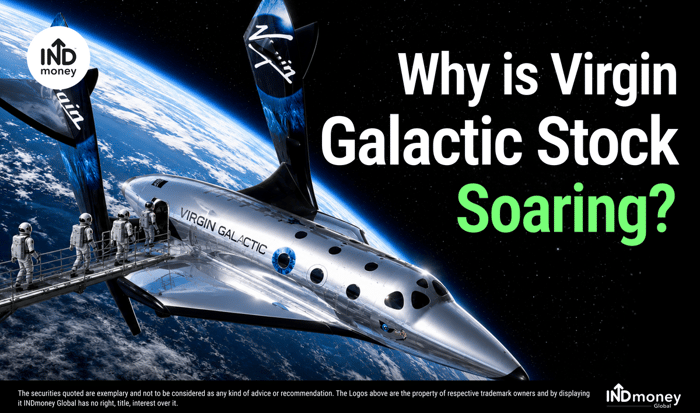
- What Does Virgin Galactic Actually Do?
- Why is SPCE Stock Rising?
- SPCE Earnings: What Happened Two Weeks Ago
- Virgin Galactic’s Delta Spacecraft: What Everyone Is Underestimating
- What Analysts Are Saying About SPCE Stock
- SpaceX IPO Factor: SPCE Riding a Wave It Did Not Create
- What Could Go Wrong for Virgin Galactic Now?
- What Investors May Still Be Underestimating
- Should You Take a Bet on SPCE Stock?
Two things happened in the last few days that most casual investors completely missed. A federal court quietly granted preliminary approval for a shareholder lawsuit settlement against Virgin Galactic, clearing years of legal overhang off the company's books. And then, on May 27, 2026, Virgin Galactic (SPCE) flew again, resuming glide flight tests of its spacecraft for the first time in two years. The stock was up 16% the very next day.
Add in a strong earnings report from two weeks ago, a Wall Street Buy rating from Jefferies, and a sector-wide wave of excitement around the upcoming SpaceX IPO, and you have everything you need to understand why SPCE stock has surged over 40% in just two trading days.
Let's break down what these developments actually mean for the business, what analysts are saying about the stock, and what investors may still be underestimating about where Virgin Galactic goes from here.
What Does Virgin Galactic Actually Do?
Most people confuse Virgin Galactic with SpaceX and that confusion leads to seriously flawed investment analysis.
Virgin Galactic is a suborbital space tourism company. It takes passengers about 80–90 km above Earth, gives them a few minutes of weightlessness and a view of Earth’s curve, then glides back. The full trip lasts around 90 minutes, with tickets priced at about $750,000 per seat.
Think of it like this, SpaceX is building the highway system to the cosmos. Virgin Galactic is selling luxury, five-minute roller coaster rides at the edge of it.
Why is SPCE Stock Rising?
1. The Lawsuit Settlement: Clearing the Overhang
A federal court has given preliminary approval to settle two shareholder lawsuits filed against Virgin Galactic in 2022. As part of the settlement, the company’s insurers will pay $2.75 million, and the related claims are expected to be dismissed after final approval.
The amount is small but the real takeaway is that one legal overhang may be cleared. Ongoing lawsuits can make investors cautious, especially institutions. Once litigation risk reduces, analysts and fund managers may be more willing to look at the aerospace stock again.
2. The Glide Flight: This One That Really Moved the Market
On May 27, 2026, Virgin Galactic completed a successful glide flight of VSS Unity at Spaceport America. The stock rose 16% the next day. A glide flight is not a spaceflight. The aircraft is released from the mothership and glides back without rocket power or passengers.
But the signal matters. Virgin Galactic has been in a commercial flight pause for nearly two years while developing its next-generation Delta-class spacecraft. This test showed that its flight operations, ground crew, airspace coordination, safety processes, and regulator-facing systems are becoming active again.
For investors, the takeaway is clear: the Q4 2026 commercial launch timeline now looks more operational, not just aspirational.
SPCE Earnings: What Happened Two Weeks Ago
The glide flight and settlement are the latest news, but the real momentum in the stock started earlier this month on May 14 when Virgin Galactic released its Q1 2026 earnings, and SPCE surged approximately 74% in after-hours trading. The stock has been broadly elevated since, and the latest catalysts extended those gains.
On paper, the Q1 numbers look bad. Revenue of $227,000. A net loss of $64.7 million. Free cash flow of negative $93.3 million. So why did the market celebrate?
Because investors in a pre-revenue growth company are not watching absolute losses. They are watching the direction of those losses and whether the hardware is actually being built. On both counts, Q1 delivered clearly.
| Metric | Q1 2025 | Q1 2026 | Change |
| Net Loss | $84 million | $64.7 million | Improved by $19.3M |
| Operating Expenses | $89 million | $66 million | Down 26% |
| Adjusted EBITDA | Baseline | -- | Improved ~24% YoY |
| Free Cash Flow | -110M | -93.3M | Improving |
| Cash on Hand | -- | $220–251M | 2–3 quarters of runway |
Source: Virgin Galactic Q1 2026 Earnings Report; Simply Wall St; MarketBeat
The most significant non-financial disclosure in the entire report was the physical delivery of the first Delta-class SpaceShip from the Assembly hangar to the Test-and-Launch hangar at Spaceport America. The hardware is no longer under construction. It is being tested. Management reaffirmed flight testing in Q3 2026 and the first commercial spaceflight in Q4 2026.
Virgin Galactic’s Delta Spacecraft: What Everyone Is Underestimating
The original spacecraft, VSS Unity, was never designed for commercial scale. It carried six passengers and could fly roughly once or twice a month. At $450,000 a seat, gross revenue per flight barely crossed $2.7 million. Factor in massive operating costs and the unit economics simply did not work.
The Delta class changes the math entirely.
Think of it like this: VSS Unity was a limited-edition concept car, built and tested almost by hand. The Delta-class spacecraft is the factory model, designed to roll out more often, carry more customers, and turn space tourism from a rare demonstration into a repeatable business.
| Specification | VSS Unity (Old) | Delta Class (New) |
| Passengers per flight | 6 | 6 |
| Max flights per month | 1–2 | Up to 8 |
| Vehicle lifetime flights | Limited | 500+ |
| Annual capacity (2 vehicles) | ~24–48 passengers | ~750 passengers |
| Rocket motor design | Fixed | Replaceable/modular |
| Manufacturing model | Bespoke/prototype | Production line |
Sources: Virgin Galactic Investor Relations, SpaceNews; Aviation News EU
At $750,000 per seat, six passengers per flight, and eight flights per month, a single Delta vehicle generates $36 million in monthly revenue at full cadence. Two vehicles at that rate is over $70 million per month, or more than $850 million annually. Management has not guided to those numbers for 2026, but the architecture makes them possible within a few years.
Virgin Galactic’s own initial two-vehicle model projects approximately $450 to $600 million in annual revenue at target cadence. The company is also building a rocket motor production assembly line in Arizona and has fabrication of the second Delta spaceship underway.
This is no longer research and development spending. This is manufacturing. Management guided that quarterly free cash flow will show sequential improvement from Q2 2026 onward, targeting "modest positive quarterly cash flow" in 2027.
What Analysts Are Saying About SPCE Stock
| Firm | Rating | Price Target |
| Jefferies | Buy | $5.00 |
| Consensus (16 analysts) | Hold | $3.55 |
| Highest target | -- | $5.00 |
| Lowest target | -- | $2.00 |
Sources: INDmoney, Benzinga; Jefferies Research.
Jefferies is the most vocal institutional supporter of this stock right now. Their thesis is straightforward: the Delta program is real, the timeline is credible, and the current price does not reflect a successful Q4 2026 launch. The broader Wall Street consensus of Hold with a $3.06 average target was set before the May catalyst stack and is almost certainly stale. Expect revisions if Q3 powered test flights succeed.
SpaceX IPO Factor: SPCE Riding a Wave It Did Not Create
A big part of Virgin Galactic’s rally may not be about Virgin Galactic at all.
SpaceX’s IPO filing in May 2026, with a reported $1.75 trillion valuation and planned SPCX ticker, has lifted sentiment across space stocks. SpaceX generated $18.7 billion revenue in 2025, including $11.4 billion from Starlink, making it the sector’s biggest upcoming catalyst.
Since SpaceX is not yet listed, investors have been buying liquid proxy names like Rocket Lab, Intuitive Machines, AST SpaceMobile, and Virgin Galactic. After the filing, Intuitive Machines rose over 13%, Rocket Lab posted double-digit gains, and SPCE added another 10% on sector sentiment.
The risk: Once SpaceX lists, capital may rotate out of proxy plays like SPCE and into SpaceX directly. So the IPO halo helping Virgin Galactic now could become a headwind after listing.
What Could Go Wrong for Virgin Galactic Now?
| Risk Factor | What It Means |
| Cash runway is thin | ~$220–251M on hand vs. $87–93M quarterly burn. Delays force dilutive equity raises |
| Shareholder dilution | Company has diluted shareholders ~51% in recent periods via at-the-market offers |
| Short interest at 23.28% | Nearly 1 in 4 SPCE shares is a short bet. High short interest amplifies both upside and downside |
| Technical complexity | Unity never hit the promised cadence. Delta may face similar real-world constraints |
| SpaceX IPO reversal | Proxy-trade capital could rotate to SPCX at listing, reversing the halo effect |
| Competition | Blue Origin's New Shepard is already flying suborbital tourists at comparable prices |
Sources: FINRA, Invezz; Simply Wall St; Short Interest Tracker
What Investors May Still Be Underestimating
Two things that almost no mainstream coverage mentions about Virgin Galactic:
1. Research payload revenue: When Delta flies without tourists, it can carry five full research payload racks with up to 20 microgravity experiment lockers per mission. Virgin has already partnered with Redwire to build these lockers for pharmaceutical firms, university labs, NASA, and aerospace companies testing materials in zero gravity. This is a separate, potentially steadier revenue stream that current financial models almost universally ignore.
2. The backlog is a financial fortress: The company already has approximately 650 founding astronauts booked at $750,000 per seat. That is $487.5 million in contracted future revenue before a single Delta flight takes off. No marketing spend required. No customer acquisition cost for the first 650 seats. The entire first year-plus of commercial operations is essentially pre-sold.
Should You Take a Bet on SPCE Stock?
The truth is Virgin Galactic is not for conservative investors. It is a pre-revenue, high-burn aerospace company with a going concern disclosure in its 2025 annual report. At current burn rates, the company has roughly two to three quarters of runway before needing more capital, unless Delta commercial flights begin generating revenue in Q4 2026 as guided.
But the investment case is also more concrete than at any previous point in the company's public history. The Delta hardware is physically in a test hangar. A glide flight has successfully resumed after a two-year pause. Legal overhang from 2022 lawsuits has been cleared. Jefferies is backing the Q4 timeline. And the SpaceX IPO is creating the largest space sector re-rating in years.
| Scenario | Condition | 12-Month Stock Outlook |
| Bull Case | Q3 powered tests succeed, Q4 commercial flight happens | $5–$8 range |
| Base Case | Minor delays, SpaceX IPO normalises sector | $3–$4.50 range |
| Bear Case | Technical delay forces dilutive raise, cash crunch | $1.50–$2.50 range |
Source: Jefferies; Invezz; Author analysis
Investors need to watch Q3 2026 powered test flights, cash balance every quarter. And watch what happens on June 12 when SpaceX lists, because that event will tell you a lot about whether the current re-rating holds or partially unwinds.