

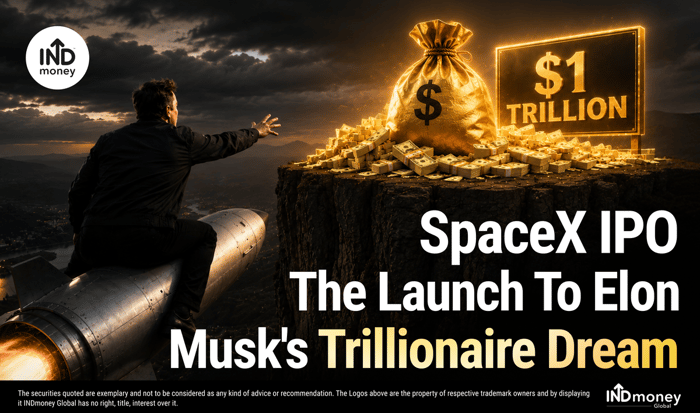
- The Scale Of The SpaceX IPO
- What SpaceX Actually Earns: Three Companies, One Price Tag
- The xAI Drag: What Elon Musk's AI Ambition Is Costing Right Now
- Elon Musk Net Worth Question. The Trillionaire Math
- Is The SpaceX Valuation Defensible? The Analyst's Take
- Risks and Red Flags With SpaceX: The Full Scorecard
- SpaceX’s Nasdaq 100 Question Nobody Is Talking About
- The Bottom Line
Sixty-two years ago, NASA spent roughly $25 billion (in today's dollars) putting humans on the Moon. On May 20, 2026, Elon Musk filed paperwork to take one company public at $1.75 trillion, seventy times that cost, under a single stock ticker.
SpaceX's IPO isn't just the biggest in history. It's the first time a public market has been asked to price a rocket company, a satellite internet empire, an AI lab, and a social network; all controlled by one person, all wrapped inside one filing.
Let's break down what SpaceX actually earns, what the xAI merger is costing, how the numbers stack up against global benchmarks, and whether the valuation is a genuinely defensible thesis or the most expensive leap of faith in financial history.
The Scale Of The SpaceX IPO
To feel the size of $1.75 trillion, consider this: Reliance Industries, India's largest and most powerful conglomerate, carries a market cap of roughly $190 billion as of May 2026. SpaceX's target IPO valuation is 9.2 times that. If SpaceX gets listed at the target valuation of $1.75 trillion, it will surpass Tesla at $1.57 trillion valuation to become the 9th largest company in the world by MarketCap as of May 21st, 2026.
| Comparison Point | Value |
| SpaceX target IPO valuation | $1.75 trillion |
| Reliance Industries market cap (May 2026) | ~$190 billion |
| SpaceX vs. Reliance | ~9.2x |
| Saudi Aramco IPO funds raised (2019, world record) | $29.4 billion |
| SpaceX target IPO fundraise | $75-$80 billion |
| Previous US IPO record (Alibaba, 2014) | $21.8 billion |
The $75-80 billion fundraise alone would eclipse Saudi Aramco's 2019 record by nearly three times. The ticker will be SPCX on Nasdaq, with pricing expected on June 11 and first trading around June 12, 2026. Goldman Sachs, Morgan Stanley, BofA, Citi, and J.P. Morgan are joint book-running managers for SpaceX; essentially every major Wall Street firm has a seat at this table.
What SpaceX Actually Earns: Three Companies, One Price Tag
Here's the part that’s very important to understand: SpaceX is not one business. It's three, and they all perform very differently.
| Segment | Q1 2026 Revenue | Q1 2026 Operating Profit / (Loss) |
| Connectivity (Starlink) | $3.26 billion | +$1.19 billion |
| Space (launches, Starship, NASA) | $0.62 billion | ($0.66 billion) |
| AI (xAI, Grok, X/Twitter) | $0.82 billion | ($2.47 billion) |
| Consolidated Total | $4.69 billion | ($1.94 billion) |
Starlink is the machine. As of Q1 2026, it has 10.3 million subscribers across 164 countries, generates $3.26 billion a quarter in revenue, and throws off $1.19 billion in operating profit every three months. Think of it like a Jio, but global, satellite-powered, and with no competition at scale. This is the asset that justifies talking about SpaceX in trillion-dollar terms.
The Space segment (rockets, NASA contracts) is a necessary cost center. SpaceX poured $3 billion into Starship R&D in 2025 alone. Falcon 9 makes money. Starship development burns it. The bet is that Starship eventually brings launch costs below $100 per kilogram to orbit, at which point the economics of everything from cargo to satellites to Mars missions reshapes entirely.
The AI segment is the problem. And it needs to be understood clearly before anyone decides to invest in SpaceX.
The xAI Drag: What Elon Musk's AI Ambition Is Costing Right Now
In February 2026, SpaceX absorbed xAI, the company behind Grok and X (formerly Twitter), in an all-stock deal. At the time, SpaceX was valued at $1 trillion and xAI at $250 billion. The combined entity became the world's most valuable private company overnight.
But here's what the accounting actually shows:
| Metric | Legacy SpaceX (Pre-xAI) | Consolidated SpaceX (With xAI) |
| 2025 Revenue | ~$15 billion | $18.7 billion |
| 2025 Net Profit / (Loss) | ~+$8 billion | ($4.9 billion) |
| 2025 Total CapEx | $5.6 billion | $20.7 billion |
| AI-directed CapEx (2025) | — | $12.7 billion |
| Q1 2026 AI Operating Loss | — | ($2.47 billion) |
| Long-term debt (Mar 2026) | — | $29.1 billion |
Before xAI, sources familiar with SpaceX's pre-merger financials indicated the legacy rocket-and-satellite business was generating roughly $8 billion in annual profit. After consolidating xAI, that profitable company now reports a $4.9 billion net loss.
Think of it like buying a high-yielding FD and then someone bundles it with a startup that's burning ₹20,000 crore a quarter, suing regulators, and still figuring out its product. You don't get the FD separately anymore. You get the whole package.
The company's capital expenditure jumped nearly fivefold in one year, from $5.6 billion in 2024 to $20.7 billion in 2025, with $12.7 billion directed at AI infrastructure alone. Musk's stated ambition is to launch 100 gigawatts of AI computing capacity into space per year. That vision is compelling. It is also, at this point, entirely unproven hardware that hasn't cleared a single regulatory review.
Elon Musk Net Worth Question. The Trillionaire Math
This IPO has one number driving every other conversation: when does Elon Musk become the world's first trillionaire?
| Musk Wealth Component | Estimated Value at $1.75T IPO Price |
| SpaceX stake (~42% equity interest) | ~$735 billion |
| Tesla holdings (~15% of ~$1.57T market cap) | ~$235 billion |
| Other ventures (Neuralink, Boring Co., etc.) | ~$50 billion |
| Estimated Total Net Worth | ~$1+ trillion |
According to Polymarket, as of early 2026 the odds of Musk becoming a trillionaire before 2027 stood at 72%. The math is straightforward: at a $1.75 trillion IPO valuation, his ~42% equity stake alone is worth approximately $735 billion. Add his Tesla holdings and he crosses the trillion-dollar mark.
What makes this governance story equally important: Musk holds 85.1% of voting power through Class B shares (10 votes each vs. Class A's 1 vote). The public IPO shares are Class A. As the filing states plainly, "Mr. Musk will have the power to control the outcome of matters requiring shareholder approval, including election of all our directors."
He was also granted 1 billion performance-based Class B shares in January 2026. The vesting condition? SpaceX must establish a permanent human colony on Mars with at least one million inhabitants. That isn't a bonus plan. That's a mission statement written into equity.
Is The SpaceX Valuation Defensible? The Analyst's Take
At $1.75 trillion against $18.7 billion in 2025 revenue, SpaceX is asking investors to pay roughly 95x trailing revenue. There is no direct comparable in public markets.
ARK Invest, one of SpaceX's most vocal bulls, argues that the $1.75 trillion target is "grounded in a plausible trajectory" for Starlink, Starship, and orbital AI combined. They project SpaceX could hit $2.5 trillion enterprise value by 2030, implying roughly 38% CAGR from current private valuations.
Scottish Mortgage Investment Trust, which holds SpaceX as 19.3% of its portfolio, publicly values its stake at a $1.25 trillion implied company value; $500 billion below the IPO ask, citing a deliberate policy of using verifiable transactions rather than press reports to mark private holdings.
The base case for the "fair" part of this valuation: Starlink alone, at typical broadband infrastructure multiples, could be worth $600-800 billion. The Space segment (with Starship potential) adds another $200-300 billion. The premium above that, roughly $600 billion-$700 billion, is a pure bet on xAI and orbital computing, both of which are losing money today.
Starlink's ARPU (average revenue per subscriber per month), notably, has been declining: from $99 in 2023 to $66 in Q1 2026. More subscribers, but paying less per head. That's a competitive pressure investors should price in.
Risks and Red Flags With SpaceX: The Full Scorecard
| Risk Category | What the Filing Actually Says |
| Grok Regulatory Probes | UK and EU opened formal investigations into Grok generating non-consensual intimate imagery and CSAM; 37 US state attorneys general demanded action |
| $500M Litigation Reserve | SpaceX has set aside over $500 million for potential losses tied specifically to Grok's "spicy mode" content lawsuits |
| AI Safety Warning Letter | Former OpenAI researchers and nonprofits publicly warned IPO investors that xAI's safety incidents are "far out of proportion to its market share" |
| Voting Control Concentration | Musk controls 85.1% of votes; public shareholders have no meaningful say in board composition or major decisions |
| ARPU Compression | Starlink revenue per subscriber has fallen 33% since 2023 as SpaceX expands into lower-income markets |
| Debt Load | $29.1 billion in long-term debt at end of Q1 2026, at a loss-making consolidated entity |
| AI CapEx Explosion | AI spending jumped from zero to $12.7 billion in one year; orbital data centers remain unproven |
| Talent Departure (xAI) | Original 12-person xAI founding team is now down to six key members |
| Dual CEO Risk | Musk simultaneously runs Tesla (public), SpaceX, and xAI; governance concerns are in the prospectus itself |
| Orbital AI Still Regulatory | FCC filing for up to 1 million solar-powered AI satellites has not cleared regulatory review |
SpaceX’s Nasdaq 100 Question Nobody Is Talking About
Almost every major piece of coverage has focused on the valuation debate and the xAI drama. What's being underreported is this: Nasdaq has a fast-entry rule. Once SPCX begins trading, it will automatically qualify for the Nasdaq-100 after just 15 days; triggering mandatory forced buying from every ETF and index fund tracking the index. That's trillions of dollars in passively managed capital that must buy SpaceX shares simply because it's in the index, regardless of valuation opinion.
Meaning even if you decide to avoid the post IPO buying till the valuation makes sense you might not be able to if you have index etfs like QQQ in your portfolio.
The Bottom Line
SpaceX is genuinely one of the most extraordinary companies in human history. Its rocket fleet handles 85% of all spacecraft launched into orbit globally. Starlink is the fastest-growing telecom network on the planet. And Starship, if it works at scale, changes the cost equation for everything from satellites to Mars.
But the IPO packages all of that alongside an AI segment that is currently burning $2.47 billion in operating losses every quarter, under a governance structure that gives public shareholders essentially no voice.
The question for any investor isn't whether SpaceX is a great company. It clearly is. The question is whether the IPO price is the right entry point or whether you're being asked to be the exit liquidity for private investors who've already made the easy money.
If Starlink hits 100 million subscribers and Starship achieves reusable sub-$100/kg launch economics, this valuation will look laughably cheap a decade from now. If xAI's regulatory exposure escalates or orbital AI capex doesn't convert to margin, the losses now would belong to every SPCX shareholder, without the ability to vote out the management team responsible.
SpaceX might be the most important company of the 21st century. Whether the IPO is the right moment to participate in that story is an entirely separate calculation.