

- Tesla's Legendary Run: From 3 Near-Deaths to $1.2 Trillion
- The Cracks Begin to Show For Tesla
- SpaceX: The Quietly Growing Giant For Elon Musk
- Is Tesla Becoming Musk's Forgotten Child?
Tesla was the ultimate growth story for years. The EV company that was written off a dozen times over, survived near-bankruptcy, rewrote the rules of the auto industry, and then did something no one expected: it turned its founder into the richest person in recorded history. But in 2026, something has quietly but decisively shifted in the Musk empire.
SpaceX, the rocket company that most people once considered a vanity project, is now targeting a $1.75 trillion IPO that could be the largest capital event in market history. Meanwhile, Tesla has posted two consecutive years of declining deliveries, lost its title as the world's biggest EV maker to China's BYD, and is trading on the hope of products that are still years from mass production. The crown, it seems, has changed heads.
Let's break down how this throne changed hands, what the numbers really say beneath the surface, and what it means for Tesla stock investors sitting in India trying to figure out where the next round of wealth creation actually lies.
Tesla's Legendary Run: From 3 Near-Deaths to $1.2 Trillion
Very few companies have come back from the dead as many times as Tesla. Elon Musk once said in a 2020 interview that both SpaceX and Tesla were weeks away from bankruptcy in 2008. He split his last $40 million between the two companies just to keep them alive. Few believed him then.
What happened next became one of the most spectacular stories in stock market history. Tesla went public in 2010 at a split-adjusted price of about $1.13. By November 2021, it touched $414 per share, crossing a market cap of $1.2 trillion and making it the first automaker in history to reach that milestone. In that single year, 2020, Elon Musk's net worth grew by $150 billion, almost entirely on the back of his Tesla stake.
The Cracks Begin to Show For Tesla
Something shifted around 2023. The story stopped being about growth and started being about survival. Tesla’s delivery growth has clearly slowed, and the recent numbers show why investors are concerned.
| Period | Tesla Vehicle Deliveries | What It Shows |
| 2023 | 1.79 million | Record year at the time |
| 2024 | 1.79 million | Almost flat growth |
| 2025 | 1.64 million | Down 9% year-on-year |
| Q1 2026 | 358,023 | Below analyst expectations of ~365,000 |
This means Tesla has now seen two straight years of weak or falling deliveries, including the sharpest annual decline in its history, according to CBS News and FactSet data. In Q1 2026, the company also built up more than 50,000 vehicles in unsold inventory. The reasons are not mysterious. Competition has intensified enormously.
| Factor | What Happened | Why It Matters |
| BYD pricing in Europe | BYD’s Dolphin Surf EV sells for around $26,900 | Nearly $15,000 cheaper than Tesla’s comparable Model 3 |
| Tesla Europe market share | Fell from 2.4% to 1.7% in 2025 | Shows Tesla is losing ground in a key EV market |
| BYD deliveries | Grew 28% worldwide | Confirms stronger global momentum for BYD |
| US EV tax credit | $7,500 federal EV credit expired | Removed a major demand incentive for Tesla buyers |
| California market share | Tesla’s EV share fell below 50% | Weakening grip in its home market |
Elon Musk has now pivoted the narrative toward Cybercab, the autonomous robotaxi, and Optimus, the humanoid robot. But neither product is in mass production yet. The Cybercab is expected to begin volume production only by the end of 2026 at the earliest, and Optimus is further still.
Roughly 75% of Tesla's revenue still comes from vehicle sales of a product lineup that is aging, facing pricing pressure from every direction, and losing share.
SpaceX: The Quietly Growing Giant For Elon Musk
While Tesla's story was becoming complicated, SpaceX's was becoming unstoppable.
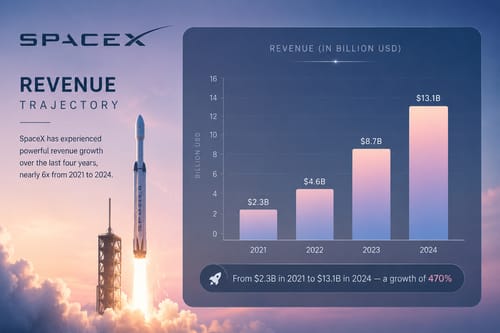
Source: Payload Space and Sacra Research estimates
In 2025, consolidated revenue is estimated at $16 to $18.7 billion. The primary engine of this growth is Starlink, the satellite internet service that now serves over 10 million subscribers in more than 100 countries, with the company adding roughly one million customers every two months.
Starlink alone generated an estimated $10 billion in 2025 revenue, representing close to 60% of total SpaceX sales, and carries EBITDA margins estimated between 54% and 63%.
On the launch side, SpaceX captured over 80% of global orbital mass in 2025, completing 166 Falcon 9 and Falcon Heavy missions. The current price for a Falcon 9 launch is $74 million, and demand is consistently outpacing supply.
| Year | SpaceX Valuation | Key Milestone |
| 2020 | $36 billion | Early private market benchmark |
| 2021 | $100 billion | Crossed $100B valuation |
| 2023 | $180 billion | Strong growth driven by Starlink and launches |
| Dec 2024 | $350 billion | Valuation nearly doubled in one year |
| Dec 2025 | $800 billion | Reached after internal tender offer at $421/share |
Source: CNBC, Forbes, Bloomberg, Business Insider
This is a roughly 22x increase in just five years. Then came February 2026. SpaceX merged with xAI, Musk's artificial intelligence company, in the largest merger ever recorded, valuing the combined entity at around $1.25 trillion. The company is targeting a June 2026 Nasdaq listing at a valuation of $1.75 trillion, raising between $40 billion and $75 billion, making it the largest IPO in market history.
And with an estimated 43% ownership stake in the combined SpaceX-xAI entity, Musk's fortune is now driven more by SpaceX than by Tesla. As of early 2026, SpaceX-xAI represented roughly 65% of his total estimated net worth of $811 billion, per Forbes, compared to Tesla's roughly 25%.
Is Tesla Becoming Musk's Forgotten Child?
Here is where the analogy that every investor should sit with arrives. Musk co-founded X.com in 1999, which became PayPal. When eBay bought PayPal for $1.5 billion in 2002, Musk received around $165 million, giving him the capital to fund Tesla and SpaceX.
Tesla may now risk becoming Musk’s “first act”: still valuable, but no longer the centre of the story. If SpaceX lists at $1.75 trillion, it would be larger than Tesla’s current market cap of around $1.6 trillion, making SpaceX the bigger driver of Musk’s wealth, media attention, and legacy.
What Does This Mean for Tesla Stock Investors?
Indian investor interest in Tesla is rising sharply. On INDmoney, Tesla share investments grew 14.97%, while search interest jumped 51% in the last 30 days. This indicates that despite valuation concerns, Indian investors are increasingly tracking and investing in Tesla.
Analysts, however, are sharply divided. HSBC has the most bearish TSLA target at $119, citing erosion in the core auto business. Goldman Sachs and Morgan Stanley remain neutral, with targets around $405 to $425, viewing Tesla as a “show me” story where autonomy execution is key.
The bulls, led by Wedbush’s Dan Ives with a $600 target, believe Tesla’s AI and autonomous driving opportunity is worth at least $1 trillion. The bears, led by GLJ Research’s Gordon Johnson with a $25 target, argue Full Self-Driving is still years from meaningful commercial deployment and the EV business is weakening.
The key risk is valuation. Tesla trades at roughly 415x trailing earnings while guiding for negative free cash flow in 2026, with capex expected to exceed $20 billion for new models, Giga Mexico, and advanced manufacturing. That is not EV-company pricing. It is robotics-and-AI pricing without those revenues yet.
This gap between Tesla’s valuation story and financial reality is where the risk sits. Whether investors are betting on a robotaxi revival or watching the SpaceX IPO from the sidelines, Musk’s wealth narrative is already shifting. The golden goose has a new name.