

- From Co-Founders to Courtroom: A Quick Backstory Of Altman & Musk
- What's Actually Happening in Court Right Now Over OpenAI
- The Actual Stakes: A $1 Trillion OpenAI IPO Hanging in the Balance
- Our Take: What Should Indian Investors Actually Make of This?
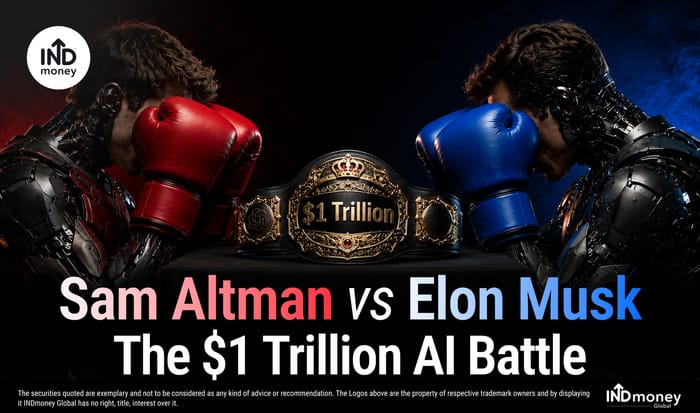
Two of the most powerful men in tech are currently sitting across from each other in a federal courthouse in Oakland, California. Not at a summit. Not on a podcast. In court. under oath, fighting over who gets to control the company that may have already changed the world more than any other in history. The Musk v. Altman trial, which kicked off on April 28, 2026, is not just Silicon Valley drama. It is a live case that could determine whether OpenAI's much-anticipated IPO, targeting a jaw-dropping $1 trillion valuation, happens on schedule, gets derailed, or gets restructured entirely. And if you hold Microsoft, Nvidia, or plan to invest in the AI wave as an Indian investor, this outcome matters more than most headlines you'll read this year.
Let's break down what the fight is actually about, what each outcome means for markets, and what Indian investors should practically do with this information right now.
From Co-Founders to Courtroom: A Quick Backstory Of Altman & Musk
Elon Musk and Sam Altman co-founded OpenAI in 2015 as a nonprofit with a single stated purpose: build safe, beneficial AI for humanity, not for profit. Musk contributed roughly $44 million to get it off the ground. Three years later, after a reported power struggle over who would run the company, Musk walked out.
What happened next is the core of the lawsuit. OpenAI created a for-profit subsidiary in 2019. Then, in October 2025, it completed its transition into OpenAI Group PBC, a public benefit corporation, with the original nonprofit retaining only 26% ownership and Microsoft holding a 27% stake. Musk filed suit in early 2024, calling it "stealing a charity."
His ask? Over $130 billion in damages, removal of Sam Altman from OpenAI's board, and a full unwinding of the for-profit conversion. That last part is the one that could shake markets.
What's Actually Happening in Court Right Now Over OpenAI
The trial, which is expected to conclude its liability phase around May 21, 2026, has produced some remarkable testimony. Musk took the stand for three days and told the jury that OpenAI's transformation was not what he signed up for, that the for-profit arm became "the tail wagging the dog." Think of OpenAI like a charity-funded research lab that later built a commercial company beside it. Musk’s argument is basically that the commercial side slowly stopped serving the original mission and started controlling it instead.
OpenAI's lead attorney fired back with arguably the sharpest line of the trial: "We are here because Mr. Musk didn't get his way. He quit, saying they would fail for sure. My clients had the nerve to go on and succeed without him."
Court documents also revealed that Musk, while still on OpenAI's board, was quietly trying to poach the company's top talent for Tesla and had even offered Altman a Tesla board seat at one point. The same man is now accusing Altman of betrayal.
The judge has split the trial into two phases. A nine-person jury will deliver an advisory verdict on liability first. The judge, not the jury, will make the final call. If Musk wins on liability, a separate remedies phase follows.
The Actual Stakes: A $1 Trillion OpenAI IPO Hanging in the Balance
Here is the number that makes this so consequential. OpenAI closed a $122 billion funding round in March 2026 at a post-money valuation of $852 billion, as per Yahoo Finance and Reuters. The company is generating $25 billion in annualized revenue which is up from $6 billion at the end of 2024. Goldman Sachs, JPMorgan, and Morgan Stanley are reportedly in discussions to advise a public listing, which OpenAI's CFO Sarah Friar has targeted for Q4 2026, with a potential $1 trillion valuation, as per The Wall Street Journal.
On the other side of the courtroom, Musk's own AI empire isn't exactly standing still. xAI, which he merged with X and then SpaceX is reportedly targeting an IPO at a valuation potentially north of $1.75 trillion, as per Bloomberg. SpaceX has already filed confidentially with the SEC.
Two trillion-dollar IPOs. One court case. Same month.
If Musk wins and the court orders OpenAI to unwind its for-profit structure, the IPO timeline collapses. Microsoft, which holds a 27% stake, faces enormous financial exposure. Nvidia, which committed $30 billion to OpenAI's latest funding round, sees that bet complicated. If Altman wins and OpenAI lists cleanly, it would be the largest technology IPO in US history and a defining moment for AI investing globally.
Our Take: What Should Indian Investors Actually Make of This?
Here is the honest view: this trial is riveting, but for most Indian investors the right move is to watch carefully and not react impulsively.
- The indirect plays are already listed: Right now, the clearest public-market exposure to the OpenAI story runs through Microsoft (MSFT), which holds a 27% stake in OpenAI Group PBC. Nvidia (NVDA) put $30 billion into OpenAI's March 2026 round. These aren't perfect proxies, but they're the closest thing to a real position you can take in OpenAI before any IPO.
- Day-one IPO buying is historically risky: Motley Fool's analysis of nearly 4,000 IPOs since 2000 found that large-cap IPOs with rich valuations have consistently underperformed the S&P 500 in the years following listing. OpenAI is projecting a $14 billion loss in 2026 alone and doesn't expect profitability until 2030, as per Reuters. At $852 billion in private valuation and $25 billion in revenue, its implied price-to-sales multiple already sits around 65x which is the most expensive ratio of any company in the S&P 500, matching Palantir.
- The court outcome has a real market signal: A clean Altman win = IPO on track, Microsoft and Nvidia positions benefit, AI sentiment strengthens. A Musk win or messy verdict = IPO delayed, governance uncertainty, near-term volatility in AI-linked stocks. Indian investors holding Microsoft or Nvidia should factor this into their near-term risk view.
- Diversification over concentration: Rather than trying to pick the winner between two of the most complicated corporate structures in modern business history, broad exposure through a US technology ETF or an S&P 500 index fund captures the AI tailwind without betting the portfolio on a single courtroom outcome.
The real story here isn't who wins in Oakland. It's that the AI economy is generating real revenue and the companies building the infrastructure for it are publicly accessible to Indian investors today. That is where the durable opportunity sits.