

- From 95% to Zero: How Nvidia Got Locked Out of China
- Can India Replace China as Nvidia's Big Market?
- What India Needs to Build to Actually Matter in AI Hardware
- What Should Indian Investors Do Right Now?
- The Bottom Line
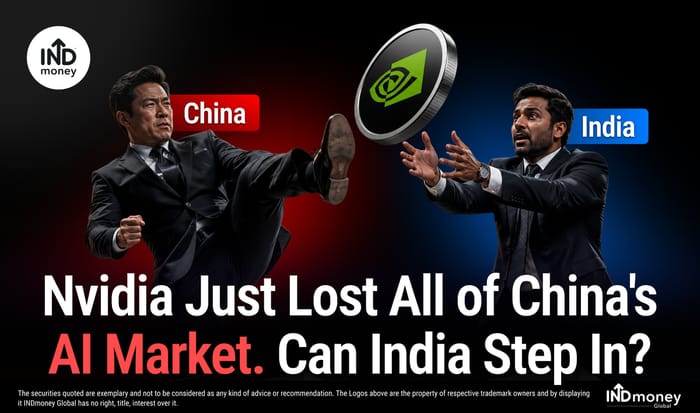
Nvidia's CEO Jensen Huang said something that should make every investor stop scrolling. On April 30, 2026, he confirmed what many suspected but few had quantified: Nvidia, the world's most valuable company has gone from holding 95% of China's AI accelerator market to a clean, flat zero. Not declining. Not shrinking. Zero. A company that booked nearly $20 billion a year from China is now assuming exactly nothing from that market in its financial forecasts. This isn't a bad quarter. It's a geopolitical wipeout.
Let's break down how this happened in under two years, whether India can realistically step in as the next big market, and most importantly, where savvy Indian investors should be looking right now.
From 95% to Zero: How Nvidia Got Locked Out of China
Two years ago, Nvidia owned China's AI chip market the way a monopoly owns a monopoly. In its most recent fiscal year, Nvidia reported $19.67 billion in revenue from China and Hong Kong (Source: Nvidia Investor Relations). That number is now forecast at zero for Q1 FY2027.
The collapse happened in two coordinated moves:
- The US government progressively banned Nvidia's high-end chips; first it was the A100, then the H100, and then even the H20, which was specifically built to comply with export rules.
- Then, in September 2025, China's own Cyberspace Administration ordered ByteDance, Alibaba, and other domestic giants to stop buying Nvidia entirely. America pushed Nvidia out; Beijing slammed the door.
Huang didn't mince words, he said: "We went from 95% market share to 0%, and I can't imagine any policymaker thinking that's a good idea... it has already largely backfired."
Huawei stepped right in. Its Ascend 910C, roughly comparable to Nvidia's 2020-era A100, has become China's default AI chip. Bloomberg reports Huawei plans 600,000 Ascend 910C units in 2026, double last year's output, with a full roadmap through the Ascend 970 by 2028.
Can India Replace China as Nvidia's Big Market?
Let's not dress this up. India cannot replace China as a market for Nvidia's high-end AI chips, not in this decade. China was dominant because it bought and built chips at scale. India, today, only does the former.
The US controls roughly 75% of the world's AI compute. India's IndiaAI Mission has deployed ~38,000 GPUs for researchers and startups which is impressive for a government program, but a fraction of what a single US hyperscaler runs.
Yes, Google has pledged $15 billion, Microsoft $17.5 billion, and Adani $100 billion toward Indian data centers. India's data center capacity is set to nearly double from 1.93 GW in 2025 to 4 GW by 2030. That makes India a fast-growing customer of AI chips, not a $17 billion replacement market.
The harder truth is that India's flagship Tata-PSMC fab in Dholera targets 28nm chips which are vital for automotive and IoT, but entirely separate from the 3nm AI accelerators powering Nvidia's Blackwell lineup.
| What India Has | What India Still Lacks |
| $200B+ data center investment pipeline | Sub-5nm fabrication capability |
| 38,000+ government-deployed AI GPUs | HBM / advanced memory manufacturing |
| Strong chip design talent | Domestic GPU at scale (ETA: ~2029) |
| OSAT packaging facilities (Micron, Tata) | A developer ecosystem rivaling CUDA |
What India Needs to Build to Actually Matter in AI Hardware
Three non-negotiables if India wants a seat at the chip table:
- Advanced fabrication: 28nm gets India on the board. Sub-5nm puts it in the game. That requires TSMC deepening its India partnership or US CHIPS Act-linked technology transfers, both very much possible but are multi-year commitments.
- HBM manufacturing: Every AI accelerator runs on High Bandwidth Memory. SK Hynix, Samsung, and Micron control this entirely. India has zero players here today.
- A software ecosystem: Huawei's Ascend chips struggle globally because there's no CUDA equivalent in China. India must build developer tooling alongside hardware or repeat that exact mistake a decade from now.
What Should Indian Investors Do Right Now?
Here's where it gets practical. Nvidia losing China doesn't shrink the AI chip market, it simply redirects it. US hyperscalers like Microsoft, Google, Amazon, Meta alone are projected to spend $635-665 billion on AI infrastructure in 2026. That spending flows directly to Nvidia, to TSMC, to SK Hynix, and to Broadcom.
If your portfolio lives entirely in Indian markets, the Nifty 50 gives you zero exposure to advanced semiconductor design or AI chip manufacturing. That's the uncomfortable truth.
Where to consider looking via US markets:
- Pure-Play AI & Semiconductor Bets, some examples include:
| Company | AI / Semiconductor Exposure | 1Yr Returns |
|---|---|---|
| Nvidia (NVDA) | The core AI infrastructure leader powering data centers, AI training, and inference globally. | ~77% |
| Broadcom (AVGO) | Exposure to AI networking chips and custom AI accelerators used by hyperscalers. | ~107% |
| AMD (AMD) | Nvidia’s biggest AI GPU challenger with growing presence in AI servers and cloud infrastructure. | ~319% |
| SanDisk (SNDK) | Exposure to AI-driven storage demand as data centers need faster and larger memory solutions. | ~3931% |
| TSMC ADR (TSM) | The world’s most important chip manufacturer producing advanced AI chips for Nvidia, AMD, and Apple. | ~140% |
| Micron (MU) | Direct play on high-bandwidth memory (HBM), a critical component inside AI GPUs. | ~707% |
Source: Google Finance | May 7th, 2026
- SOXX / SMH: US-listed semiconductor ETFs covering Nvidia, TSMC ADR, Broadcom, AMD, it’s the full AI hardware stack.
- QQQ (Nasdaq-100): Broad US tech exposure with heavy AI weighting across software and hardware.
- Franklin FTSE Taiwan ETF (FLTW) / iShares MSCI South Korea ETF (EWY): Access to TSMC and SK Hynix, the manufacturers powering every AI chip on the planet.
And here's a benefit most investors overlook: the dollar hedge. Over the past decade, the rupee has depreciated from ~₹66 to over ₹95 per dollar which is a 44% slide (Source: Google Finance). As the US dollar appreciates against the Indian Rupee, USD-denominated investments naturally deliver an added boost on INR conversion, giving Indian global investors a return layer that domestic investors do not get.
The Bottom Line
Nvidia's China story is a masterclass in how geopolitics can vaporise $17 billion of annual revenue from the world's most dominant chip company. India is rising, the data center investments are real, and the ambition is genuine, but India is not Nvidia's next China. Not yet.
For investors, the right move isn't waiting for India to catch up on chip manufacturing. It's investing where the AI semiconductor supercycle is already compounding, while letting the rupee's decade-long structural slide quietly amplify your returns along the way.