

- The AI Chip Supercycle: A Rally India Isn't Leading
- What’s Driving Taiwan & South Korea’s Market Surge
- What's Creating Headwinds for India Right Now
- The Case for Diversification Beyond India, Not Abandonment
- The Bottom Line For Indian Investors
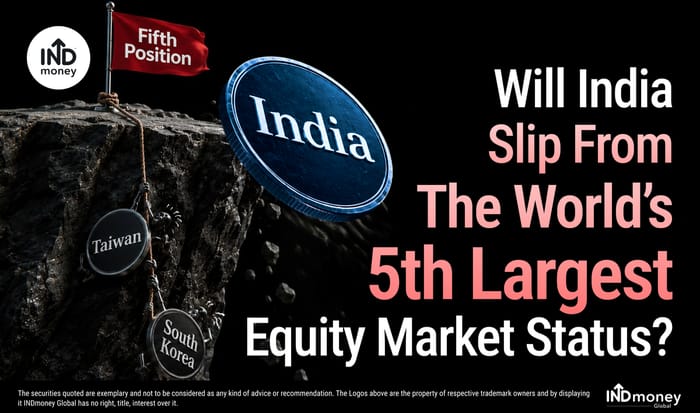
For most of the last two years, India wore its badge as the world's 5th-largest equity market proudly and rightly so. A $5 trillion market cap, a booming middle class, and GDP growth that the developed world quietly envied. But as of May 2026, two countries that most Indian retail investors barely glance at, Taiwan and South Korea, are breathing right down India's neck. Taiwan's stock market has surged to a record $4.5 trillion. South Korea is not far behind at $4.1 trillion. India's lead, which once felt comfortable, is suddenly looking a lot thinner. The reason? A single, sweeping, unstoppable force: artificial intelligence.
Let's break down why these two markets have sprinted so close to India, what's creating headwinds for India right now, and whether Indian investors should think about adding some of this AI-driven momentum to their portfolios without abandoning the India story they know and believe in.
The AI Chip Supercycle: A Rally India Isn't Leading
Here's the core of what's happening. The global explosion in AI, from data centres to large language models to autonomous systems, all runs on one thing above all else: advanced semiconductors. And the two countries that make the most critical chips in the world happen to be Taiwan and South Korea.
Taiwan Semiconductor Manufacturing Company (TSMC) alone controls 72% of the global foundry market. Every Nvidia GPU that powers a ChatGPT query, every Apple silicon chip inside an iPhone, every AI accelerator inside a hyperscaler data centre; chances are, TSMC made it. In Q1 2026, the company posted revenue of $35.9 billion, a 35% jump year-on-year, and net profit surged 58% to a fresh record.As a result, TSMC's market cap has crossed $2 trillion, making it the 6th most valuable company on Earth and its weighting in the MSCI Emerging Markets Index now sits at 14.2%, well above India's 11.94%, which is at its lowest level in six years.
South Korea's story runs parallel. Samsung Electronics and SK Hynix, two companies that dominate the global market for High Bandwidth Memory (HBM) chips, the critical memory layer inside every AI accelerator, have seen their valuations soar. In early May, SK Hynix surged 13% in a single session to a record high. Samsung jumped over 5% on the same day.
In short, both markets have become what analysts are calling "pure plays" on the AI semiconductor supercycle. And global money has followed.
What’s Driving Taiwan & South Korea’s Market Surge
| Taiwan | South Korea |
| AI chip dominance: Taiwan’s rise is anchored by TSMC, whose 2nm and 3nm chipmaking lead gives it unmatched pricing power over customers like Nvidia, Apple, and AMD. | HBM memory boom: Samsung Electronics and SK Hynix dominate the high-bandwidth memory (HBM) market powering Nvidia’s AI chips, with demand still far exceeding supply. |
| Massive expansion: TSMC has committed $165 billion toward US fabs, signalling its dominance is expanding globally, not slowing down. | Next-gen AI push: Samsung recently unveiled its HBM4 memory lineup, aiming to strengthen its grip on the AI accelerator ecosystem. |
| Trade tailwind: Taiwan’s 2026 trade agreement with the US reduced reciprocal tariffs from 20% to 15%, boosting competitiveness for tech exports. | Corporate reforms: South Korea’s “Corporate Value-Up Programme” is pushing companies to improve shareholder returns and close historically low valuation gaps. |
| Foreign inflows: The TAIEX crossing the 40,000 mark attracted fresh global capital, reinforcing momentum. | Still attractively valued: Korea’s popular US-listed ETF, EWY, trades around 19 P/E and 2.23 P/B, relatively cheap for a market seeing strong gains. |
| Key risk: Taiwan’s biggest overhang remains geopolitical tensions with mainland China, which could become a major tail risk if escalations intensify. | Potential MSCI upgrade: South Korea is being evaluated for a move from Emerging Market to Developed Market status, which could unlock massive passive inflows. |
Together, both markets are benefiting from the same mega trend which is the global AI infrastructure race, but through different strengths. Taiwan dominates advanced chip manufacturing, while South Korea controls critical AI memory supply and is pairing it with structural market reforms.
What's Creating Headwinds for India Right Now
None of this is to say India's story is broken, it isn't. GDP growth came in at 7.8% in the October-December quarter. GST collections crossed ₹2 trillion in March 2026 for the first time since mid-2025. Automobile volumes grew over 20% across segments. The domestic growth engine is intact.
But India faces a specific, compounding set of headwinds that are temporarily blunting its equity market appeal to global capital:
- Historic FII outflows: By early May 2026, foreign investors had pulled nearly ₹1.92 lakh crore from Indian equities, already exceeding 2025’s record selloff.
- The rupee slide: Since January 2025, the rupee has depreciated from 85 to approximately 95 against the US dollar. For foreign investors, that currency erosion alone wipes out a meaningful portion of returns, making India less attractive in USD terms even when the Nifty holds up. Although, the same dynamic works in favour of Indian investors investing globally, as the dollar's rise against rupee gives an extra layer of returns for Indians.
- Oil and inflation risk: Crude near $108 per barrel hurts India disproportionately because the country imports over 80% of its oil, pressuring inflation, margins, and the current account.
- Limited AI exposure: Unlike Taiwan and South Korea, India’s largest companies are not direct beneficiaries of the global AI chip boom. IT services firms also face concerns that AI could reduce outsourcing demand.
- Lower institutional preference: India’s weight in the MSCI EM Index has dropped to a six-year low.
Most foreign brokerages currently have India as a consensus "underweight" and Taiwan and South Korea as "overweight." That's not a permanent verdict on India, but it is where institutional capital is flowing right now.
The Case for Diversification Beyond India, Not Abandonment
Staying invested in India over the long run makes complete sense. The country's demographic dividend, infrastructure push, and expanding consumer market are as real as ever. But the world doesn't wait for one market to sort out its headwinds before rewarding others.
The AI supercycle is a once-in-a-generation structural shift in global capital allocation, comparable in some ways to the internet boom of the late 1990s. Investors who were geographically concentrated in any single market during such a shift paid an opportunity cost, often without realising it.
For Indian investors who already have Nifty SIPs running and domestic equity exposure, the question worth asking is: does my portfolio participate in the AI-driven semiconductor boom at all? If the answer is no, AI and Semiconductor companies or Taiwan and South Korea ETFs, available on US markets offer one of the cleanest ways to get that exposure.
Taiwan & South Korea ETFs Worth Knowing About
These ETFs trade on US exchanges and give Indian investors direct access to the AI semiconductor story in Asia:
The Bottom Line For Indian Investors
India's position as the world's 5th-largest equity market is not under existential threat, but it is being genuinely tested for the first time in years. Taiwan and South Korea have captured a structural tailwind that India's market isn't positioned to ride in the same way.
For long-term Indian investors, this is less about panic and more about portfolio architecture. Staying the course on India is sensible. But if a single AI boom cycle can add $2.7 trillion to Taiwan's market cap in 12 months, it probably deserves at least a line item in a globally minded portfolio.
When India's next up-cycle arrives, and it will, you'll want to have participated in what was working in the meantime, too, wouldn’t you? After all, it’s your hard earned money at work, and it deserves to be working in the right places.