

- Silver Today: More Than Just a Precious Metal
- Samsung’s Silver Solid-State Battery: A Potential Demand Shock?
- Why This Matters for Silver Prices
- How Investors Can Participate: Silver ETFs
- Final Takeaway on Silver
Silver has been one of the standout stories of 2025. Prices have shattered records across global markets, with spot silver crossing the $70 per ounce mark amid a powerful combination of investment demand, industrial use, and a prolonged supply deficit. Analysts now point to multiple drivers, from green energy technologies and investor inflows to macroeconomic uncertainty, altogether pushing silver to levels not seen in decades.
Amid this historic surge, an intriguing narrative has captured investors’ attention: could Samsung’s cutting-edge battery technology become a game-changer for silver demand? The answer lies not just in prices but in how this metal may be used in future automotive and energy technologies.
Let’s break down with this blog what Samsung’s role could mean for silver’s future, how the metal’s demand landscape is evolving, and how you as an investor can participate through ETFs.
Silver Today: More Than Just a Precious Metal
Silver’s recent rally is rooted in more than sentiment. Fundamental supply and demand data show that the global silver market has been structurally deficient, where demand has exceeded supply for years, and this has only intensified in 2025. Industrial use, especially in solar photovoltaics and advanced electronics, accounts for a significant share of total silver demand, supported by robust growth in renewable energy and tech sectors.
With the silver market forecast to remain in a sizable deficit for the fifth consecutive year, tighter physical supplies are beginning to show up in pricing. This deep structural imbalance is a key backdrop for silver’s robust performance this year.
Samsung’s Silver Solid-State Battery: A Potential Demand Shock?
Here’s where the story gets particularly compelling.
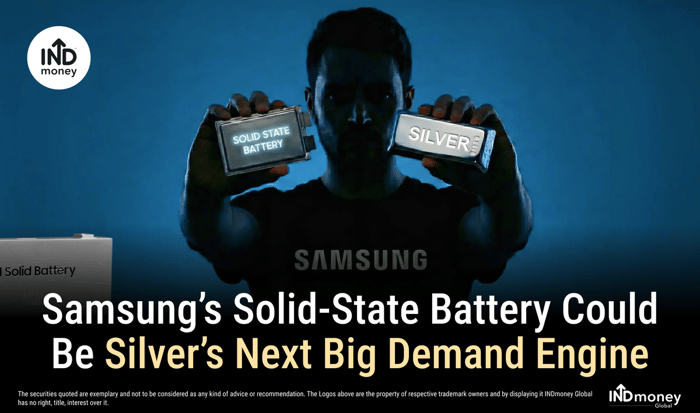
Samsung is developing silver-based solid-state battery technology that’s different from traditional lithium-ion designs by incorporating silver at a meaningful scale within the battery cell.
According to credible industry estimates, each battery cell in this technology may contain about 5 grams of silver and for a typical 100 kWh electric vehicle battery pack, that adds up to roughly 1 kilogram (about 1,000 grams) of silver per car.
By comparison, today’s traditional EV batteries use only small amounts of silver primarily in electrical contacts and electronics; often in the tens of grams per vehicle, rather than in the core battery chemistry itself.
What makes this development notable is the scale of potential demand:
- If a solid-state battery like Samsung’s were to see adoption across just a fraction of EV production, silver demand could surge dramatically.
- For example, if just 20% of global EVs were equipped with such batteries, the total incremental silver demand could approach around 16,000 metric tons annually which itself is a significant portion of current global silver production (~25,000 metric tons).
For silver markets already under pressure from broad industrial use, this kind of new battery demand represents a structural shift in how silver could be consumed in the decade ahead.
It’s also worth being clear about where things stand today. These batteries are not being produced at scale yet, and they are not part of mainstream EV supply chains. Early use, if it happens, is likely to come later in the decade. How far the technology goes will depend on whether it can be made cheaply enough, produced in large volumes, and hold up against other batteries already in the race..
Still, the narrative has sparked investor interest because it highlights how silver could transition from traditional industrial uses to core material roles in emerging battery technologies.
Why This Matters for Silver Prices
Even without solid-state batteries, silver’s demand story is strong:
- Solar energy installations continue to use silver paste in photovoltaic cells, driving structural industrial demand.
- Electronics and connectivity technologies, including semiconductors and data centers, rely on silver’s unmatched conductivity.
- Physical and ETF investment flows have strengthened as metals become alternative stores of value amid macro concerns.
The addition of a future silver battery demand vector only increases the breadth of structural demand forces acting on the metal.
This combination explains why analysts see the potential for silver prices to continue outperforming over the medium term if supply constraints persist and new industrial drivers materialize.
How Investors Can Participate: Silver ETFs
If you want to be part of silver’s potential upside, exchange-traded funds offer a transparent, liquid way to gain exposure without owning physical bullion.
Here are some popular silver ETFs among many available that investors use:
US Silver ETFs
- iShares Silver Trust (SLV): Tracks the price of silver bullion and is one of the most widely traded silver ETFs globally.
- Aberdeen Standard Physical Silver Shares ETF (SIVR): Offers another established vehicle for exposure to the physical silver price.
Indian Silver ETFs
- Nippon India Silver ETF: Enables Indian investors to gain silver exposure through Indian markets.
- UTI Silver ETF: Another option providing silver price linkage for domestic investors.
Each of these funds holds physical silver or closely tracks silver prices, making them accessible tools for capturing silver’s price movements without dealing with physical storage.
Final Takeaway on Silver
Silver’s run in 2025 hasn’t come from one single trigger. It’s been building for a while. Industrial demand from solar panels, electronics and manufacturing has stayed strong, and supply has struggled to keep up. At the same time, new use cases are starting to enter the conversation. Silver-based solid-state batteries are one such example. Samsung’s work in this area isn’t what pushed prices higher this year, but it does hint at how silver’s importance in the modern industry could expand over time.
For investors, that matters. When a metal keeps finding new roles across energy, technology and manufacturing, it stops being just a defensive asset. It becomes part of the growth story as well. Holding silver through ETFs or other linked instruments offers a way to stay exposed to that shift, especially as long-term technological and structural trends continue to shape global metals markets.
Disclaimer:
The content is meant for education and general information purposes only. Investments in the securities market are subject to market risks, read all the related documents carefully before investing. Past performance is not indicative of future returns. The securities quoted are exemplary and are not a recommendation. This in no way is to be construed as financial advice or a recommendation to invest in any specific stock or financial instrument. Readers are encouraged to verify the exact numbers and financial data from official sources such as company filings, earnings reports, and financial news platforms and to conduct their own research, and consult with a registered financial advisor before making any investment decisions. All disputes in relation to the content would not have access to an exchange investor redressal forum or arbitration mechanism. INDmoney Global (IFSC) Private Limited,Registered office address: Office No. 507, 5th Floor, Pragya II, Block 15-C1, Zone-1, Road No. 11, Processing Area, GIFT SEZ, GIFT City, Gandhinagar – 382355.