

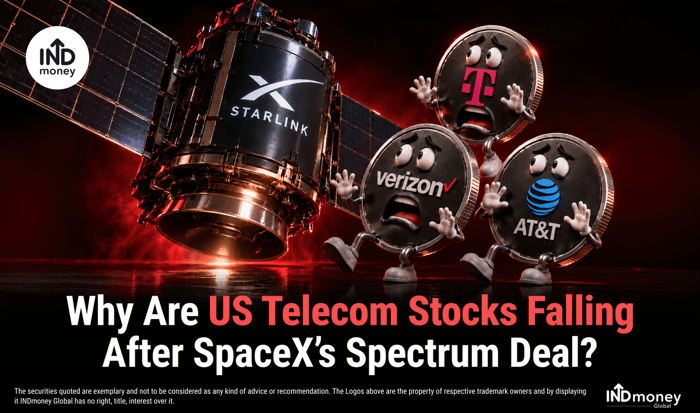
- How Much Did Verizon, AT&T and T-Mobile Stocks Fall?
- What Is SpaceX’s 800 MHz Spectrum Deal?
- Why Could Starlink Mobile Hurt US Telecom Profits?
- How Does the SpaceX Deal Affect Verizon, AT&T and T-Mobile?
- Can Starlink Mobile Replace Traditional US Mobile Networks?
- What Does the Selloff Mean for Telecom Stock Valuations?
Verizon, AT&T and T-Mobile shares fell sharply after SpaceX announced an agreement to acquire nationwide low-band wireless spectrum from Grain Management. The concern is that Starlink Mobile could eventually compete for Americans’ monthly phone bills, expanding beyond its role of helping existing carriers cover areas without cellular service.
For telecom investors, that raises a difficult question. What happens to an established carrier’s profits when a new competitor can offer customers another way to stay connected?
The immediate threat is pressure on pricing, customer retention costs and future cash flow. SpaceX does not need to replace every mobile tower, or win most subscribers, to make those economics less attractive. However, the proposed spectrum acquisition remains subject to regulatory approval, and a licence portfolio is only one part of building a competitive mobile network.
How Much Did Verizon, AT&T and T-Mobile Stocks Fall?
The Financial Times reported the following declines after SpaceX’s announcement:
| Company | US stock ticker | Reported after-hours decline on October 8 |
| Verizon Communications | VZ | ~ 7.0% |
| AT&T | T | ~ 7.5% |
| T-Mobile US | TMUS | ~ 6.7% |
Source: Financial Times, October 8, 2026, report published at 22:50 UTC, or 6:50 p.m. US Eastern time. These are reported trading snapshots, not regular-session closing returns or final after-hours returns.
A sharp move after the market closes can change as trading continues. The table captures the initial reaction to a potentially more credible competitor, rather than proving how much the carriers’ earnings will decline.
The new agreement also does not establish that customers are already moving to a standalone Starlink mobile plan. Investors are changing the price they are willing to pay for the carriers’ future profits.
What Is SpaceX’s 800 MHz Spectrum Deal?
On October 8, SpaceX agreed to acquire 100% of Grain Management’s nationwide 800 MHz spectrum portfolio. SpaceX describes the licences as providing up to 14 MHz of paired low-band spectrum. The transaction requires Federal Communications Commission approval and other customary closing conditions.
Reuters reported that The Wall Street Journal put the cash consideration at about $8 billion, citing people familiar with the matter.
Spectrum is the set of radio frequencies over which wireless signals travel. A spectrum licence gives an operator rights to use particular frequencies in specified areas. It does not deliver an operating network, customers or guaranteed service quality.
The two numbers describe different things. 800 MHz identifies the frequency band; up to 14 MHz describes the amount of spectrum involved. Neither number tells an investor how fast every customer’s internet connection will be.
Why Low-Band Spectrum Matters for Starlink Mobile
Low-band frequencies generally offer useful coverage over longer distances and better building penetration. SpaceX intends to use the new spectrum as a coverage layer alongside its planned 2 GHz capacity.
That combination matters because a mobile service must work in homes and offices as well as on remote roads. Customers are less likely to replace their main phone plan with a service that only helps them when they can see the sky.
Crucially, SpaceX describes a hybrid architecture combining satellites with terrestrial deployment. Its transaction filing identifies radios and antennas on towers, rooftops and other structures. The proposal therefore includes equipment on the ground to help deliver reliable service.
This makes the competitive argument more credible, but it also introduces network deployment costs. The potential advantage depends on how efficiently SpaceX can combine the two types of infrastructure.
How This Differs From the Earlier EchoStar Spectrum Agreement
The Grain agreement adds low-band spectrum to an existing expansion strategy. SpaceX’s original EchoStar agreement was announced at approximately $17 billion in September 2025. A November amendment added AWS-3 spectrum and increased the consideration to approximately $19.62 billion, commonly rounded to $20 billion.
There is also an important timing distinction. EchoStar’s filing for the quarter ended June 30, 2026 describes a two-step transfer, with the spectrum acquisition closing expected around November 30, 2027, unless SpaceX proceeds earlier under the agreement’s terms. Regulatory permission and completion of the underlying transfer are separate milestones.
The latest news strengthens an established plan. It does not mean a fully deployed nationwide competitor appeared overnight.
Why Could Starlink Mobile Hurt US Telecom Profits?
A carrier can suffer financially even while retaining most of its customers. A credible alternative may force it to charge less, provide larger discounts or spend more to keep customers from leaving.
Our assessment is that these costs could become visible before substantial migration to Starlink. The three channels investors should watch are customer switching, pricing pressure and the expense of defending the existing subscriber base.
Losing Customers Reduces the Revenue Base
A subscriber who switches takes a recurring monthly payment with them. Some costs disappear when that customer leaves, but much of the network, support infrastructure and financing expense remains.
This is why the relevant question is not simply how many people Starlink can reach. It is how many paying subscribers it can attract profitably, and how much lost revenue an incumbent can offset by reducing costs.
Keeping Customers Can Also Become More Expensive
Carriers may respond with handset promotions, discounted family plans, additional services or stronger satellite coverage. Those offers can protect subscriber numbers while weakening the profit earned from each account.
An illustrative example shows the difference:
| Hypothetical competitive pressure | Assumed calculation | Annual revenue effect |
| One million subscribers leave | 1 million × $50 monthly service revenue × 12 | $600 million less revenue |
| Average monthly service revenue falls by $1 across 100 million subscribers | 100 million × $1 × 12 | $1.2 billion less revenue |
Source: Author calculations. These are separate hypothetical examples, not forecasts or reported customer figures for any carrier.
In the second example, the company retains every subscriber in the assumed base. A small reduction in average monthly revenue still has a large effect because it applies across so many accounts.
For the first example, assume that 40% of revenue from departing subscribers would have contributed to profit after variable service costs. That implies approximately $240 million less annual operating contribution. The margin is illustrative, not a reported carrier figure.
The second example can be more damaging: if usage and operating costs stay unchanged, the $1.2 billion revenue reduction could reduce pre-tax operating profit by the same amount. A price cut does not automatically create cost savings. Neither example estimates free cash flow, which also depends on taxes, investment and other cash movements.
The practical implication is that stable customer numbers alone would not establish that a carrier has successfully defended its economics.
Bundles Could Broaden the Competitive Pressure
Starlink’s established broadband service gives SpaceX a possible route to offer home internet and mobile connectivity together. Reuters reported that William Blair analysts expect a compelling broadband and mobile bundle. Pricing and the resulting customer economics remain uncertain.
A bundle could be especially attractive to households dissatisfied with their current connectivity. It could also prompt incumbent carriers to strengthen their own combined internet and mobile offers.
Our view is that the first commercial test will be whether customers see enough value in the complete offer to change providers. Technical progress matters, but a service needs useful coverage, a competitive bill and reliable support to become a serious retail competitor.
How Does the SpaceX Deal Affect Verizon, AT&T and T-Mobile?
The three companies face the same emerging competitor, but their financial starting points and strategic positions differ. Their second-quarter results provide a useful baseline:
| Company | Q2 2026 cash flow measure | Reported amount | Operating evidence entering the latest development |
| Verizon | Free cash flow | $6.4 billion | Mobility and broadband service revenue grew 2.8% year over year |
| AT&T | Free cash flow | $4.7 billion | Added 432,000 postpaid phone subscribers; phone churn was 0.86% |
| T-Mobile US | Adjusted free cash flow | $4.8 billion | Service revenue grew 9% year over year |
Sources: Verizon, AT&T and T-Mobile Q2 2026 earnings releases. Cash flow definitions differ, particularly T-Mobile’s adjusted measure; these figures are not a fully standardised profitability ranking. Quarterly cash flow should not be multiplied by four without accounting for seasonality and other timing effects.
These results show substantial cash generation before the October announcement. They do not establish how much it will cost the carriers to respond to future competition.
Verizon Stock Faces a Test of Customer Economics
For Verizon stock, the question is whether customer growth can remain profitable as competition intensifies. Its Q2 release reported stronger cash flow alongside a strategic reduction in spending on device subsidies.
Our assessment is that defending this improvement matters more than simply producing higher subscriber additions. If Verizon needs to reverse its spending discipline to retain customers, some of the benefit could disappear even with a stable subscriber base.
The useful evidence will be service revenue, customer departures and the cost of promotions considered together. A strong cash flow quarter provides a starting point; it cannot settle the longer-term competitive question.
AT&T Stock Has a Broader Connectivity Defence
For AT&T stock, the defence includes its fibre and wireless combination. In Q2, 42.5% of households using AT&T’s advanced home internet services also chose its wireless service.
AT&T also closed its approximately $23 billion EchoStar spectrum acquisition on July 28, adding nationwide low-band and mid-band capacity. It therefore has additional resources with which to improve its own network.
Our assessment is that this gives AT&T several ways to compete, although it does not make the company immune. A household using both services may find switching inconvenient, but Starlink could eventually challenge the same household with another bundle.
The key question is whether AT&T can protect revenue and customer loyalty without giving away too much margin. Its wider connectivity offering is a defence that needs to show up in operating results.
T-Mobile Stock Faces Both a Partnership and a Competitive Question
T-Mobile stock has a particularly complicated position because T-Satellite already uses Starlink. The existing service supports texting and selected satellite-ready apps on compatible devices, generally in outdoor locations where customers can see the sky.
T-Mobile advertises the service as included with selected plans or available for $10 per month per line. That is the price of its current satellite offering, not a disclosed price for a future standalone Starlink mobile plan.
Our assessment is that the partnership gives T-Mobile useful experience, while SpaceX’s broader ambitions create a question about future bargaining power. A supplier with its own spectrum and retail ambitions may eventually have more choices about how to reach customers.
However, the Grain announcement does not establish that the existing partnership has ended. T-Mobile’s 9% Q2 service revenue growth also provides evidence of an expanding business entering this development.
T-Mobile also previously owned the spectrum involved in the new agreement. In August, it transferred the 800 MHz portfolio to Grain for $2.9 billion in cash and all of Grain’s 600 MHz licences. The later reported SpaceX price cannot be compared with that cash payment alone, because T-Mobile also received spectrum.
The investor test is whether T-Mobile can sustain its growth and a competitive satellite offering as its partner gains more options to operate independently.
Can Starlink Mobile Replace Traditional US Mobile Networks?
The evidence supports a more credible future competitor. It does not yet demonstrate a nationwide replacement for the carriers’ existing services.
SpaceX’s October 8 update says the FCC authorised a next-generation constellation of 15,000 mobile satellites. Permission to launch and operate those satellites does not mean they are already deployed. The separate Grain spectrum transfer also still needs approval.
Three practical issues remain central to the investment case.
- Coverage and capacity are different. Reaching a location does not establish how much data a network can carry there when many people connect simultaneously. A competitive service must deliver useful speeds and reliability under everyday demand, rather than only in a demonstration.
- A hybrid network still needs deployment. SpaceX’s plans include terrestrial equipment, so investors need evidence of site access, installation, service quality and the cost of operating the network. Owning spectrum improves its options without removing those tasks.
- Commercial returns matter as much as engineering. Competitive pricing must leave enough revenue to fund the network, customer acquisition and ongoing operations. SpaceX’s launch and satellite capabilities may help execution, but their economic advantage needs to be demonstrated in the mobile business.
Why Cell Tower Stocks Rose While Telecom Stocks Fell
Barron’s reported that Crown Castle and American Tower rose in after-hours trading following the announcement. That reaction fits the possibility that a new hybrid mobile operator could need infrastructure from existing tower owners.
For a carrier, an additional competitor may threaten the value of the customer relationship. For a tower owner, an additional tenant could create rental income. Neither outcome is guaranteed, but the difference explains why the same development can produce opposite reactions within telecom-related stocks.
The incumbents are also responding. An October 1 announcement confirmed that AT&T, T-Mobile and Verizon had entered a joint venture agreement to expand satellite-enabled connectivity in underserved areas, while allowing existing carrier-satellite agreements to remain in place.
AT&T and Verizon also have relationships with AST SpaceMobile, which is developing another satellite cellular network. These give the carriers options to strengthen their own offerings, although competitive service quality and deployment still need to follow.
What Does the Selloff Mean for Telecom Stock Valuations?
A stock price reflects both expected future cash generation and how much investors are willing to pay for it. Competitive uncertainty can weaken both assumptions, even before quarterly results change.
Consider a deliberately simplified equity valuation example. Assume a hypothetical company produces 100 units of sustainable annual cash available to shareholders after interest, taxes and investment, and investors value that cash at 10 times.
| Illustrative case | Annual cash available to shareholders | Valuation multiple | Implied equity value | Change from starting value |
| Starting assumption | 100 | 10× | 1,000 | - |
| Cash flow falls 5% | 95 | 10× | 950 | -5.0% |
| Multiple falls from 10× to 9× | 100 | 9× | 900 | -10.0% |
| Both assumptions weaken | 95 | 9× | 855 | -14.5% |
Source: Author calculations. This is a sensitivity example, not a price target or a complete valuation of Verizon, AT&T or T-Mobile. The cash measure is after financing costs, so the example values equity directly and does not subtract debt again.
The example explains how uncertainty can produce a larger stock reaction than the eventual change in annual cash flow. Investors may reduce both their cash forecast and the multiple they assign to it.
That also creates an important distinction when assessing the selloff. A lower share price is more attractive only if the cash generation supporting it remains sufficiently durable. Keeping an old earnings forecast unchanged while assuming the entire price decline creates value would ignore the development that caused the repricing.
For dividend-focused investors, the same logic applies. A falling price mechanically raises the dividend yield if the payout stays unchanged, but it does not increase the cash available to fund that dividend. The relevant question is how much cash remains after investment, financing obligations and the expense of defending the business.
What Investors Should Watch Next
- Regulatory progress: Approval and completion of the Grain transfer, alongside the remaining conditions attached to SpaceX’s other spectrum and operating rights.
- The actual mobile offer: Pricing, compatible devices, coverage, data allowances and whether customers can replace their main plan.
- Everyday performance: Indoor reliability, busy-area speeds, continuity of coverage and performance across different locations.
- Carrier economics: Customer departures, revenue per account, handset promotions and the cost of attracting or retaining subscribers.
- Cash flow and capital spending: Whether defence of the subscriber base changes the carriers’ cash generation and shareholder return plans.
Our assessment is that SpaceX’s spectrum agreement deserves a place in telecom valuation assumptions now. Dismissing it would overlook an increasingly credible competitive strategy. Treating it as proof of imminent carrier displacement would go beyond what has been demonstrated.
The strongest conclusion is that the carriers face a greater risk of having to spend more or earn less to defend their customers. The next evidence should determine how large that risk becomes, and whether the market has priced it sensibly.