

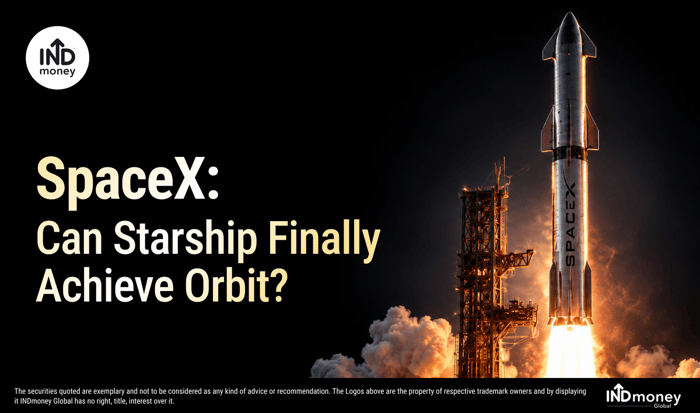
- Has Starship already reached orbit?
- What exactly will Starship Flight 14 attempt?
- Why does orbit matter more to Starlink than to launch headlines?
- What do SpaceX’s financials and stock valuation already assume?
- How does Starship compare with Rocket Lab, Blue Origin and ULA?
- What is the connection for Indian investors and the Moon programme?
- What should investors watch after Flight 14?
Starship has crossed the edge of space before. It has even released Starlink satellites on a test flight. Yet it has never completed an orbit of Earth. SpaceX’s 14th Starship flight is designed to change that, carrying satellites intended to become part of its commercial network. The distinction matters for investors: reaching orbit would prove a much more useful rocket, while launching it repeatedly at an attractive cost remains a separate challenge.
Let’s break down what Flight 14 is trying to prove, why the result matters to Starlink and SpaceX’s valuation, and where Rocket Lab, Blue Origin, United Launch Alliance and India’s launch industry fit into the picture.
Has Starship already reached orbit?
No. The first 13 integrated Starship flights flew deliberately suborbital trajectories. On those paths, the upper stage could reach space and test engine performance, payload release, re-entry and ocean landing without remaining in a stable orbit. Orbit means acquiring enough sideways speed to keep falling around Earth instead of quickly falling back into it. SpaceX explicitly describes Flight 14 as the first attempt to put Starship into Earth orbit.
The two latest flights show why the next step is credible while also showing what remains to be proved. Flight 12 in May was the first flight of the V3 vehicle and Raptor 3 engines. Flight 13 in July deployed 20 production Starlink V3 satellites on a suborbital trajectory, restarted a Raptor engine in space and brought the upper stage to a soft ocean splashdown. SpaceX subsequently recovered that ship to inspect its heat shield. Those 20 satellites were test articles on a path that did not leave them operating in Earth orbit.
Sources: SpaceX, Flight 12 and Flight 13 mission reports and Q2 2026 earnings update.
| Milestone | What it demonstrates | Status before Flight 14 |
| Reach space | The vehicle can climb above most of Earth’s atmosphere | Demonstrated |
| Release V3 satellites in flight | The deployment system can operate | Demonstrated on Flight 13’s suborbital path |
| Enter and maintain Earth orbit | The ship can achieve an orbital trajectory | Flight 14 objective; not yet confirmed at this update |
| Deliver working satellites into orbit | Starship can contribute to Starlink’s operating network | Flight 14 objective; not yet confirmed at this update |
| Recover and reuse both stages economically | The whole system can launch repeatedly at an attractive cost | Still to be demonstrated |
This sequence prevents a common overstatement. A successful satellite release is not the same as a successful satellite deployment into a usable orbit. Equally, one orbital mission would be a major engineering milestone without proving routine, fully reusable operations.
What exactly will Starship Flight 14 attempt?
SpaceX plans to launch from Pad 2 at Starbase, Texas during a 75-minute window opening at 7:15 a.m. local time on 28 September, or 5:45 p.m. IST. The upper stage is intended to enter an orbit around 275 kilometres above Earth, release 26 Starlink V3 satellites, circle the planet about six times and then perform a controlled deorbit and ocean splashdown west of Chile roughly 10 hours after launch. The Super Heavy booster is planned to splash down offshore in the Gulf rather than be caught by the launch tower. The upper stage is also not scheduled for a tower catch on this flight. These are plans, not reported outcomes.
For investors, there are several independent pass or fail points. Did the stages separate normally? Did the ship make orbit? Were the satellites released into their intended path and subsequently able to communicate? Did the ship restart its engines to deorbit and survive re-entry? A webcast image of satellites leaving the bay would answer only one of those questions. The satellite operator must then confirm their health and service readiness.
The date can move even after a window opens. At the stated check time, the company’s mission listing still showed Flight 14 as an upcoming flight. If the launch happens later today, the tense and status in this article should be updated before publication.
Source: SpaceX, launch manifest, checked 28 September 2026.
Why does orbit matter more to Starlink than to launch headlines?
SpaceX is both the owner of the rocket and a large customer for it. That is the central business advantage of Starship: a capable new launch vehicle could put larger batches of higher-capacity Starlink satellites into orbit without SpaceX having to wait for outside customers. It could also support government contracts and, eventually, other large payloads. But an internal satellite launch does not create the same immediately reported launch revenue as selling a launch to a third party; SpaceX says it capitalises internal Starlink launch costs in its satellite assets rather than recording intersegment Space revenue.
Starlink already generates far more revenue than SpaceX’s external launch business. The latest reported quarter makes the gap clear:
| SpaceX segment, Q2 2026 | Revenue | Operating result | What an operational Starship could change |
| Connectivity, including Starlink | $4.291 billion | $1.656 billion profit | More network capacity and potentially better deployment economics |
| Space, including external launches and Starship development | $962 million | $542 million loss | More launch capacity, but development costs must eventually be absorbed |
| AI, including xAI and X | $2.561 billion | $1.257 billion loss | Possible future demand for orbital infrastructure remains speculative |
| Consolidated company | $7.814 billion | $143 million loss | One launch cannot by itself settle the group’s profitability question |
Connectivity had 12.0 million subscribers at 30 June 2026, up from 6.0 million a year earlier. Its revenue rose 66% year on year and its operating profit rose 79%. By comparison, the Space segment spent $1.076 billion on research and development in the quarter, largely as Starship investment increased. Its $542 million operating loss grew from $369 million a year earlier despite higher revenue. Starlink’s profitable growth is helping support a costly launch technology programme today.
Here is the useful investor equation, stated without pretending that SpaceX has disclosed Starship’s cost per flight:
Value from Starship = incremental profitable satellite service enabled + external launch profit + other validated uses − the full cost of developing, building, launching and refurbishing the fleet.
An orbital flight moves the first two terms from possibility toward practical testing. It says little yet about the last term. Flight 14’s two stages are expected to end in the ocean. Therefore this mission cannot establish the refurbishment time or cost required for full reusability. SpaceX says each future V3 deployment could add much more Starlink network capacity than a current Falcon launch, but actual capacity, utilisation, subscriber demand and maintenance expenditure will determine returns.
Sources: SpaceX, September 2026 Starship update and Q2 2026 Form 10-Q.
What do SpaceX’s financials and stock valuation already assume?
SpaceX is a listed company, so investors can examine its filings rather than treating it as an inaccessible private venture. Its Class A shares began trading in June 2026 under SPCX. They closed at $148.68 on Friday, 25 September, the last completed US session before this Monday launch. That is a dated reference price, not a live 28 September quote.
SpaceX reported $18.674 billion in 2025 revenue and $12.508 billion in the first half of 2026, compared with $8.138 billion in the first half of 2025. That gives trailing 12-month revenue of $23.044 billion: $18.674 billion + $12.508 billion − $8.138 billion. Using the 13.182 billion Class A and Class B shares disclosed as outstanding on 28 July and the 25 September close yields an illustrative equity value of about $1.96 trillion, or about 85 times trailing sales. This is an estimate based on the last disclosed share count and excludes subsequent share changes. It is a companywide multiple for launch, connectivity and AI together, not a valuation of Starship alone.
There is financial strength alongside the demanding valuation. SpaceX reported $93.522 billion of cash and $6.487 billion of marketable securities at 30 June, substantially boosted by its June IPO, and reported a $541 million consolidated net loss in Q2. Its adjusted EBITDA was $3.538 billion, but that measure adds back depreciation and share-based compensation and should not be confused with free cash flow. A particularly revealing comparison is capital allocation: the AI segment reported $15.828 billion of Q2 capital expenditure versus $1.174 billion in Space and $1.367 billion in Connectivity. Starship matters enormously to the long-term narrative, but shareholders are funding a much broader business with substantial AI spending.
At roughly 85 times trailing revenue, a clean orbit alone cannot establish that SPCX is inexpensive. The stock’s longer-term case needs sustained subscriber economics, manageable investment across all three segments and repeated missions that turn engineering progress into cash generation. A failed or delayed attempt would hurt the timetable, but it would not erase Starlink’s existing customer base or Falcon’s established operations.
How does Starship compare with Rocket Lab, Blue Origin and ULA?
These businesses compete for some satellite and government missions, but they do not sell the same product. A small, dedicated launch that gives one customer a specific orbit can remain useful even if another provider carries much larger batches at a lower cost per kilogram. The most informative comparison is operational maturity, payload market and economic exposure.
| Operator or vehicle | What is already demonstrated | Competitive angle | Investor connection |
| SpaceX: Falcon family and Starship | Falcon routinely launches payloads; Starship completed suborbital V3 tests and is attempting its first orbit | Combines launch capacity with its own Starlink demand; aims for full Starship reuse | SpaceX (SPCX) owns launch, connectivity and AI businesses |
| Rocket Lab: Electron and Neutron | Electron is operational; larger Neutron is in development | Dedicated small launches plus satellite manufacturing; Neutron seeks larger missions | Rocket Lab (RKLB) offers a more concentrated public space business |
| Blue Origin: New Glenn | New Glenn reached orbit and landed a booster on its second mission in 2025; its third mission launched in April 2026 | Heavy orbital lift, booster recovery and contracts for large constellations | Blue Origin is private; owning Amazon (AMZN) is not equivalent to owning Blue Origin |
| United Launch Alliance: Vulcan | Vulcan has flown US national security missions | Government mission assurance and specialised orbits | ULA is a 50:50 venture of Boeing (BA) and Lockheed Martin (LMT); each parent has much larger businesses |
Sources: SpaceX mission reports and Q2 filing; Rocket Lab Q2 2026 Form 10-Q; Blue Origin New Glenn mission reports; ULA mission releases; Boeing and Lockheed Martin joint-venture disclosures. Company pages are linked once in the table for reader convenience.
Rocket Lab is the clearest public launch and spacecraft comparison, though its scale is very different. It reported $234.1 million Q2 revenue, with $189.5 million from space systems and $44.6 million from launch services. Its backlog was $2.356 billion at 30 June. Electron completed 12 launches in the first half of 2026, including suborbital HASTE missions, while Neutron remains subject to development and launch risk. An investor buying RKLB is therefore backing a satellite hardware and smaller-launch business with a prospective move upmarket, not a miniature version of Starlink.
Blue Origin is the key heavy-lift engineering rival. Its New Glenn has already put a payload into orbit and landed its first-stage booster, so Starship reaching orbit would not make SpaceX the first company with a heavy orbital rocket or a reusable booster. Starship’s proposed distinction is its much larger long-term reuse ambition, particularly the upper stage. Blue Origin is privately held and its link to Amazon is commercial rather than an equity ownership shortcut: Amazon has contracted New Glenn launches for its own satellite constellation.
ULA is relevant where customers prize proven, certified access for sensitive national security missions. Boeing and Lockheed Martin provide indirect exposure through their 50:50 ownership, but their share prices are driven heavily by aircraft and defence programmes. A successful Starship test could eventually sharpen price competition in certain launch categories; one test will not displace an already certified provider overnight.
What is the connection for Indian investors and the Moon programme?
India is a launch provider and a potential market for satellite connectivity, not a like-for-like Starship peer. ISRO’s LVM3 has carried commercial and Indian government payloads to orbit, including a BlueBird Block 2 communications satellite in December 2025. ISRO describes LVM3 as a roughly 10-tonne-class low Earth orbit launcher on its launchers page; missions and orbit requirements affect actual payload capacity. Comparing that figure mechanically with Starship’s advertised future capacity would obscure the difference between a mature expendable service and a still developing reusable system.
Starship also matters to NASA’s Artemis lander plans. NASA has selected the Starship Human Landing System for Artemis III and IV while Blue Origin is developing a separate lander for Artemis V. A lunar version of Starship would need substantial propellant supplied in orbit, which makes reliable launches, transfer between spacecraft and storage of very cold propellants important future tests. Flight 14 does not attempt an orbital propellant transfer or a Moon landing. NASA’s inspector general has warned that lander development challenges can delay planned Artemis missions.
Sources: NASA Human Landing System programme and NASA Office of Inspector General report, March 2026.
For an Indian investor, SpaceX is now a direct listed exposure to the combined launch, satellite broadband and AI enterprise. Rocket Lab and the other companies above provide different business exposures, not interchangeable bets on the same rocket. Compare the revenue sources, development spending and demonstrated flight record before comparing share-price reactions.
What should investors watch after Flight 14?
The first question is whether SpaceX confirms a stable orbit and healthy deployment of the 26 satellites. The second is whether the ship completes the planned deorbit and re-entry after several orbits. Then come repeatability, time between launches, actual mass and network capacity delivered, booster and ship recovery, refurbishment expense and orbital propellant transfer. These successive tests matter more to long-term value than one spectacular launch image.
Our view: Starship has a credible path to its first orbit after Flights 12 and 13, but confidence in an attempt is not confirmation of success. Flight 14 would be a meaningful advance if it gets working Starlink satellites into a usable orbit. The harder investment test is whether SpaceX can repeat such flights while controlling costs and generating returns across Starlink, launch and AI. At the last completed close, its valuation already placed substantial weight on future execution. Investors should treat today’s flight as one significant data point in a much longer economics experiment.