

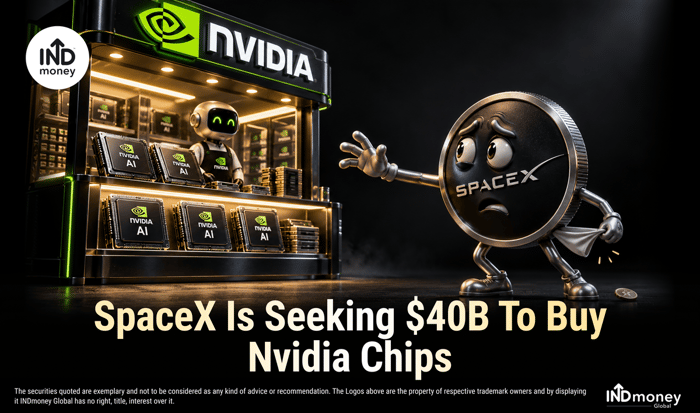
- What Is SpaceX’s $40 Billion Nvidia Chip Plan?
- Why Does a Rocket Company Need So Much AI Computing Power?
- Why Borrow When SpaceX Has About $100 Billion?
- How Does SpaceX’s Nvidia Chip Plan Affect Google?
- What Does Nvidia Gain From SpaceX’s AI Expansion?
- What Must $40 Billion of AI Hardware Earn?
- Are Space-Based AI Data Centres Part of the Story?
- What Should Investors Watch Next?
SpaceX wants $40 billion for Nvidia chips. But the most revealing number in this story may be Google’s disclosed $920 million monthly compute agreement.
Together, they explain how Elon Musk is trying to turn SpaceX into an AI infrastructure giant, and why the company financing the hardware faces a different investment proposition from its supplier and customers.
Let's break down what the funding would pay for, why Google is involved, and how much cash SpaceX needs to generate to make this enormous chip investment worthwhile.
What Is SpaceX’s $40 Billion Nvidia Chip Plan?
Reuters reported that SpaceX was discussing $40 billion of financing with banks and asset managers for Nvidia AI chips. The Financial Times first reported the proposed transaction, with Apollo expected to lead and PIMCO involved in financing discussions.
| Reported financing detail | Amount or status |
| Total funding sought | $40 billion |
| Bank loans | Approximately $10 billion |
| Investment-grade debt | Approximately $30 billion |
| Expected lead arranger | Apollo |
| Another participant in discussions | PIMCO |
| Completion | FT reported an expected 2027 closing |
Sources: Reuters, October 6-7, 2026; Financial Times, October 6, 2026.
These are negotiations. Final pricing, repayment schedules, collateral and the financing structure remain essential details before investors can judge the economics. Investment-grade debt means credit assessed within the stronger rating categories; it still carries repayment risk.
The distinction between funding and earnings matters. Raising $40 billion would provide spending capacity. The value comes later, if the equipment earns enough from customers to cover operating costs, recover the investment and compensate investors for the risk.
Why Does a Rocket Company Need So Much AI Computing Power?
SpaceX acquired xAI on February 2, 2026. Its businesses now include rockets, Starlink connectivity and AI, bringing the Grok developer and its computing infrastructure into the same group. Investors tracking SpaceX stock therefore need to assess several very different businesses.
SpaceX can use computing capacity for its own products and charge other companies for access. Anthropic announced in May that its agreement covered Colossus 1’s entire computing capacity, including more than 220,000 Nvidia GPUs.
Think of a cinema operator renting screens to outside distributors while also showing its own films. Owning the building creates options, but earnings still depend on how many seats get filled and what customers pay.
The strategic opportunity is credible: SpaceX can monetise infrastructure even when another company develops a successful AI product. The financial challenge is building enough capacity without leaving expensive equipment underused.
Why Borrow When SpaceX Has About $100 Billion?
SpaceX’s June financials show substantial liquidity alongside enormous investment requirements.
| Financial measure | Period | Amount |
| Cash, cash equivalents and marketable securities | June 30, 2026 | $100.0 billion |
| Principal debt, excluding finance leases | June 30, 2026 | $38.43 billion |
| Operating cash flow | First half of 2026 | $3.47 billion |
| Purchases of property, plant and equipment | First half of 2026 | $28.48 billion |
| Simple free cash flow, calculated | First half of 2026 | −$25.01 billion |
Source: SpaceX Q2 2026 Form 10-Q. Free cash flow here equals $3.466 billion of operating cash flow minus $28.476 billion of property, plant and equipment purchases.
These are June balances. They show why a large cash reserve and further financing can coexist: the spending pipeline can absorb substantial capital before the resulting assets produce cash.
Borrowing could preserve liquidity and avoid immediate equity dilution. If all $40 billion became additional corporate borrowings, it would roughly double June’s principal debt. The balance-sheet effect depends on the final structure and other transactions.
Borrowing initially adds cash and debt together. Spending the cash leaves a repayment obligation against assets whose earnings must still be proven.
The debt market is asking harder questions. The FT reported on October 7 that SpaceX’s five-year credit-default-swap spread reached 194 basis points, versus 110 in June. This measures the market cost of protection against default and signals greater caution.
The AI segment makes the challenge clearer.
| SpaceX AI measure | Q2 2026 |
| Revenue | $2.561 billion |
| Capital expenditure | $15.828 billion |
| Adjusted EBITDA | $1.146 billion |
| Operating loss | $1.257 billion |
Source: SpaceX Q2 2026 earnings release.
AI capital expenditure was about 6.2 times quarterly AI revenue. This ratio is a snapshot of an expansion phase, rather than a forecast of permanent spending intensity.
Adjusted EBITDA measures earnings before interest, taxes, depreciation and amortisation, with additional company adjustments. It helps show operating progress, but omits costs that matter greatly in a hardware business. SpaceX’s AI segment added back $1.885 billion of depreciation and amortisation in Q2.
So, improving EBITDA deserves attention, but the more demanding test is whether cash generation can eventually fund equipment renewal. A fleet of GPUs needs profitable workloads as well as impressive specifications.
How Does SpaceX’s Nvidia Chip Plan Affect Google?
Google has three connections to this story: it rents computing capacity, owns SpaceX shares and develops competing AI infrastructure.
Google gains computing capacity and flexibility
SpaceX disclosed its Google Cloud Service Agreement on June 5.
| Google agreement term | Disclosed detail |
| Monthly fee at full capacity | $920 million |
| Annualised fee, calculated | $11.04 billion |
| Stated full-fee period | October 2026 through June 2029 |
| Hardware access | Approximately 110,000 Nvidia GPUs, plus related components |
| Termination after December 31, 2026 | Either party may terminate on 90 days’ notice |
Source: SpaceX’s June 5, 2026 SEC filing. Annualisation assumes twelve months at the full disclosed fee.
The disclosed terms also allow Google to terminate or accept reduced capacity at lower fees if SpaceX misses its GPU delivery obligation, following a one-month grace period. The proposed financing does not establish a new Google agreement or identify Google as a lender.
For Google stock investors, renting capacity can speed up access to computing while Google expands its own infrastructure. Google’s tensor processing units, or TPUs, are its custom AI chips. Its Q2 call described demand for both its AI services and TPU systems.
An airline can lease aircraft to add routes before its own deliveries arrive. Similarly, external compute can help Google serve demand sooner. The cost is recurring rental payments and reliance on a supplier.
Google Cloud generated $24.8 billion in Q2 revenue, up 82%, with a 35.6% operating margin. Management also raised Alphabet’s 2026 capital expenditure guidance to $195-205 billion.
That makes the investor question concrete: does faster capacity access generate enough additional profit, or protect enough existing business, to justify the rental bill? Renting supplements Google’s investment programme; it does not eliminate the cost of expanding its own infrastructure.
The contract gives SpaceX a demanding financing problem
At $920 million for 33 months, the stated full-fee period would produce $30.36 billion if maintained throughout. The disclosed termination right means this arithmetic cannot be treated as irrevocably committed revenue.
This is the key mismatch to watch. Customer commitments may be shorter than the period needed to recover equipment costs. SpaceX can replace a departing customer, but doing so quickly and at an attractive price becomes crucial.
Google’s flexibility helps it manage changing computing needs. SpaceX must price that flexibility into its investment decisions. The older Google contract also cannot automatically be assigned as revenue supporting this new $40 billion hardware purchase.
Alphabet’s SpaceX stake creates a second exposure
Alphabet’s filing for the June quarter disclosed approximately $94.1 billion of SpaceX shares across two categories of restricted securities. That was a June 30 value, rather than an October valuation.
Illustratively, a 10% change in that marked value would equal $9.41 billion before tax, assuming an unchanged position. Alphabet can therefore be affected through investment values as well as computing costs.
Its Q2 filing also reported $99 billion of net gains on equity securities, primarily unrealised gains involving SpaceX and a private company.
Investors should separate these gains from recurring advertising and cloud earnings. In a valuation that adds the SpaceX stake separately, check that the same shares are not counted again within cash and marketable securities. Otherwise, the apparent valuation cushion gets overstated.
What Does Nvidia Gain From SpaceX’s AI Expansion?
For Nvidia stock, the attraction is hardware demand from a customer expanding aggressively. On SpaceX’s August earnings call, Musk said the company had decided to build exclusively on Nvidia, citing the Vera Rubin architecture.
That strengthens Nvidia’s position as SpaceX’s preferred supplier. It also concentrates SpaceX’s exposure to one hardware roadmap and supplier’s economics.
The scale deserves perspective.
| Nvidia reference measure | Amount |
| Data Center revenue, Q2 FY2027 | $89.0 billion |
| Annualised quarterly Data Center revenue, calculated | $356.0 billion |
| Proposed $40 billion spending relative to that reference | 11.2% |
| Company-wide GAAP gross margin, Q2 FY2027 | 75.0% |
Source: Nvidia Q2 FY2027 results; calculations by INDmoney. Annualisation is a scale comparison, not guidance.
A potential order of this size is substantial. Investors still need to know delivery dates, product mix and how much demand is additional to existing expectations before translating the headline into an earnings forecast.
There is also a financing connection. Nvidia announced partnerships with six financial institutions, including Apollo, to establish platforms designed to mobilise more than $500 billion of third-party capital over time. That figure is a financing-platform ambition, not Nvidia revenue or a commitment to this SpaceX transaction.
Nvidia has the clearest direct commercial benefit if financing closes and deliveries proceed. Over time, however, its growth depends on customers earning enough to keep ordering. Capital availability can accelerate demand; sustainable customer cash flow determines its durability.
What Must $40 Billion of AI Hardware Earn?
A useful investment model starts with the cash the equipment must produce. Consider three explicit assumptions:
- $40 billion of upfront hardware spending.
- An 8% annual required return and zero resale value.
- A 50% cash operating margin before financing, tax and further capital expenditure.
The margin means $50 remains from every $100 of revenue after cash operating costs. These are illustrative assumptions, rather than disclosed deal terms or management forecasts.
The table shows the level of annual cash flow needed to recover the investment and earn the assumed return over each equipment life.
| Assumed economic life | Annual cash generation required | Annual revenue required at a 50% cash margin |
| 3 years | $15.52 billion | $31.04 billion |
| 5 years | $10.02 billion | $20.04 billion |
| 7 years | $7.68 billion | $15.37 billion |
Source: INDmoney illustrative discounted cash-flow calculations. Annual cash requirement equals $40 billion multiplied by 8%, divided by one minus 1.08 raised to the negative equipment life.
In the five-year case, the investment needs roughly $20 billion of annual revenue to clear this simplified hurdle. Taxes, buildings, networking, power infrastructure and any additional capital spending could raise the full project’s requirement. Revenue from this equipment would need to be additional, without double-counting earnings generated by existing assets.
This also explains why an interest-only calculation is incomplete. At a hypothetical 8% debt coupon, annual interest on $40 billion would be $3.2 billion. Covering that bill leaves the principal to be recovered. The table already incorporates capital recovery and the required return; interest should not be added to it again.
The assumptions change the outcome sharply. At a 40% cash margin, the five-year revenue hurdle rises to about $25.05 billion. A longer useful life helps, provided older hardware remains commercially productive.
The investment deserves confidence when customer economics support these cash requirements. The number of chips installed, on its own, cannot establish that.
Are Space-Based AI Data Centres Part of the Story?
SpaceX also has orbital computing ambitions. On its August earnings call, Musk described Starmind AI satellites based on an optimised Nvidia Vera Rubin system and said launches were expected to begin in 2027. These were management plans.
Orbital computing would run AI hardware aboard satellites. SpaceX’s launch capabilities could become an advantage if it can deploy and operate computing capacity economically.
For investors, terrestrial and orbital computing deserve separate financial cases. The orbital case must account for launch costs, communications, reliability, heat management and equipment replacement. Each affects the cost of delivering useful computation.
Our valuation approach would give proven customer cash flows greater weight, while treating orbital computing as an opportunity requiring further evidence. Confidence should rise with demonstrated operating performance and economics per unit of useful compute.
The reported $40 billion financing package does not disclose a precise allocation between terrestrial infrastructure and orbital programmes. Assigning the entire amount to satellites would go beyond the available terms.
What Should Investors Watch Next?
For SpaceX, the most useful comparison is between the hardware’s earning life, the financing schedule and the duration of customer commitments. A long-lived asset with reliable customers can support debt; frequent customer exits or rapid hardware obsolescence make the same borrowing harder to justify.
| Indicator | What would strengthen the investment case |
| Final financing terms | Manageable repayments and clear collateral obligations |
| Customer agreements | Greater revenue visibility and a broader customer base |
| Capacity usage and pricing | Productive equipment with resilient earnings per unit |
| Cash generation | Progress toward funding investment and equipment renewal |
| Google’s operating results | Capacity expansion accompanied by durable profit growth |
| Nvidia’s customer economics | Repeat orders supported by customers’ operating cash flow |
The power constraint matters too. A chip order produces little value if the data centre cannot operate it reliably. Our analysis of Google’s nuclear power deal with Constellation Energy explains why electricity access is becoming central to AI investment.
Our judgement is that this development strengthens the commercial opportunity for Nvidia and gives Google more computing flexibility. SpaceX has a larger potential revenue opportunity, alongside the greatest need to prove returns on the new equipment.
A larger financing package alone should not justify a higher SpaceX valuation. The stronger evidence would be profitable workloads, durable customer relationships and cash generation catching up with capital investment. That is the test that will remain useful long after this headline fades.