

- What Apple Announced at WWDC 2026
- Why Apple Stock Fell After WWDC 2026
- Tim Cook’s Final Keynote and Apple’s Leadership Transition
- Apple Earnings: Strong Business, Premium Valuation
- Apple September 2026 Event: Foldable iPhone as the Next Catalyst
- What Should Investors Do?
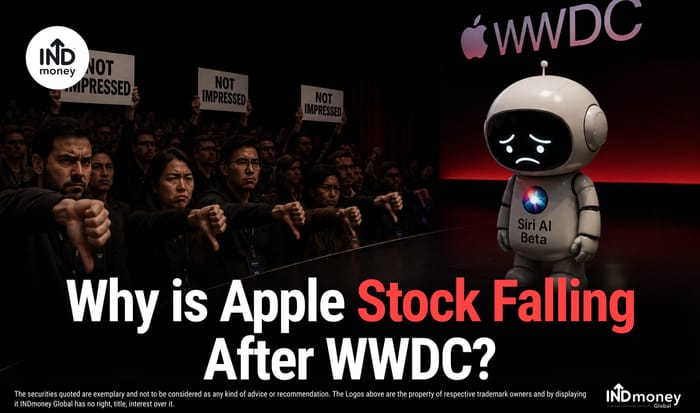
Apple's stock touched $$317.4 on Monday morning, an all-time intraday high, right as WWDC 2026 was underway in Cupertino. By the closing bell, it had fallen back to $301.54, a drop of nearly 2%. The broader market had a perfectly fine day. The S&P 500 ended up 0.30%. Nasdaq rose 0.86%. But Apple went the other way. And this was the day Apple showed the world its most ambitious AI overhaul in years.
Let's break down what actually disappointed investors at WWDC 2026, why Apple stock follows the same bruising pattern after every major event, and what Indian investors holding AAPL need to watch next.
What Apple Announced at WWDC 2026
For context, here is what Apple announced during Tim Cook's final keynote as CEO:
| Announcement | What It Is |
| Siri AI | A ground-up rebuild of Siri, powered by Google's Gemini model, with system-wide awareness and multi-step task handling |
| Apple Intelligence Expansion | AI photo editing, smarter Home notifications, cross-app context awareness |
| iOS 27 and macOS Golden Gate | New OS versions, available to all devices from iPhone 11 onward |
| Safari AI | Tab organisation, one-tap password updates |
| AFM Cloud Pro | Apple's large AI model running on Nvidia GPUs via Google Cloud |
| Performance Improvements | Photos load 70% faster, AirDrop transfers 80% faster |
| Parental Controls | Expanded child safety and content restriction tools |
That is a full slate. Apple positioned Siri AI as the biggest update to its assistant in the product's 15-year history. It committed to bringing iOS 27 to "more users than any iOS release ever." It even got Tim Cook to deliver an emotional farewell on stage. Wall Street checked the list and sold the stock anyway.
(Sources: Bloomberg WWDC 2026 Preview, TechCrunch WWDC Coverage, CNBC Live Updates, June 8, 2026)
Why Apple Stock Fell After WWDC 2026
The frustration wasn't with what Apple announced. It was with what Apple didn't say. Apple launched Siri AI in beta mode, with no firm date for when users would actually get it. Gene Munster, a veteran Apple analyst who has covered the company for decades, put it plainly on June 8: the stock is falling because Apple gave no timeline on Siri.
This matters because the Siri AI story is already two years old. Apple first teased its AI vision at WWDC 2024. It has since delayed the full rollout multiple times. Investors have watched Samsung, Google, and OpenAI ship capable AI tools while Apple kept saying "soon." The stock had run up sharply into WWDC on the expectation that "soon" finally had a date. It still doesn't.
There was also an uncomfortable detail buried in the announcement. Siri AI runs on Google's Gemini model. Apple, the company that built its entire brand on privacy and ecosystem control, is renting its most important AI layer from a direct competitor. But for investors who were betting on Apple as an independent AI powerhouse, it read differently. This Has Happened Before: Apple's Event Curse
Apple’s Post-WWDC Stock Reaction: A Familiar Pattern
| Event | What Was Promised | What Was Delivered | Stock Move |
| WWDC 2024 | Apple Intelligence, AI-powered Siri | Strong AI roadmap | +20-point outperformance (Morgan Stanley) |
| iPhone 17 Launch (2025) | Major AI features, new design | Modest updates, Siri delays pushed to 2026 | -1.5% on day, -3.2% next day, ~$112B market cap erased |
| WWDC 2026 (June 2026) | Full Siri AI rebuild, AI roadmap clarity | Siri in beta, no launch date | ATH $317 to close $301.54, down 1.89% |
The pattern is always the same: the stock runs up in the weeks before the event, hits a peak around the announcement, and then sells off when reality fails to match the run-up. The deeper structural issue, though, is not just "buy the rumour, sell the news." It is this: Apple's stock has been re-priced from a hardware company to an AI company over the last two years.
The P/E ratio has climbed from its 10-year average of about 26x to approximately 36x today. That premium requires Apple to deliver AI that actually changes user behaviour, generates new services revenue, and drives a genuine upgrade cycle. Every event is a chance for the market to say, "Yes, the AI premium is justified." WWDC 2026 was not that moment.
Tim Cook’s Final Keynote and Apple’s Leadership Transition
Another layer was the fact that WWDC was, officially, Tim Cook's last major keynote as the company's chief executive. On September 1, 2026, Tim Cook will hand the CEO title to John Ternus, currently Apple's SVP of Hardware Engineering. Cook will stay on as executive chairman.
Cook's legacy needs no defence. He inherited Apple in 2011 when it was a $350 billion company and will likely leave it above $4 trillion in market cap. He built the services business from near-zero to a $31 billion per quarter engine. He executed the shift to Apple Silicon without disrupting a single product line.
The market's concern is narrower and forward-looking. Ternus is a hardware man. He led the M-series chip transition, the Vision Pro, multiple iPhone generations. But he is inheriting a company at the exact moment when the defining competitive battle is software and AI. Notably, Ternus was not seen at WWDC at all. In an event that was supposed to introduce the future leadership's AI direction, the future leader was absent. That is not a signal investors loved.
Apple Earnings: Strong Business, Premium Valuation
| Metric | Q2 FY2026 | Year-on-Year Change |
| Total Revenue | $111.2 billion | +17% |
| iPhone Revenue | Record for March quarter | +22% |
| Services Revenue | $31 billion (all-time high) | Double-digit growth |
| Net Income | $29.6 billion | Record for March quarter |
| EPS | $2.01 | +22% |
| Gross Margin | 49.3% | Beat guidance |
| H1 2026 Operating Cash Flow | $82.6 billion | Strong |
| Share Buyback Authorised | $100 billion new program | 14th consecutive year of dividend growth |
Apple's Services segment, which includes the App Store, Apple Music, Apple TV+, iCloud, and the Google search deal, is now approaching a $120 billion annual run rate. This is the business that earns roughly 70% gross margins, compared to about 35% on hardware.
However, Apple’s valuation question is harder. At a P/E of approximately 36x against a 10-year historical average around 26x, Apple is priced about 37% above its own norm. For that premium to stay, the AI chapter needs to deliver real revenue, not just beta software.
Apple September 2026 Event: Foldable iPhone as the Next Catalyst
Apple's next test is September 2026, and it could be the most important iPhone event since the 5G launch in 2020. For the first time, Apple is expected to launch a foldable iPhone, commonly called the iPhone Fold or iPhone Ultra. Bloomberg confirmed in April that the device remains on track for a September launch alongside the iPhone 18 Pro and Pro Max.
Apple is also skipping the standard iPhone 18 this fall, pushing it to early 2027. The September lineup will be premium-only: the two Pro models and the foldable. This is a deliberate move to drive higher average selling prices and test consumer appetite for the new form factor.
The September event will also be John Ternus's first product keynote as CEO, which makes it even more significant than usual. His performance on stage, and the quality of the products he unveils, will set the tone for how investors view the new leadership's first chapter.
One genuine risk: mass production of the foldable was reportedly pushed from June to August due to hinge complexity. Initial supply may be limited, which could cap early revenue even if demand is strong.
What Should Investors Do?
Wedbush analyst Dan Ives reiterated his Outperform rating and $400 price target after WWDC, saying the event was "a good step in the right direction" and that AI could ultimately add $75 to $100 per share to Apple's valuation.
On the other side, UBS stayed Neutral at $296. Some bear-side projections put a floor as low as $215 if the AI premium fully unwinds.
Wall Street consensus from 48 analysts, sits at a Buy with an average target near $310, implying modest upside from current levels. INDmoney data shows that Apple is seeing rising retail interest in India, with investments up 5.31% and search interest up 64% over the last 30 days.
| Theme | Bull Case | Bear Case |
| AI + Siri | Siri AI could drive a new iPhone upgrade cycle; Wedbush sees $15-20B annual AI services upside | No clear launch timeline; delays widen Apple’s AI gap vs Google, Samsung and OpenAI |
| Foldable iPhone | $2,000+ iPhone Fold/Ultra could trigger Apple’s biggest upgrade cycle since 5G | Hinge issues reportedly pushed mass production to August; launch supply may stay tight |
| Services | Services margins remain 70%+, giving Apple a high-profit growth engine | Google search deal worth ~$20B/year faces DOJ antitrust risk; Morgan Stanley links it to ~12% of EPS |
| Valuation | AI monetisation could support premium multiples; Wedbush target $400, BofA $380 | Stock trades at ~36x P/E, around 37% above 10-year median; UBS remains Neutral at $296 |
| Leadership | John Ternus brings hardware credibility before a possible device supercycle | A hardware-first CEO may not fully solve Apple’s AI and software narrative gap |
So, Apple is not a broken story. It is one of the most profitable businesses ever built, and its ecosystem lock-in is something that rivals have spent decades trying to replicate without success. The Services engine is real, the cash generation is exceptional, and the potential upgrade cycle from the foldable iPhone is a genuine, near-term catalyst.
But at a P/E of approximately 36x, the stock is priced for Apple to execute on AI in a way it has not yet demonstrated. The gap between the AI premium in the stock and the AI delivery in the product is the central risk.
For investors, the September iPhone event is the next most important thing to watch for. A successful foldable launch plus a clearer Siri rollout timeline would directly address the two things that disappointed the market at WWDC. If both deliver, the valuation conversation changes. If they don't, the stock's current premium is harder to justify at 36x.