

- What Is OpenAI’s Confidential S-1 Filing?
- OpenAI Financials: Revenue, Losses and Cash Burn
- The Biggest Risk in OpenAI’s Business Model: Inference Costs
- OpenAI Legal Risks Before Its IPO
- What Analysts Are Saying About OpenAI’s IPO Valuation
- Key Risks That Could Hurt OpenAI’s IPO Valuation
- What OpenAI’s IPO Means for Indian Investors
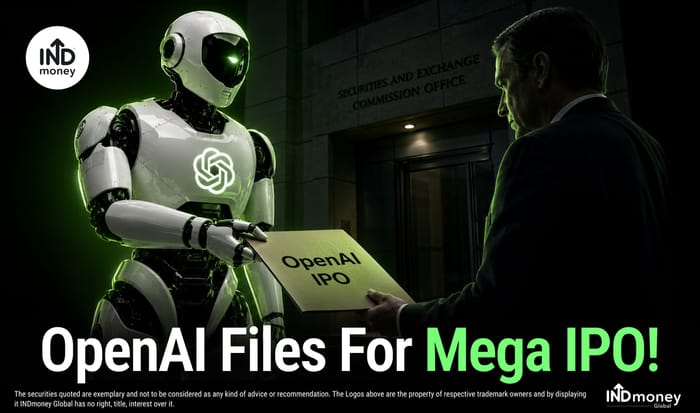
The company that gave the world ChatGPT just handed Wall Street its most anticipated document in years. OpenAI submitted its confidential S-1 prospectus to the US Securities and Exchange Commission around May 22, 2026, with the filing confirmed publicly on June 8, 2026 with the US Securities and Exchange Commission, with Goldman Sachs, Morgan Stanley, and JPMorgan leading the offering, as per CNBC.
The target: a public listing as early as September 2026, at a valuation analysts at CNBC and Enterprise DNA expect to exceed $1 trillion. That figure would make OpenAI's debut roughly 4x the valuation at which Alibaba listed in 2014. Here is the part worth sitting with: according to an analysis by European Business Magazine of OpenAI's 2025 and FY 2026 financials, the company lost approximately $1.22 for every dollar it earned in the quarter.
Let's break down what the filing actually means, what the financials look like behind the headline numbers, how this compares to what investors already know, and the one structural question about OpenAI's economics that needs your attention.
What Is OpenAI’s Confidential S-1 Filing?
A confidential IPO filing lets a company submit its draft prospectus to the SEC for private review before any public disclosure. OpenAI works through regulatory comments and financial disclosure requirements in private. The full public S-1, which will contain audited financials, must be released at least 15 days before the investor roadshow, as per SEC rules.
As per Axios reporting, confidential filings are typically submitted a couple of months before the public S-1 and another month or so before the actual listing. So a September 2026 window is plausible. The timing is significant: the filing came two days after a jury dismissed Elon Musk's lawsuit against OpenAI on statute of limitations grounds, as per CNBC. That case was the single most visible legal obstacle to going public, and it was cleared first.
The process is not a listing announcement. It is the beginning of a months-long sequence that ends at an IPO roadshow.
OpenAI Financials: Revenue, Losses and Cash Burn
Because OpenAI's full S-1 is not yet public, the numbers below come from confirmed CFO disclosures, reporting by The Information, Sacra's private company analysis, and CNBC. These are estimates and projections, not audited figures. The audited data will arrive with the public S-1.
| Metric | Figure | Source |
| 2023 Revenue | ~$2 billion | CFO Sarah Friar, Reuters (Jan 2026) |
| 2024 Revenue | ~$6 billion | CFO Sarah Friar confirmed, Reuters |
| 2025 Revenue | ~$20 billion | CFO Sarah Friar, Reuters |
| Feb 2026 Annualized Run Rate | ~$25 billion | Sacra (April 2026) |
| 2026 Revenue (estimate) | $26-42 billion | Sacra / The Information |
| 2029-30 Revenue (projection) | ~$280 billion | OpenAI internal, per The Information |
| 2026 Projected Loss (non-GAAP) | ~$14 billion | The Information |
| 2026 Projected Loss (GAAP) | ~$25-26 billion | FutureSearch (June 2026) |
| 2026 Cash Burn | ~$25 billion | The Information / CNBC |
| Cumulative Cash Burn 2026-2030 | ~$665 billion | The Information |
| Gross Margin (2025) | 33% | Sacra |
| Expected Profitability | 2029-2030 | Multiple sources |
The revenue growth is striking. OpenAI went from $2 billion in annualized revenue at end-2023 to roughly $25 billion by February 2026, a 12.5x increase in a little over two years. For reference, Google took over a decade to reach comparable annual revenue, as per Technerdo's April 2026 analysis. The problems sit on the cost side of this table.
The Biggest Risk in OpenAI’s Business Model: Inference Costs
Every large-scale software company that went public and traded at premium valuations shared one structural truth: the more customers they added, the cheaper each new customer became to serve. WhatsApp added 100 million users with nearly no additional infrastructure cost. Google's 10th advertiser costs the same to serve as the 10th million. This is what "software economics" means, and it is why software companies deserve high revenue multiples.
OpenAI's gross margin was 33% in 2025, as per Sacra. In 2024, it was approximately 40%. Revenue nearly tripled in the same period. Margins fell anyway.
The reason: inference costs. Every time you type a query into ChatGPT, OpenAI pays for the GPU compute that generates your response. These are real, recurring, per-query costs. Sacra reports that inference costs reached $8.4 billion in 2025 and are projected to rise to $14.1 billion in 2026. That is a 68% increase in costs for what may be less than 100% revenue growth.
When Jio launched in India and spent thousands of crores building its 4G network, long-term investors were patient. The infrastructure was expensive upfront, but once the towers and fiber were in place, each new customer cost almost nothing to add. Per-customer cost fell as scale grew. That is why capital-intensive infrastructure builds can eventually produce very high-margin businesses.
OpenAI's compute "towers" do not work like Jio's physical towers. A Jio tower serves a million users at the same cost as a thousand. An OpenAI GPU cluster serving a million queries costs proportionally more than one serving a thousand. The marginal cost does not fall with scale; it grows with it.
This makes OpenAI's business model structurally unlike any trillion-dollar tech company before it, and it is the central question public market investors will need an answer to. Bridgewater partner Greg Jensen reportedly told clients the implied 35x forward revenue multiple is "priced for a monopoly outcome that does not yet exist," as per a Financial Times investigation cited in tech-insider.org's April 2026 analysis. HSBC analysts, as per CMC Markets, estimate OpenAI may need over $207 billion in additional capital by 2030 even under optimistic revenue projections.
The bull case, to be fair, has something behind it. OpenAI renegotiated its revenue-share arrangement with Microsoft, capping total payments at $38 billion through 2030, down from a prior trajectory of approximately $135 billion, a saving of roughly $97 billion, as per Sacra. If inference costs fall fast enough, the margin story reverses.
But investors are being asked to pay a trillion dollars for a company betting that the costs fall before the cash runs out. That is a bet, not a certainty.
OpenAI Legal Risks Before Its IPO
OpenAI enters its IPO process with several active legal challenges. Here is the current status of each, as of June 2026.
| Case | Filed By | Core Allegation | Status |
| Musk v. Altman | Elon Musk | Breach of nonprofit founding contract | Jury ruled for OpenAI, May 18, 2026 (statute of limitations) |
| New York Times suit | NYT | Copyright infringement; articles used to train models without licensing | Ongoing; no settlement; discovery fight over user logs |
| Authors Guild and others | Multiple writers, publishers | Copyright infringement during model training | Multiple class actions; OpenAI's fair use defense partially validated by federal judges in related cases |
| State AG oversight | California, New York attorneys general | Nonprofit conversion, governance concerns | Ongoing monitoring |
Legal analysts at lawdrafted.com estimate total settlement exposure across all active cases at $500 million to $5 billion, with the New York Times case carrying the largest variable. OpenAI's position on fair use has received independent support from two federal judges in separate but related cases, as per OpenAI's own filings on its website. None of these cases are resolved, and the public S-1 will need to disclose them as material risks.
What Analysts Are Saying About OpenAI’s IPO Valuation
The analyst community splits along a fairly clean line between financial modeling skeptics and structural AI bulls.
FutureSearch, which has modeled OpenAI's financials since 2024, puts its central post-IPO market cap estimate at roughly $860 billion, nearly matching the last private mark. Their analysis weighs an 80% probability scenario where OpenAI does not recover clear AI model leadership before listing, implying the $1 trillion target requires either a significant new model release or public market optimism that outruns the GAAP loss numbers.
On the institutional side, Goldman Sachs, Morgan Stanley, and JPMorgan signed on as lead underwriters, as per CNBC. Amazon, Nvidia, and SoftBank backed the $852 billion March 2026 round with strategic capital.
CMC Markets notes that CFO Sarah Friar has described the company as "preparing to operate with public-company discipline," which typically signals an active roadshow preparation process.
There is also a governance question that most analyst notes have buried. Sam Altman, the CEO of a company targeting a trillion-dollar listing, currently holds no confirmed equity stake. The leaked March 2026 cap table, analyzed by The VC Corner, shows his position as "None/Pending."
Every major tech IPO in history has had a CEO with significant ownership. Whether Altman receives a formal equity grant before the S-1 goes public, and how large it is, will be a closely watched event because any grant at current valuations is immediate dilution for all other shareholders.
Key Risks That Could Hurt OpenAI’s IPO Valuation
1. Inference costs stay elevated: The entire path to profitability depends on GPU compute getting meaningfully cheaper per query. If AI hardware efficiency gains slow, or if demand grows faster than cost reductions can offset, the 2029-2030 profitability target shifts further out and the $665 billion cumulative cash burn estimate grows with it.
2. Competition removes pricing power: Anthropic recently surpassed OpenAI in private market valuation ($965 billion vs $852 billion, as per CNBC, May 2026). Sacra's April 2026 analysis shows OpenAI's developer market share has declined from approximately 60% to 51% year-on-year, with Anthropic's Claude Code taking meaningful share in AI coding. Google's Gemini and Meta's open-source Llama models provide free alternatives that compress what OpenAI can charge. If enterprise customers can substitute, the revenue multiple is hard to defend.
3. Microsoft dependency becomes a vulnerability: Despite the renegotiated revenue-share deal, OpenAI still runs substantially on Microsoft Azure infrastructure. If that relationship ever faces commercial or regulatory pressure, OpenAI's cost structure changes sharply.
4. The public S-1 discloses worse-than-expected GAAP losses: FutureSearch estimates 2026 GAAP losses at $25-26 billion, approximately 80% higher than the $14 billion non-GAAP figure most headlines cite. When the audited S-1 arrives, the GAAP number will be the one public investors see first. If it is significantly above market expectations, demand could price the offering below $1 trillion.
5. The governance structure creates investor hesitation: The combination of a CEO with no equity, a nonprofit foundation holding a meaningful stake, and a complex public benefit corporation structure is unprecedented for a US tech listing at this scale. Institutional investors may demand a valuation discount for governance complexity that private investors did not price.
What OpenAI’s IPO Means for Indian Investors
Once OpenAI lists on a US exchange, Indian investors would be able to buy shares directly, just like any other US stock. But context matters before approaching this as an investment.
OpenAI is not a conventional software company with predictable margin expansion baked in. It is a capital-intensive AI platform operating in the most competitive technology market in recent history, burning approximately $25 billion in cash this year alone, while generating around $25 billion in revenue. The path to profitability is visible on the timeline, but it depends on cost variables that are not fully in OpenAI's control.
The revenue growth is real and historically fast. The product is used by approximately 900 million people weekly, as per OpenAI's own disclosures from March 2026. The market opportunity is large. The question a public market investor must answer before buying is simpler than it sounds: at 35x forward revenue, is this priced for what OpenAI is today, or for what it needs to become by 2030?
The S-1 prospectus, when it goes public roughly 15 days before the roadshow, will be the first place to find audited answers to that question. Until then, treat every number in circulation as an estimate.
Watch the gross margin line when the S-1 drops. If it has stopped falling, the bull case gets real. If it is still declining, the $1 trillion ask becomes a much harder conversation.