

- The Big Picture For Apple And Samsung: Scale vs Profit Power
- Financial Snapshot: Apple vs Samsung
- Why Apple Makes More Money Per Phone
- The Twist: Rivals Who Need Each Other
- Strategy Showdown: Apple’s Premium Castle vs Samsung’s Open Kingdom
- So, Who Is Winning Between Apple And Samsung?
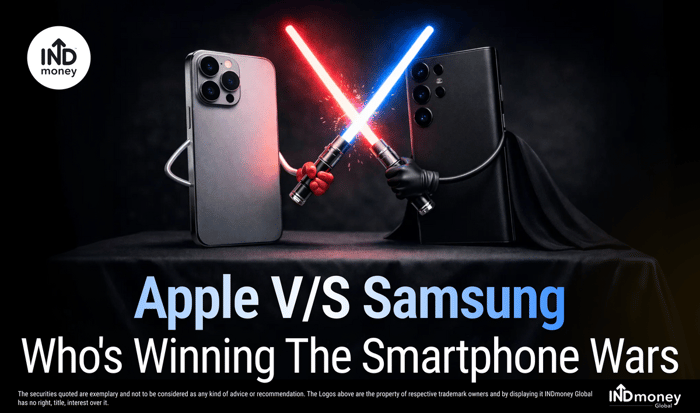
Some rivalries in business feel like sport. Coke versus Pepsi. Nike versus Adidas. And then there is Apple versus Samsung, a battle that has quietly shaped the device in almost every pocket on the planet. Every year I find myself watching their launches like season finales of a long running show. New cameras, brighter screens, smarter chips. Yet beneath the glitter of keynote stages lies a deeper question that investors and consumers both care about. Who is actually winning?
Let's break down with this blog the numbers, the profits, the strategies, and the surprising moments where competitors quietly become collaborators.
Because the smartphone war today is less about who shouts louder and more about who builds stronger ecosystems and steadier cash machines.
The Big Picture For Apple And Samsung: Scale vs Profit Power
If smartphone sales were a race track, Apple and Samsung are running almost neck and neck. They ship a similar number of devices globally, each hovering around the 240 to 250 million mark annually. But here is where the plot thickens. Selling phones is only half the story. Making money from them is the other half, and that is where the scoreboard begins to tilt.
Apple’s strategy resembles a luxury hotel chain. Fewer rooms than the budget motel across the street, but each room priced higher and bundled with premium services. Samsung, on the other hand, operates like a massive airline network. It covers every route, every budget, every segment. Both approaches work, but they produce very different financial outcomes.
Financial Snapshot: Apple vs Samsung
| Metric (FY 2025) | Apple | Samsung |
| Overall Revenue | $416 Billion | $230 Billion |
| Net Profit | $112 Billion | $31 Billion |
| Smartphones Sold | 247.8 Million | 241.2 Million |
| Approx Global Share | ~20% | ~19% |
Source: Apple & Samsung filings, Counterpoint Research, IDC
These numbers reveal a fascinating contrast. Unit sales are close. Market share is close. But revenue and profit are not even in the same weight class. Apple generates nearly quadruple of Samsung’s net profit despite shipping a comparable number of phones. It is the classic case of margin versus volume.
Why Apple Makes More Money Per Phone
When I look at Apple’s success, I do not just see hardware. I see a carefully built ecosystem that behaves like gravity. Once users enter, it is hard to leave. iCloud, App Store purchases, Apple Music, accessories, seamless syncing across devices. Each iPhone is not just a product, it is an entry ticket to a digital universe that keeps generating revenue long after the initial purchase.
Samsung plays a different but equally smart game. Its strength is diversification. Smartphones are only one chapter in its story. The company is also a semiconductor giant, a display leader, and a memory chip powerhouse. In other words, Samsung sometimes sells the ingredients that go inside the very phones competing with its own. It is like being both the restaurant owner and the farmer supplying vegetables to every restaurant in town.
The Twist: Rivals Who Need Each Other
Here is the irony that makes this rivalry almost poetic. Apple may start sourcing camera sensors from Samsung. For decades, Apple has used Sony image sensors exclusively for iPhone cameras, but that may be changing. Recent reports suggest Samsung is gearing up to supply advanced camera sensors for future Apple devices, possibly in the iPhone 18 lineup.
Think about that for a second. These two rivals may be on opposite sides of the market battlefield, yet there’s a moment where one relies on the other for critical hardware components. This isn’t a one-off rumor, multiple industry sources have reported that Apple is shifting its sensor strategy, marking a significant supply-chain shift.
This cooperation isn’t unexpected in tech, but it does show that the smartphone war isn’t about ‘total annihilation’. Competitors sometimes rely on each other when it makes strategic sense, especially in parts like cameras where the technology is tightly specialized
Strategy Showdown: Apple’s Premium Castle vs Samsung’s Open Kingdom
Apple’s castle is built on premium pricing and brand loyalty. People do not just buy an iPhone, they buy into a lifestyle and a promise of consistency.
Samsung’s kingdom is vast and open. From entry level Galaxy A models to cutting edge foldables, it ensures there is a Samsung phone for nearly every wallet and preference.
Both strategies have merit. Apple captures outsized profits. Samsung captures breadth and resilience. One rules the luxury lane, the other dominates the highway.
So, Who Is Winning Between Apple And Samsung?
If winning means profit dominance, Apple clearly holds the crown. If winning means global reach and diversification, Samsung is equally formidable. The smartphone war is not a simple scoreboard with one final winner. It is more like a marathon where both runners keep changing pace, terrain, and tactics.
What excites me most is not who leads in a given year, but how this rivalry keeps pushing innovation forward. Better cameras, longer battery life, smarter AI features.
Consumers benefit every time these two giants try to outdo each other. In a way, the real winner might just be the person holding the phone.
Disclaimer:
The content is meant for education and general information purposes only. Investments in the securities market are subject to market risks, read all the related documents carefully before investing. Past performance is not indicative of future returns. The securities quoted are exemplary and are not a recommendation. This in no way is to be construed as financial advice or a recommendation to invest in any specific stock or financial instrument. Readers are encouraged to verify the exact numbers and financial data from official sources such as company filings, earnings reports, and financial news platforms and to conduct their own research, and consult with a registered financial advisor before making any investment decisions. All disputes in relation to the content would not have access to an exchange investor redressal forum or arbitration mechanism. INDmoney Global (IFSC) Private Limited,Registered office address: Office No. 507, 5th Floor, Pragya II, Block 15-C1, Zone-1, Road No. 11, Processing Area, GIFT SEZ, GIFT City, Gandhinagar – 382355.