

- How Opendoor Went From $39 to $0.51 to Opendoor 2.0
- What 250 People in India Were Actually Doing For Opendoor
- How AI Changed the Offshoring Math for Opendoor
- What Opendoor’s Financials Say About the Turnaround
- What Opendoor’s India Exit Signals for India’s IT Sector
- Key Risks to the Opendoor Turnaround Thesis
- The Bottom Line
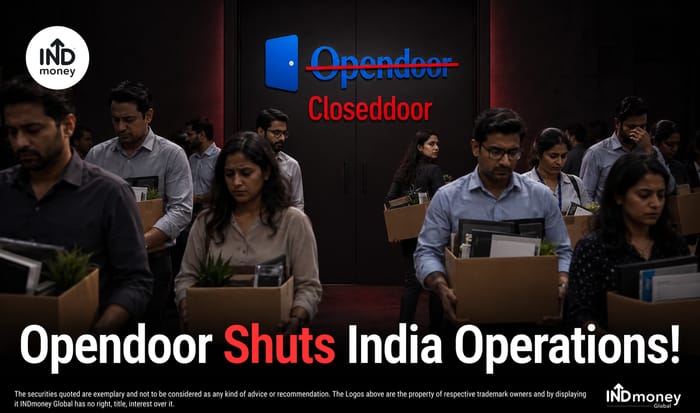
On June 10, 2026, Opendoor CEO Kaz Nejatian posted a note on X. It said the company was winding down its India operations and parting ways with all 250 employees across its India offices, effective immediately. The announcement came with no performance critique of the Indian team. Nejatian called them great people, recommended them to other employers, and was clear that the decision had nothing to do with their work. It was about a changed operational model. Opendoor had unified its fragmented internal systems, deployed AI tooling across its US teams, and no longer needed an offshore workforce to fill the manual workflow gaps those systems had previously created.
The OPEN stock hit around 8% higher on the day.
That detail of investors bidding up a company on the day it lets go of an entire country's workforce, is where this story gets interesting. Not because layoffs are good, but because the market reaction tells you something specific about how Opendoor's turnaround is being read, and about a structural shift in the economics of offshore operations that goes well beyond one company in real estate tech.
Let's break down what really happened with Opendoor's India exit, what the numbers behind it say, and what it signals for investors watching OPEN stock and for the broader question of where AI is disrupting the offshoring model that defined global tech operations for two decades.
How Opendoor Went From $39 to $0.51 to Opendoor 2.0
Opendoor invented iBuying. Founded in 2014, it built the first platform that let Americans sell their homes online, skip the listings and showings, and receive a direct cash offer within days. Opendoor would buy the home, renovate it, and relist it for a profit. The concept worked brilliantly on paper. The business itself had a harder time.
The company went public via SPAC in December 2020 at a valuation of approximately $4.7 billion. Within weeks, the stock was trading above $35 a share, and by early 2021, it briefly reached an all-time high close to $39. Then the 2022 rate hike shock arrived. The Federal Reserve's rapid interest rate increases dried up home buyer demand, and Opendoor was sitting on billions worth of homes purchased at peak prices. Zillow Offers had already exited iBuying in November 2021 after reporting approximately $304 million in inventory write-downs. RedfinNow followed in late 2022. Opendoor survived, but barely. By June 2025, the stock had fallen to an all-time low of $0.51 a share, according to data from TradingView.
What reversed it was a leadership overhaul. In September 2025, Kaz Nejatian, the former COO of Shopify, took over as CEO. Co-founders Keith Rabois and Eric Wu returned to the board, with Rabois becoming Chairman. Eric Wu and Khosla Ventures committed $40 million in new capital through a PIPE financing. The company relaunched under the Opendoor 2.0 banner: smaller, leaner, AI-first, and built around unit economics rather than growth at any cost.
Rabois was blunt about the scope of change needed. Speaking to CNBC in September 2025, he said: "There's 1,400 employees at Opendoor. I don't know what most of them do. We don't need more than 200 of them."
The India closure is Opendoor 2.0 in action.
What 250 People in India Were Actually Doing For Opendoor
To understand why Opendoor had 250 people in India in the first place, you have to understand how operationally complex the iBuying model actually is at scale. A single home goes through a buy, renovation, and resale cycle. Each stage involves contractors, inspections, local market pricing adjustments, customer communications, and workflow tracking across multiple internal tools, many of which were built at different times and did not communicate cleanly with each other.
That kind of work is high-volume, rules-based, but requires human judgment to navigate the gaps in software and that was exactly what made offshore teams in India the standard playbook for US tech companies over the past two decades. A competent operations professional in Bengaluru costs a fraction of what you'd pay for the equivalent in San Francisco. Scale that across 250 seats, and the annual savings are meaningful. Opendoor had built its India operations over several years to manage precisely these workflows. By Nejatian's own account, the team was good at what they did.
What changed is that the work itself changed.
How AI Changed the Offshoring Math for Opendoor
Offshoring to India worked on a specific unit of logic: a competent operations employee in Bengaluru costs roughly one-tenth the equivalent in San Francisco. Over twenty years, that arithmetic built an entire industry. India's IT and BPO sector grew to employ approximately 5.67 million people and contribute over 7% of the country's GDP, according to Reuters.
AI does not eliminate that cost gap. But it compresses the productivity multiplier enough to change the math in a specific subset of cases: work that is high-volume, manual, and rule-based, but does not require deep domain judgment. That is precisely the work Opendoor had offshored.
Think of it like this. Jio's entry into India's telecom market in 2016 did not destroy Airtel's business overnight. But it compressed the premium Airtel could charge for data so sharply that the company had to completely rebuild its value proposition. Airtel's moat was never really technology, it was the infrastructure advantage of having towers already in place. When that became commoditised, the moat narrowed fast. AI is doing something structurally similar to the offshore labor model: not eliminating the cost advantage India offers, but compressing it enough that for certain categories of work, the value equation tips back toward onshore teams with better tooling. Opendoor is saying: AI tools plus a small US team now equals a better outcome than a large India team plus fragmented software. Whether that holds at scale is still being tested. But the logic is coherent.
| Factor | Pre-AI Offshoring Model | Opendoor 2.0 Model |
| India team size | ~250 employees | 0 |
| US operational model | Minimal (India fills gaps) | Small AI-native teams |
| Cost arbitrage logic | ~10x salary differential | 2-3x, compressed by AI |
| Geographic advantage | Cost savings | Proximity to customers |
| System overhead | High (fragmented tools) | Low (unified platform) |
| Customer feedback loop | Days | Hours |
The key claim in Nejatian's announcement is the phrase "unified these systems." For years, the fragmented tools created the manual work that justified the offshore headcount. Once you remove the fragmentation, you remove the work itself.
What Opendoor’s Financials Say About the Turnaround
The financials heading into the India exit are genuinely interesting to see, even as the company still reports GAAP losses.
| Metric | Q3 2025 | Q4 2025 | Q1 2026 |
| Revenue | $915M | $736M | $720M |
| Gross Margin | 7.2% | 7.7% | 10.0% |
| Contribution Margin | 2.2% | 1.0% | 4.4% |
| Adjusted EBITDA | -$33M | -$43M | -$31M |
| Net Loss | -$90M | -$1,096M* | -$173M |
| Aged Inventory (>120 days) | ~51% | ~33% | 10% |
*Q4 2025 net loss was elevated mainly due to one-time items, including a $933 million loss on extinguishment of debt. Source: Opendoor Q1 2026 Earnings Release, SEC Form 8-K, May 7, 2026..
The key figure is contribution margin, which is Opendoor's measure of unit-level profitability per home sold. It bottomed at 1.0% in Q4 2025 and recovered to 4.4% in Q1 2026, its strongest reading since Q2 2024. Management guided Q2 2026 contribution margin to the 5-7% target range. Aged inventory of homes sitting unsold for more than 120 days, fell from 51% in Q3 2025 to 10% by end of Q1 2026. That is not a small improvement. At 51%, Opendoor had nearly half its balance sheet stuck in slow-moving homes. At 10%, it has a portfolio that is broadly moving at normal velocity.
As of April 1, 2026, Opendoor declared itself adjusted EBITDA profitable on a 12-month go-forward basis. That is not GAAP profitability. The Q1 net loss was $173 million. But the direction of every operational metric is right. Management has also guided roughly 25% sequential revenue growth for Q2 2026, and the company is due for inclusion in the Russell 3000 index effective June 26, 2026, which typically brings passive buying from index funds.
Of nine analysts covering OPEN, five rate it hold, two rate it buy, and two rate it sell, as per data cited by Stocktwits citing Koyfin as of June 2026. The stock was down approximately 21% year-to-date heading into the India announcement, well below its SPAC-era highs. The India exit provided a positive catalyst, but sustained re-rating requires sustained financial improvement.
What Opendoor’s India Exit Signals for India’s IT Sector
Opendoor's India exit is a small event in absolute headcount. But it lands alongside a larger set of signals that India's tech sector is watching closely.
TCS, India's largest IT employer with over 600,000 employees as of mid-2025, cut approximately 12,000 jobs (roughly 2% of its workforce) citing AI-driven efficiency and skill mismatches. Infosys eliminated approximately 26,000 positions in fiscal 2024. Wipro shed approximately 24,500 in the same period. Total job cuts at Indian IT services companies reached approximately 80,000 over an 18-month stretch, according to industry data cited by multiple outlets. Gaurav Vasu, founder of tech market intelligence firm UnearthInsight, estimated in a Reuters-reported analysis from August 2025 that 400,000 to 500,000 Indian IT professionals could face displacement over the next two to three years as AI absorbs their workflows. Approximately 70% of those at highest risk have between four and twelve years of experience.
Opendoor's case is distinct from the TCS story in an important way. TCS was an Indian company cutting its own headcount as AI raised productivity. Opendoor is a US company pulling work back entirely, ending the offshore relationship rather than just reducing it. Both directions point to the same underlying pressure on the same category of work.
India's tech sector is not going away. The country has a deep talent pool, competitive cost structures for complex technical work, and decades of institutional knowledge in software services. But the version of that sector that absorbed the largest volume of India's engineering graduates, large teams managing manual, high-volume, rule-based operational workflows, is structurally exposed to exactly the productivity gains that companies like Opendoor are now claiming. The $283 billion outsourcing sector, which Reuters noted in 2025 faces potential disruption of this scale, is watching this closely.
Key Risks to the Opendoor Turnaround Thesis
The Opendoor 2.0 story carries genuine risk, and the India exit does not remove it.
1. Housing market risk is not resolved. Opendoor's business runs on transaction volume. Revenue fell from $1.15 billion in Q1 2025 to $720 million in Q1 2026, a drop of around 37% year-over-year. Management guided Q2 2026 for roughly 25% sequential revenue growth, which requires a real acceleration in home purchases. If US housing activity disappoints due to persistently high interest rates or a slowdown in consumer confidence, improved contribution margins look impressive on a smaller number of transactions, and total losses may not narrow in a meaningful way.
2. AI productivity gains may not transfer cleanly to complex operational judgment. Opendoor's work is not purely mechanical. Pricing a home in a specific neighborhood, managing a renovation scope, responding to unexpected inspection findings: all of these require contextual judgment that current AI tools handle unevenly. If replacing 250 experienced people with AI-assisted US teams leads to quality degradation or higher error rates per transaction, the efficiency thesis takes real damage quickly.
3. Profitability guidance may slip. Nejatian has set a specific milestone: adjusted net income positive on a 12-month basis by the end of 2026. That goal depends on Q2 and Q3 contribution margins performing at 5-7% while simultaneously scaling acquisition volumes (homes purchased were still down approximately 31% year-over-year in Q1 2026). Both improvements need to happen in parallel, not sequentially.
4. Finally, 250 India employees do not, by themselves, move the profitability needle dramatically. The India exit matters most as a signal that the operational transformation is real. If the deeper Opendoor 2.0 changes of fewer tools, fewer manual workflows, AI-native operations throughout, do not deliver, the India news will look like headline cost-cutting rather than genuine structural change.
The Bottom Line
The 250 people leaving did not make Opendoor unprofitable. A housing market that turned against the company, combined with a business model that had structural weaknesses at interest rate inflection points, did that. But their exit marks the end of a specific way of doing business, and the beginning of a harder test: can a smaller, AI-equipped onshore team actually do more work, at the same or better quality, than a larger team spread across continents?
The market gave Opendoor credit for trying. The answer will show up in the numbers over the next two to three quarters.