

- Act I: The Twitter Bet, and Who Came In With Musk
- The Value Collapse: How X Lost Value After Elon Musk’s Twitter Takeover
- Act II: The First Escape Hatch; xAI Absorbs X
- Act III: The Grand Consolidation; SpaceX Absorbs xAI
- The Exit Window: SpaceX Goes Public
- The $62.8 Billion Insider Liquidity Detail Retail SPCX Investors Should Know
- The Rolling Exit Architecture: How Musk’s X to xAI to SpaceX Investor Exit Chain Worked
- Is SpaceX Overvalued at a $1.75 Trillion IPO Valuation?
- Could Tesla and SpaceX Merge After the IPO? The Playbook Repeats
- The Bottom Line
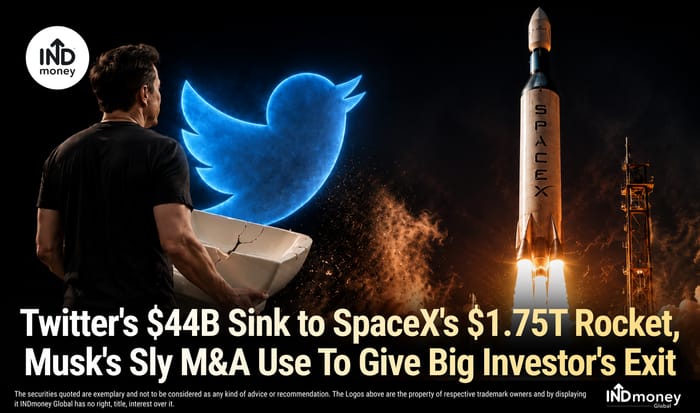
When Elon Musk walked into Twitter's San Francisco headquarters on October 27, 2022, carrying a bathroom sink as a prop, he wanted the image to go viral. "Let that sink in," the caption read. It did. Three and a half years later, the real punchline has arrived. The same group of co-investors who put up $7.1 billion alongside Musk in that $44 billion takeover are about to receive their exit via the largest IPO in financial history. Tomorrow, SpaceX begins trading on the Nasdaq at $135 a share. Before you buy a single share of SPCX, trace the money from that Twitter deal to tonight's IPO pricing. What you find is worth understanding.
Let's break down how Musk ran the same pool of investors through a chain of three mergers over four years, converting a troubled social media asset into SpaceX stock, and why this history matters every bit as much as the S-1 financials when deciding what SPCX is actually worth at $1.75 trillion.
Act I: The Twitter Bet, and Who Came In With Musk
Musk's $44 billion acquisition of Twitter was not a solo move. The deal required $33.5 billion in personal equity from Musk, $13 billion in bank debt from Morgan Stanley, Barclays, Bank of America, and others, and a further $7.1 billion from co-investors who came in on the equity side.
Those co-investors were not passive bystanders. They were among the most well-connected institutional names in US finance, according to SEC filings from May 2022.
Key Co-Investors in the Twitter Buyout (October 2022)
| Investor | Amount Committed | Background |
| Larry Ellison (Oracle co-founder) | $1 billion | Tech billionaire and Tesla board member |
| Sequoia Capital | $800 million | Top-tier Silicon Valley VC |
| VyCapital | $700 million | Technology-focused investment firm |
| Binance | $500 million | Crypto exchange |
| Andreessen Horowitz (a16z) | $400 million | Prominent Silicon Valley VC |
| Prince Al-Waleed bin Talal | ~$1.9 billion | Saudi royal; rolled over existing Twitter shares |
| Jack Dorsey | ~$1 billion | Twitter co-founder; rolled over existing stake |
| Fidelity Investments | $300 million | Asset management giant |
| Qatar Holding, Brookfield, 8VC, others | ~$500 million+ | Sovereign wealth, PE, and venture |
Sources: SEC 13D filing (May 2022), TechCrunch, Reuters
Every one of these investors went in private. There was no public market to sell into. Their only exit was Musk making good on his vision for the platform, or some future liquidity event.
The Value Collapse: How X Lost Value After Elon Musk’s Twitter Takeover
It went wrong fast. Advertisers began leaving within months of the deal closing. Ad revenue, which had been running at roughly $1 billion per quarter, fell sharply. By 2023, annual revenue from ads was estimated at $2.5 billion, down from over $4 billion before the acquisition, according to Bloomberg. Musk fired three-quarters of staff and made a series of content moderation decisions that drove major brands off the platform.
Fidelity's Blue Chip Growth Fund, one of the few investors in X required to publicly disclose portfolio valuations, gave the market its clearest view into what was happening to co-investor stakes.
Fidelity's Rolling Markdowns on Its X Stake
| Period | Estimated Markdown vs. Oct 2022 Cost | Implied X Valuation |
| November 2022 | -56% | ~$19 billion |
| Early 2023 | -61% | ~$17 billion |
| Late 2023 | -71% | ~$12-13 billion |
| Mid-2024 | -72% | ~$12 billion |
Sources: Bloomberg, Fortune, Fidelity Blue Chip Growth Fund monthly filings
Sequoia, a16z, and the others did not publish comparable figures, but the trajectory was not hard to read. X was a private company. Investors could not sell. They were holding a heavily impaired asset with no visible exit.
Then came the first rescue.
Act II: The First Escape Hatch; xAI Absorbs X
On March 28, 2025, Musk posted on X that his AI startup, xAI, had acquired X in an all-stock deal. No cash changed hands.
The transaction valued xAI at $80 billion and X at $33 billion in equity terms, or $45 billion including X's $12 billion in outstanding debt, according to Bloomberg and CNBC. X investors received xAI shares in exchange for their holdings.
The X-to-xAI Conversion (March 2025)
| Metric | Value |
| X equity value in deal | $33 billion |
| X enterprise value (equity + $12B debt) | $45 billion |
| xAI valuation in deal | $80 billion |
| Combined entity valuation | ~$113 billion |
| X implied valuation at Fidelity's low mark | ~$12-13 billion |
| Effective recovery vs. markdown low | ~2.5x |
Sources: Bloomberg, CNBC, FinTech Weekly, Malay Mail
Gil Luria, analyst at D.A. Davidson, noted at the time that the $45 billion enterprise value "is $1 billion higher than the take-private transaction for Twitter in 2022." That is not a coincidence. At enterprise value, X was priced to basically return investors to their entry point, even as the equity value remained below the original $44 billion. The co-investors, whose X stakes were sitting at deep paper losses, suddenly held shares in a hot AI startup valued at $80 billion. They moved from a struggling social media platform into an AI company at a moment when AI valuations were at their most optimistic.
TechCrunch described the deal as Musk finding "a way to make his $44 billion Twitter acquisition look less like an impulsive takeover and more like a strategic play for AGI dominance." Whether or not the $80 billion valuation for xAI was justified at the time, that is a separate debate. The investors who had been stranded in X for two and a half years were now sitting in something with a clearer path to liquidity.
Act III: The Grand Consolidation; SpaceX Absorbs xAI
The second merger happened faster than most observers expected. On February 2, 2026, SpaceX officially acquired xAI in an all-stock deal. Bloomberg reported it first; SpaceX confirmed it the same day on its website, per CNBC.
The xAI-to-SpaceX Conversion (February 2026)
| Metric | Value |
| SpaceX valuation in deal | $1 trillion |
| xAI valuation in deal | $250 billion |
| Combined entity value | $1.25 trillion |
| xAI value at time of X merger (March 2025) | $80 billion |
| xAI value growth in under a year | ~3x |
| Exchange ratio | 0.1433 SpaceX shares per xAI share |
| xAI share implied price | $75.46 |
| SpaceX share implied price | $526.59 |
Sources: CNBC, Bloomberg, Axon Capital Management
CNBC called it the largest private merger in history. Not in tech specifically. In any industry, ever.
For the Twitter co-investors, the mechanics had now run through two full cycles. Their X stakes became xAI shares in March 2025. Their xAI shares became SpaceX shares in February 2026. xAI itself was valued at $250 billion in the SpaceX deal, compared to $80 billion at the time of the X merger. The same investors who had been staring at 71% markdowns in 2024 were now holding SpaceX stock, the world's most valuable private company, at a three-times higher valuation than when they first got converted into xAI.
The escalator had one more floor to go.
The Exit Window: SpaceX Goes Public
Starting tomorrow, June 12, those SpaceX shares become publicly tradeable. The IPO prices tonight are at $135 a share, implying a valuation of approximately $1.75 trillion, according to the S-1 filing submitted to the SEC on May 20, 2026.
SpaceX IPO Summary
| Metric | Value |
| IPO price per share | $135 |
| Implied market capitalisation | ~$1.75 trillion |
| Total amount raised | ~$75 billion |
| Previous largest IPO | Saudi Aramco (2019): ~$25.6 billion |
| SpaceX vs. Aramco record | ~3x larger |
| Shares issued | 555.6 million |
| Retail allocation | ~30% (~$22.5 billion) |
| Ticker / Exchange | SPCX / Nasdaq |
Sources: S-1 filing (SpaceX, May 20, 2026 + amended June 3, 2026), Bloomberg, Investing.com
The entity listing is no longer just a rocket company. SpaceX's S-1 organises the business into three segments: Connectivity (Starlink), Space (launches, Starship, government contracts), and AI (xAI, Grok, X). Starlink is the profit engine. The AI segment is the cash burner.
SpaceX Segment Financials (Full Year 2025)
| Segment | 2025 Revenue | Operating Profit / (Loss) | Key Metric |
| Connectivity (Starlink) | $11.4 billion | +$4.4 billion | 10.3M subscribers by Q1 2026 |
| Space (launches + Starship) | $4.1 billion | ~$0.7 billion | $3B+ in Starship R&D spend |
| AI (xAI, Grok, X) | $3.2 billion | ($6.35 billion) | Colossus supercomputer capex |
| Consolidated | $18.7 billion | ($2.6 billion) | $6.58B adjusted EBITDA |
Sources: SpaceX S-1 (SEC EDGAR), Via Satellite, Morningstar, HL Markets
The headline numbers hold up. Revenue grew 33% year-over-year in 2025. Starlink operates at a 63% adjusted EBITDA margin. But the consolidated company still posted a $4.94 billion net loss in 2025, and burned through an extraordinary $7.72 billion in AI-segment capital expenditure in Q1 2026 alone, per the S-1. The accumulated deficit since founding stands at $41.3 billion.
At 49% ownership of SpaceX post-IPO, as per Morningstar's analysis of the S-1, Musk holds a stake worth approximately $857 billion from SpaceX alone at the $1.75 trillion valuation. Combined with his Tesla stake (~13% of ~$1.6 trillion), Elon Musk net worth estimates now routinely exceed $1.1 trillion, making him by most counts the world's first trillionaire. That is also why the IPO is designed to keep most institutional and insider shares under a one-year lockup. His personal exit is not today.
The $62.8 Billion Insider Liquidity Detail Retail SPCX Investors Should Know
Here is the part of the IPO structure that most coverage skips.
According to Fortune's reporting on the SpaceX prospectus, roughly 78% of the maximum projected proceeds; assuming underwriters exercise their full over-allotment options to push the total raise to $80.5 billion, which equates to approximately $62.8 billion, is already committed to insiders, vendors, and previous investors, including Musk's X Corp., xAI investors, and Valor Equity Partners.
In addition, the S-1 reserves 5% of shares ($3.75 billion worth) for friends, family, and certain employees of SpaceX executives. Unlike Musk and senior management, who face standard lockup restrictions of around a year, these recipients can sell immediately from day one, per Fortune.
So when SpaceX says it is raising $75 billion from the public, the more precise description is: it is directing $75 billion through a public offering, most of which has already been earmarked for people who were involved long before the Nasdaq listing was announced. The public markets are providing the liquidity mechanism, not the destination for the money.
This is not illegal. It is common in large IPOs. But it is worth naming plainly before investing.
The Rolling Exit Architecture: How Musk’s X to xAI to SpaceX Investor Exit Chain Worked
Look at the full sequence in one view.
The Musk Asset Escalator (2022-2026)
| Stage | Entity | Key Valuation | Entry Year | Exit Mechanism |
| Lock-in | Twitter / X | $44 billion | 2022 | None (private) |
| Upgrade 1 | xAI (absorbs X) | xAI at $80B, X at $33B | 2025 | Stock-for-stock swap, no cash |
| Upgrade 2 | SpaceX (absorbs xAI) | SpaceX at $1T, xAI at $250B | 2026 | Stock-for-stock swap, no cash |
| Exit | SpaceX IPO | $1.75 trillion | 2026 | Public market liquidity |
What Musk built here is not just a business empire. It is a structured, sequenced exit mechanism for a specific group of investors who were otherwise stuck.
The pattern is consistent across each step: two private entities under common control merge on terms set by the same founder. Each merger converts the previous, impaired asset into a newer, higher-valued one. No investor in the chain ever had to sell into a falling market or accept their losses. They waited, converted, and waited again. The final conversion, into SpaceX stock at a $1.75 trillion IPO, is where the public market provides the cash.
Call this the Rolling Exit Architecture. The original investors did not exit at each merger. They simply rode the escalator one floor higher. The public market is the only floor where the doors open.
This framework applies cleanly here because all three entities were controlled by the same founder throughout. Musk set the terms of both mergers. No external bidder set the price. No public company shareholders voted. No arms-length negotiation determined whether $33 billion or $80 billion was the right price for X at the time of the xAI deal.
That does not make it fraudulent. But it does make it structurally different from a standard M&A transaction, and the difference is worth understanding before you treat the IPO as a normal new-listing event.
Is SpaceX Overvalued at a $1.75 Trillion IPO Valuation?
At $135 a share, SpaceX trades at approximately 94 times its 2025 annual revenue and around 266 times its 2025 adjusted EBITDA, according to BitMEX's analysis of the S-1. Neither figure is a conventional valuation metric for an industrial or technology company.
Motley Fool's analysis from March 2026 noted that even assuming "some revenue from xAI, the business likely did not do much more than $20 billion in revenue last year. That would give the stock an extreme valuation and likely mean poor forward returns over the next decade, even if the business experiences rapid growth."
Morningstar is more direct. It estimates SPCX is overvalued by roughly half at the IPO price and recommends waiting for a better entry after the initial hype settles.
The bull case for the valuation is real: Starlink's subscriber base roughly doubled from 2024 to 2025 (from 4.4 million to 8.9 million), the AI TAM from SpaceX's own calculations is $26.5 trillion, and Starship, if it delivers on its reusability promises, cuts launch costs by an order of magnitude. These are not fictional outcomes. They are genuinely plausible.
But the company needs most of them to happen simultaneously to justify $1.75 trillion today. That is the nature of a long-duration growth bet priced at 94x revenue.
Could Tesla and SpaceX Merge After the IPO? The Playbook Repeats
CNBC reported in late May 2026 that Musk is actively considering a Tesla-SpaceX merger after the IPO. Wedbush Securities analyst Dan Ives, who has been tracking the possibility for months, said on a podcast that he sees roughly an 80% probability of a Tesla-SpaceX combination by 2027. Tesla is mentioned 87 times in SpaceX's S-1 filing, per Morningstar, which is unusually high for a company not directly involved in the transaction.
The financial ties between the two companies are already substantial. Tesla invested $2 billion in xAI in January 2026. SpaceX spent $697 million purchasing Tesla Megapacks for xAI data centers and $131 million on Cybertrucks, per ZeroHedge's compilation of cross-company transactions.
Tesla vs. SpaceX: A Hypothetical Merger Context
| Metric | Tesla (June 2026) | SpaceX (IPO, June 2026) |
| Market capitalisation | ~$1.4 trillion | ~$1.75 trillion |
| Revenue (FY2025) | $94.8 billion | $18.7 billion |
| Profitability | $3.7 billion | Net loss ($4.94B in FY2025) |
| Musk ownership | ~13% | ~49% post-IPO |
| Listing status | Public (Nasdaq: TSLA) | Public from June 12 (SPCX) |
Sources: Morningstar, CNBC, ZeroHedge, SpaceX S-1, Wedbush Securities
If SpaceX's post-IPO stock performance disappoints, the Rolling Exit Architecture could run one more cycle. A Tesla-SpaceX merger would give current SpaceX shareholders, including the Twitter co-investors who converted through two mergers, exposure to Tesla's more stable cash flows. And Tesla shareholders would get a piece of Starlink and the AI infrastructure narrative.
Again, the terms of any such merger would be set in rooms where retail SpaceX shareholders have no seat. By the time an announcement is made, the structure will already exist.
The Bottom Line
SpaceX is a real company. Starlink is a real cash-generating business. The rockets are real, the launch contracts are real, and the ambition is real.
But this IPO did not materialize from nowhere. It is the final step in a four-year, three-company sequence that converted a 2022 Twitter co-investment into SpaceX shares, stage by stage, merger by merger. The $62.8 billion that Fortune reports is already committed to insiders is not a scandal. It is just the structure being visible, if you know where to look.
The Twitter co-investors, Sequoia, a16z, Larry Ellison, and the others, are not selling to public markets because they think SPCX will triple from $135. They are selling because the escalator has finally reached the top floor and the doors are open.
The bathroom sink is long gone. The rocket is real. Whether $135 is the right price to board is the only question that matters now.