

- Why FAANG Became the Defining Tech Stock Acronym
- Why MAANG, MAMAA and Mag-7 Failed to Replace FAANG
- What Are MANGOS Stocks? Meaning, Companies and Valuations
- Why MANGOS Is an AI Infra Bet, Not Just A Tech Acronym
- Meta’s Llama Strategy Threatens OpenAI and Anthropic
- OpenAI, Anthropic and Financial Reality Behind MANGOS
- What Does This Mean For Investors?
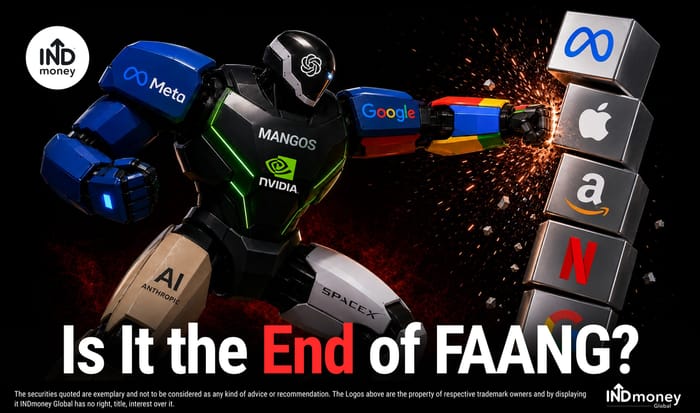
A developer named Krishna B. posted a graphic on X on June 8 with six company logos and the label MANGOS. Within 24 hours, it had over 20,000 likes and soon it was doing rounds in mainstream media. Wall Street now has a new acronym: Meta, Anthropic, Nvidia, Google, OpenAI, and SpaceX, the six companies, the argument goes, that will define the next decade the way FAANG defined the last one.
The thesis has real merit. It also has a contradiction sitting right at its center that almost nobody is examining. The most strategically powerful company in the basket is, simultaneously, one of the biggest structural threats to two of its own members.
Let's break down the full story of where FAANG came from, why its replacements kept failing, what is genuinely new about MANGOS, and what the financial reality looks like beneath the headlines.
Why FAANG Became the Defining Tech Stock Acronym
Market technician Bob Lang coined the term FAANG and CNBC’s Jim Cramer brought it to a mass audience in 2013, describing the group as companies "totally dominant in their markets." The original four were Facebook, Amazon, Netflix, and Google.
Apple joined in 2017, turning FANG into FAANG. Facebook became Meta. Google became Alphabet. The acronym never changed, a signal of how deeply it embedded itself in the market's vocabulary.
What held the five together was not just size. It was a shared economic model: the attention economy. Every FAANG company made money by converting human time into revenue, whether that was advertising against your social feed, subscription fees for what you streamed at night, or hardware tied to a phone you checked over a hundred times a day.
At their 2021 combined peak, the FAANG five had a market cap of approximately $7.8 trillion, per Benzinga. As of June 2026, they still account for roughly 35% of the Nasdaq-100 and approximately 19% of the S&P 500, according to data cited by TechTimes. FAANG is not dead. It just has competition.
Why MAANG, MAMAA and Mag-7 Failed to Replace FAANG
This is not the first time that the FAANG acronym has been challenged. Between 2021 and 2025, Wall Street produced at least three serious replacements. None of them stuck.
| Acronym | What Changed | Why It Failed as a Narrative |
| MAANG | Updated names after rebrands | Same era, one substitution, no new story |
| MAMAA | Swapped Netflix for Microsoft | Changed the letters, kept the same thesis |
| Magnificent Seven | Added Nvidia and Tesla, expanded to seven | Analytically useful; never became cultural shorthand |
The reason is simple. A successful tech acronym does not just group large companies. It captures a specific economic era in a single label. FAANG said: consumer internet is eating the world. MAANG and MAMAA said: mostly the same companies, slightly updated. Neither offered a new chapter.
The Magnificent Seven came the closest, it did include Nvidia and Tesla, but it justed became a new category instead of replacing FAANG because the group was too diverse to tell a clean story.
MANGOS is different. Here is why, and here is where it gets complicated.
What Are MANGOS Stocks? Meaning, Companies and Valuations
MANGOS did not originate from an X post, just gained more attention. The acronym has older roots. Bank of America analyst Vivek Arya originally coined it for a semiconductor basket. Analyst Stirling Larkin repurposed it in 2025 for an AI-era grouping.
Retail investors on X crystallized the current six-company version in June 2026, right as three major private tech companies were converging toward public markets at the same time. SpaceX filed an S-1 with the SEC in May 2026 and will be listed on June 12, targeting what may be the largest IPO in history.
OpenAI and Anthropic have also filed confidential S-1 papers with SEC, targeting listing this year. That timing is what turbocharged the acronym.
| Company | Role | Status | Valuation |
| Meta | AI applications + social distribution | Public: META | ~$1.8 trillion |
| Anthropic | Frontier AI model developer | Pre-IPO | ~$965 billion |
| Nvidia | AI chip supplier (GPUs) | Public: NVDA | ~$5 trillion |
| Google / Alphabet | AI research + search + cloud | Public: GOOGL | ~$4.4 trillion |
| OpenAI | Frontier AI model developer | Pre- IPO | ~$852 billion |
| SpaceX | Space + Starlink connectivity + xAI | Pre-Listing | ~$1.75 trillion |
Sources: Bloomberg, Yahoo Finance, Investing.com, SpaceX S-1 (June 2026)
Combined, MANGOS represents approximately $14 trillion in market value and private valuations.
Why MANGOS Is an AI Infra Bet, Not Just A Tech Acronym
FAANG was an attention economy. MANGOS is an infrastructure economy.
Every FAANG company built its core business around capturing consumer time. Every MANGOS company, with Meta as a partial exception, is building infrastructure that other businesses pay to run on. Nvidia makes the chips that train and serve virtually every major AI model. Google and Meta are building AI systems that enterprises pay to embed in their own products.
OpenAI and Anthropic are selling API access to developers who build consumer and enterprise products on top. SpaceX's Starlink provides connectivity to industries and geographies that standard broadband cannot reach.
This matters because infrastructure businesses behave differently from consumer attention businesses. Their customers are other businesses, not individual people. That creates stickier demand, longer contract cycles, and in theory, more durable pricing power, provided the infrastructure itself doesn't get commoditized.
The Real Beneficiaries of AI Boom
Think of it like this: During the real estate boom of the 2000s, the most consistent winners weren't always the builders or the homebuyers. The companies making the raw material that every builder needed, ACC, Ambuja, Ultratech, often delivered steady returns because demand flowed to them regardless of which project ultimately succeeded. No one builds without cement.
Nvidia sits in that position in the AI boom. Every MANGOS company depends on Nvidia chips to train models and run inference. Nvidia's data center revenue hit $75.2 billion in Q1 FY2027, up 92% year over year, per the company's own earnings report. That number does not depend on which AI model wins the market.
The infrastructure thesis also explains why companies like OpenAI and Anthropic carry valuations approaching $1 trillion despite not being conventionally profitable. Investors are paying for what they believe will be the foundational layer of the AI economy, not for today's earnings.
Meta’s Llama Strategy Threatens OpenAI and Anthropic
Here is the analysis that most MANGOS coverage is skipping entirely. Meta is simultaneously the most strategically secure company in MANGOS and the most dangerous structural threat to two of its own basket members.
Meta's Llama model series is open-source, meaning developers can download it, run it, and build products on top of it for free. Llama 4, released in April 2025, outperformed OpenAI's GPT-4o on several key benchmarks, including LM Arena rankings, per independent analyses cited by Value Add VC and others.
When world-class AI models are free to download, companies lose the ability to charge high prices for access. This reality has triggered a massive industry price war:
- Prices collapsed by 90%: In March 2023, OpenAI charged $30 per million tokens to use GPT-4. By April 2026, top-tier models cost just $1 to $3 for the same amount.
- Older AI became virtually free: Stanford data shows that running an AI as smart as GPT-3.5 became 280 times cheaper in just two years.
- The competitors driving the cuts: Free models like Meta’s Llama and ultra-cheap alternatives like China's DeepSeek (which matched GPT-4o quality at 1/100th of the cost) forced companies to slash their prices over and over again to stay relevant.
Think of what UPI did to payment processing fees. Before UPI, payment gateways charged merchants 1.5-2% per transaction and built entire businesses around that margin. When the NPCI made UPI free at the infrastructure level, that pricing model collapsed almost overnight. Companies that owned distribution (Google Pay, PhonePe) survived and grew. Companies that just sold payment processing as a service got squeezed.
Meta's open-source strategy is doing something structurally similar to AI inference pricing. OpenAI and Anthropic are selling access to a product that Meta is giving away to commoditize them. Meta isn’t being generous here. They make money from ads, not AI. By giving away world-class models for free, they achieve two things:
- Boosts Ad Revenue: Free AI keeps Meta's 3 billion users scrolling longer on Instagram and Facebook, which brings in more ad money.
- Crushes Competitors: It starves rivals like OpenAI and Anthropic of profits by forcing them to constantly cut their prices to compete with "free."
MANGOS groups these three companies into a single basket as if their interests align. They do not.
OpenAI, Anthropic and Financial Reality Behind MANGOS
The numbers behind the two AI model companies in MANGOS deserve a closer look.
OpenAI: Bleeding Cash
- The 2025 Deficit: OpenAI earned $13.1 billion but spent $22 billion, a $9 billion loss. Essentially, it spent $1.69 for every $1 it made.
- Deepening Losses: 2026 losses are projected to hit $14 billion, and annual operating losses could peak at $74 billion by 2028. The company expects $44 billion in total losses before finally turning a profit around 2029.
Anthropic: Fast Growth, Smart Spending
- Massive Valuation: Anthropic is on a much more disciplined financial path. By June 2026, its revenue run-rate passed $47 billion, pushing its valuation near $965 billion.
- Low Burn Rate: Anthropic expects to break even by 2028. By 2027, its cash burn is projected to drop to just 9% of revenue, compared to OpenAI's heavy 57% burn rate.
So, both companies are burning cash. The distinction matters for investors evaluating IPO valuations.
| Company | Revenue | 2025 Net Loss | Break-even (Est) | Current Valuation |
| OpenAI | ~$13.1 billion | ~$9 billion | ~2030 | ~$852 billion |
| Anthropic | ~$47B+ (ARR) | Not disclosed | ~2028 | ~$965 billion |
Sources: Fortune/WSJ (OpenAI), CTech, secondary market estimates (Anthropic), Investing.com
Beyond the model companies, the hyperscalers in MANGOS face their own financial pressure. Meta, Google, Amazon, and Microsoft are collectively projected to spend $600-700 billion on AI infrastructure in 2026 alone, up roughly 36% year over year, per data compiled by Epoch AI and reported by CNBC.
Goldman Sachs projects a combined $5.3 trillion in capital spending for the four largest hyperscalers between 2025 and 2030. The question investors are asking, but not getting a clean answer to, is straightforward: when does the revenue catch up to the spending? So, the infrastructure is real. The monetization timeline is uncertain.
What Does This Mean For Investors?
The MANGOS framework is useful for understanding where the AI economy is being built. It is not a ready-made portfolio. Here is a tiered way to think about it.
Tier 1: The Cash-Flow Giants (Meta, Nvidia, Alphabet)
- The Play: Public, highly profitable, and winning the AI race right now.
- The Data: Meta’s revenue is up 33%, Nvidia’s AI sales are growing ~90% annually, and Alphabet’s cloud backlog sits at $460B+.
Tier 2: The Hyped 2026 IPOs (OpenAI, SpaceX, Anthropic)
- The Play: Going public this year. Massive upside, but priced at dangerous valuations.
- The Data: OpenAI is valued at $852B despite projecting $44B in future losses. SpaceX’s Starlink has 9M users but faces looming competition from Amazon.
Tier 3: The Overlooked Essentials (Microsoft, Amazon, TSMC)
- The Play: Left out of the "MANGOS" acronym, but they actually power the entire ecosystem at a much safer price.
- The Data: Microsoft's AI revenue grew 123% to a $37B run-rate, AWS dominates AI cloud hosting, and TSMC holds a literal monopoly on manufacturing Nvidia's chips.
The MANGOS debate tells you where the industry is heading. But an acronym built around a viral moment is not an investment thesis. The companies are real. The technology is real. But, the financial pressures, the internal contradictions, and the valuation gaps are real too.