

- Anthropic IPO: How Big Could the AI Listing Be?
- What Does Anthropic Do and How Does It Make Money?
- How Much Does Anthropic Spend to Generate $1 of Revenue?
- Anthropic’s Governance Model: Why Its AI Safety Structure Matters
- Anthropic Valuation: Is a $1 Trillion Price Tag Justified?
- What Indian Investors Should Know
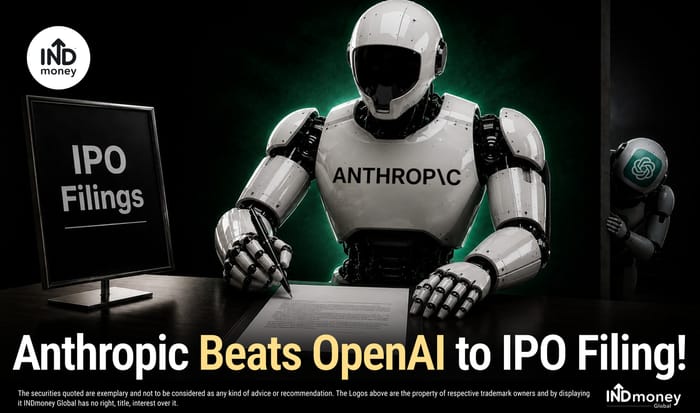
Anthropic just beat OpenAI to file a confidential draft S-1 with the U.S. Securities and Exchange Commission. No ticker announced. No pricing set. No roadshow date confirmed. Just seven words from the company, "This gives us the option to go public." This, however has rolled the ball for what may be the most consequential IPO of this decade.
A public market debut for an AI company that didn't exist five years ago, now valued at the doorstep of $1 trillion.
Let's break down what Anthropic does, how it earns, what makers its IPO fundamentally different from every other major tech listing in recent memory, and everything else an investor needs to know before
Anthropic IPO: How Big Could the AI Listing Be?
Since Anthropic filed confidential IPO papers, the scale, size and other details are not yet available for scrutiny. This kind of filing keeps competitors in the dark, limits market volatility before pricing, and lets the company refine its disclosures without public scrutiny.
However, it is clear that Anthropic is stepping into the public markets with a scale that defies traditional software benchmarks. Just days before its SEC filing, the company closed a historic $65 billion Series H funding round that pushed its post-money valuation to $965 billion, surpassing rival OpenAI's $852 billion valuation.
To put this in perspective, it took Nvidia 23 years to hit $1 trillion valuation, while it took Anthropic about 5 years to almost reach that valuation!
| Funding Round | Date | Amount Raised | Reported Valuation | Lead / Key Investors |
| Series A | May 2021 | $124 million | $550 million | Dustin Moskovitz, Jaan Tallinn, others |
| Series B | April 2022 | $580 million | $4 billion | Sam Bankman-Fried, Caroline Ellison, Jaan Tallinn, others |
| Series C | May 2023 | $450 million | $4 billion+ | Spark Capital, Google, Salesforce Ventures, Zoom Ventures, others |
| Series D | Early 2024 | About $750 million | $18.4 billion | Menlo Ventures-led round |
| Series E | March 2025 | $3.5 billion | $61.5 billion | Lightspeed Venture Partners |
| Series F | September 2025 | $13 billion | $183 billion | ICONIQ, Fidelity, Lightspeed |
| Series G | February 2026 | $30 billion | $380 billion | GIC, Coatue, D. E. Shaw, Dragoneer, Founders Fund, ICONIQ, MGX |
| Series H | May 2026 | $65 billion | $965 billion | Altimeter, Dragoneer, Greenoaks, Sequoia |
Source: Anthropic company announcements, Reuters
Investment bankers and analysts now widely expect Anthropic to debut well above the $1 trillion mark when it officially lists, likely targeting an October 2026 window. A market value that high will straight away put Anthropic among the world’s top 15 companies by m-cap.
What Does Anthropic Do and How Does It Make Money?
Founded in 2021 by former OpenAI researchers Dario and Daniela Amodei, Anthropic is focused on building safer, more reliable AI systems for businesses. Unlike some rivals that are more consumer-focused, Anthropic has built its strength in enterprise and developer use cases.
| Area | What Anthropic Does | Why It Matters |
| Claude for Work & Enterprise API | Offers AI models for companies through direct enterprise products and platforms like Amazon Bedrock | Helps businesses use Claude inside their workflows |
| Claude Code | An AI coding assistant made generally available in May 2025 | It has become a major tool for developers and is reportedly writing about 4% of global GitHub commits as of mid-2026 |
| Infrastructure Scale | Ordered $21 billion worth of custom chips through Broadcom, including nearly 1 million TPUs and over 1 GW of compute power for inference | Shows how aggressively Anthropic is scaling to meet enterprise AI demand |
In simple terms, Anthropic is building the AI infrastructure layer for companies, developers, and large-scale software workflows.
Anthropic Revenue Model: Enterprise AI, APIs and Claude Code
Anthropic earns mainly from businesses, developers, and large enterprises rather than casual consumer users. Its revenue comes from companies paying to use Claude inside real workflows such as coding, customer support, legal review, research, finance, data analysis, and internal knowledge management.
The business has three major revenue engines:
- Enterprise subscriptions: Companies pay for Claude for Work and enterprise access so employees can use Claude securely inside the organisation.
- API usage: Businesses pay Anthropic based on how much they use Claude inside their own products, apps, and workflows.
- Claude Code: Developers and engineering teams pay for Anthropic’s coding assistant, which has become one of its fastest-growing products.
Cloud distribution is another important channel. Claude is available through platforms like Amazon Bedrock and Google Cloud Vertex AI, which helps Anthropic reach large companies through cloud ecosystems they already use.
Here's where things get genuinely remarkable. Salesforce took about 20 years to reach $30 billion in annual revenue. Anthropic did it in under three years from a standing start.
| Time Period | Annualized Revenue Run Rate |
| January 2024 | ~$87 million |
| December 2024 | ~$1 billion |
| End of 2025 | ~$9–10 billion |
| February 2026 | ~$14 billion |
| April 2026 | ~$30 billion |
| May 2026 | ~$47 billion |
Sources: Anthropic investor announcements, CNBC, VentureBeat, Sacra
The key driver behind this is Claude Code which surpassed $1 billion in annualized revenue within six months of its launch, driven by enterprise developers. Over 1,000 customers now spend over $1 million annually on Claude, doubling from 500+ in under two months as of April 2026, and up from a dozen two years ago.
How Much Does Anthropic Spend to Generate $1 of Revenue?
The biggest cost for Anthropic is compute. This includes the chips, servers, cloud infrastructure, and inference costs required to run Claude every time a user sends a prompt or a company runs Claude inside its systems.
| Metric | Q1 2026 | Q2 2026 Expected | Context |
| Compute cost for every $1 of revenue | $0.71 | $0.56 | Anthropic is expected to spend less on infrastructure to generate the same $1 of revenue. |
| Amount left after compute cost | $0.29 | $0.44 | More money remains after paying for compute, before salaries, R&D, sales, admin, and other costs. |
| Business implication | Compute-heavy model | Improving efficiency | Revenue is scaling faster than compute costs, showing early operating leverage. |
Source: Wall Street Journal, Financial Times, Reuters
This is the key operating leverage story. Anthropic is still expensive to run, but it is becoming more efficient. Revenue is growing faster than compute spending, which means the company is getting better at turning AI infrastructure into profit.
Anthropic has told investors it expects to report its first profitable quarter in June 2026, as revenue growth starts to outpace its heavy compute costs. The company expects revenue of $10.9 billion in Q2 2026, nearly double its Q1 revenue. This could translate into around $559 million in operating profit
Anthropic’s Governance Model: Why Its AI Safety Structure Matters
Here's the part almost no one is writing about. Anthropic’s biggest difference is its governance. Unlike a normal company built mainly to maximise shareholder value, Anthropic is incorporated as a Public Benefit Corporation. This means it must balance profits with its mission of building AI safely and responsibly.
It also has a Long-Term Benefit Trust (LTBT), which is designed to protect this mission even as the company grows. In simple terms, Anthropic has built a structure where safety oversight sits above short-term investor pressure.
This is where it differs from OpenAI. OpenAI has faced tension between its nonprofit roots and commercial ambitions. Anthropic is trying to avoid that conflict by making safety part of its legal and control structure from the start.
What Anthropic’s Governance Structure Means for Investors
For investors, this is both a reassurance and a question. The reassurance: no activist hedge fund or hyperscalers (Amazon, Google) can swoop in and force Anthropic to compromise on safety for quarterly numbers. Amazon has committed up to $33 billion in investment and Google up to $43 billion, but neither has voting rights or board seats.
The uncertainty is that this structure has never been tested at public-market scale. What happens if investors want faster growth, but the Long-Term Benefit Trust believes a decision is unsafe or misaligned with Anthropic’s mission?
That is the real question. Anthropic may become one of the first trillion-dollar AI companies where governance is not just a footnote, but a core part of the investment thesis.
Anthropic Valuation: Is a $1 Trillion Price Tag Justified?
Traditional valuation models struggle here, but let's try to build a framework that's useful rather than arbitrary.
| Metric | Anthropic (2026E) | Benchmark / Context |
| Revenue Run Rate (May 2026) | ~$47 billion | From $1B in Jan 2024 |
| Target IPO Valuation | ~$1 trillion | ~21x run-rate revenue |
| Q2 2026 Operating Profit | ~$559 million | First profitable quarter |
| Compute Cost Per Revenue Dollar | 56 cents (Q2E) | Down from 71 cents in Q1 |
| Enterprise Customers ($1M+ spenders) | 1,000+ | Doubled in under 2 months |
| Revenue Projected by 2028 | Up to $70 billion (bull case) | Source: The Information |
Note: All projections carry inherent uncertainty.
At approximately 21x run-rate revenue, Anthropic would be priced somewhere between a hypergrowth SaaS company and a mega-cap platform. For reference, Salesforce trades at roughly 7–8x revenue, while high-growth software companies during peak cycles have traded at 20–40x. The key variable is whether the growth rate sustains anywhere near current levels.
For investors, the key question is simple: will companies keep paying premium prices for Claude, or will cheaper AI models from OpenAI, Google, Meta, and others reduce Anthropic’s pricing power?
What Indian Investors Should Know
For investors tracking Anthropic’s IPO, the next major signal will be the public S-1 filing. Companies usually wait at least 21 days after making their IPO draft public before they can move ahead. That public filing will be important because it will reveal Anthropic’s detailed financials and indicate that the IPO is getting closer.
| Risk | What It Means | Why Investors Should Care |
| Compute Cost Trap | Anthropic is signing large compute deals with Amazon, Google, Nvidia, and Microsoft, but much of this capacity may come online only by late 2026 or early 2027. | Profitability could be temporary if compute spending rises faster than revenue. |
| Claude Code Concentration | A major part of Anthropic’s growth is coming from Claude Code. | If Microsoft cuts GitHub Copilot pricing or OpenAI bundles coding agents into ChatGPT Enterprise, Claude Code’s growth could slow. |
| Governance Paradox | Anthropic’s Long-Term Benefit Trust is designed to protect its safety-first mission, even against short-term market pressure. | Public investors may want faster growth, but the governance structure could prioritise caution over quarterly returns. |
| Run-Rate Reality Check | Anthropic’s revenue run-rate is based on recent monthly revenue multiplied by 12. | If growth slows, the valuation based on annualised revenue could look stretched very quickly. |
| Regulatory Overhang | Amazon and Google’s stakes in Anthropic have already attracted regulator attention. | An IPO could invite fresh scrutiny around Big Tech influence, competition, and control. |
One more thing worth knowing: post-IPO lock-up periods (typically 90–180 days) will prevent early investors and employees from selling. This often means additional selling pressure after the lock-up expires, which has historically caused short-term price dips for high-profile tech IPOs.