

- What Did the Union Budget Announce for FY27?
- How Does Infrastructure Spending Create Demand for Equipment?
- What Do the Q2 FY27 Results Show for BEML, ACE and Escorts Kubota?
- What Should Investors Watch Next?
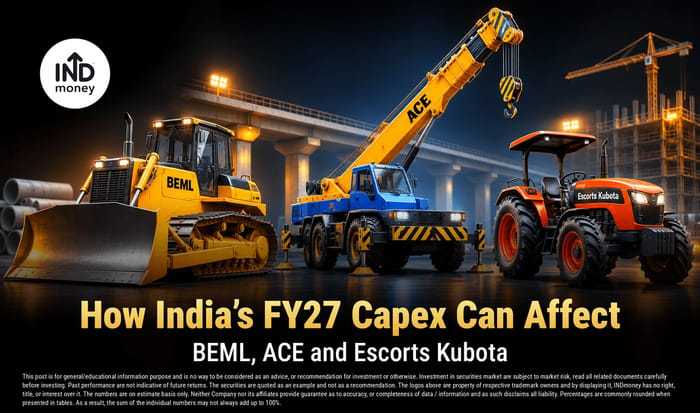
The Centre raised its planned capital expenditure from ₹11.21 lakh crore in FY26 to ₹12.22 lakh crore in FY27. More spending on roads and railways can create demand for the machines that dig, lift and move material at project sites. The September-quarter results give us a way to see how that opportunity could affect three companies with different businesses. Action Construction Equipment (ACE) and Escorts Kubota reported higher equipment sales, while BEML secured a major order through its rail business.
What’s covered
- What the Union Budget allocated and how much the Centre spent by September
- How infrastructure projects create demand for construction equipment
- What the latest disclosures reveal about BEML, ACE and Escorts Kubota
What Did the Union Budget Announce for FY27?
The ₹12.22 lakh crore is the Centre’s total capital expenditure budget. It is 9.0% higher than the original FY26 allocation and 11.5% higher than the FY26 revised estimate of ₹10.96 lakh crore. Roads and railways are two areas where that spending can support machinery demand. The Ministry of Road Transport and Highways’ net capital allocation rose from ₹2.72 lakh crore in the FY26 Budget to ₹2.94 lakh crore in FY27. The Ministry of Railways reported ₹2.78 lakh crore in gross budgetary support for capital investment.
The Centre spent ₹6.55 lakh crore on capital expenditure between April and September 2026, up 12.7% from ₹5.81 lakh crore in the same period a year earlier. That was 53.6% of its full-year budget. The Controller General of Accounts includes loans disbursed in that total. Excluding those loans, capital expenditure rose 9.0% year on year, so part of the headline increase came from higher lending.
How Does Infrastructure Spending Create Demand for Equipment?
A highway contractor might use excavators to dig drainage channels, cranes to place bridge girders and compactors to prepare the road surface. As more projects reach that stage, contractors and equipment rental companies can put more machines to work. They may add to their fleets when existing machines are already busy or when a project requires equipment they lack.
The timing matters for manufacturers. A project award can come months before a contractor needs machinery on site, and some contractors can do the work with equipment they already own or rent. Project execution and equipment sales give investors a closer read on demand than the Budget allocation alone.
What Do the Q2 FY27 Results Show for BEML, ACE and Escorts Kubota?
BEML has exposure through heavy machinery and rail
BEML makes hydraulic excavators, bulldozers and motor graders through its Mining & Construction business. The same product range serves both mines and infrastructure sites, so equipment demand can come from either market. BEML’s Rail & Metro business gives it a separate route into public infrastructure projects.
In September, BEML disclosed an order worth more than ₹5,400 crore to supply and maintain rolling stock and carry out allied work for the Mumbai-Ahmedabad high-speed rail corridor. Its consolidated quarterly revenue from operations grew 42.0% year on year to ₹1,191.61 crore. The quarterly filing cites a Ministry of Corporate Affairs exemption from publishing segment information, so the figure covers the whole company and leaves the contribution from construction machinery unknown.
Cranes and related machinery account for most of ACE’s sales
Action Construction Equipment sells mobile and tower cranes used to lift heavy materials at bridges, buildings and industrial sites. ACE estimates that construction and infrastructure account for about 35% of its end-user exposure. Manufacturing and logistics are also major markets for its equipment, so demand across factories and warehouses can influence how the business performs.
The company sold 2,812 units across cranes, material handling and construction equipment in Q2 FY27, against 2,348 a year earlier. Standalone revenue from that combined segment rose 13.5% to ₹788.01 crore and accounted for about 89.2% of standalone revenue from operations. Segment EBIT rose to ₹147.00 crore from ₹126.03 crore, taking the segment margin to 18.7% from 18.2%, helped by price increases that offset higher steel costs. The margin measures how much of each rupee of segment revenue was left as segment profit. Both figures cover the full equipment segment.
Where construction fits in Escorts Kubota’s tractor-led business
Escorts Kubota supplies backhoe loaders and mini excavators for digging, cranes for lifting and compactors for roadworks. Sales grew from a weak base of 1,146 units in the same quarter a year earlier. Standalone construction equipment revenue rose 58.6% from ₹338.1 crore to ₹536.2 crore in Q2 FY27, while the segment’s operating profit margin rose from 3.8% to 7.9%. The company attributed most of the improvement to operating leverage, which means higher sales helped it spread costs across more units.
Construction equipment made up about 16.6% of standalone revenue from operations. The larger agricultural machinery division generated ₹2,690.1 crore in revenue, and its operating profit margin fell from 12.8% to 7.8%. Even with higher construction equipment sales and margins, company-wide standalone net profit fell 20.6% to ₹255.0 crore. The quarter shows how much the tractor business can influence the company’s overall earnings.
| Company | Equipment sales in Q2 FY27 | Standalone revenue from the relevant segment | Share of standalone revenue from operations |
| BEML | Undisclosed in the quarterly filing | Undisclosed in the quarterly filing | Undisclosed in the quarterly filing |
| ACE | 2,812 units, up 19.8% year on year | ₹788.01 crore, up 13.5% year on year | 89.2% |
| Escorts Kubota | 1,764 units, up 53.9% year on year | ₹536.2 crore, up 58.6% year on year | 16.6% |
Escorts Kubota’s 58.6% revenue growth looks much faster than ACE’s 13.5% partly because it started from a smaller, weak base of ₹338.1 crore a year earlier, while ACE grew on a base more than twice that size.
ACE’s figures cover cranes, material handling and construction equipment. Escorts Kubota’s figures cover construction equipment. Revenue shares are calculated using each company’s standalone revenue from operations.
What Should Investors Watch Next?
For BEML, new orders for earthmoving machinery would give a clearer view of equipment demand, while delivery milestones on the high-speed rail contract would show how that order is turning into revenue. For ACE, the next test is whether its core equipment segment continues to earn more as shipments grow. For Escorts Kubota, the construction division’s margin matters alongside margins in agricultural machinery, given how much of the company’s revenue comes from that business.
ACE’s equipment segment gives it broad exposure to demand for machinery. Escorts Kubota offers a clearer view of construction equipment performance because it reports the division separately. For both, rising steel costs or heavier discounting could limit the profit gained from higher sales.