

- A business built around controlling the manufacturing chain
- Its growth opportunity is larger than its own business, but not as straightforward as it looks
- The numbers show why investors are willing to pay attention
- The IPO is effectively asking whether this model can be scaled
- The valuation puts the quality of the business under a sharper test
- Author's Take: Should You Apply For This IPO?
Adroit Industries (India) IPO is coming to the market with a business most investors may never notice, but one that sits inside some of the machines they use every day. The company makes propeller shafts and other driveline components used in trucks, tractors, SUVs, construction equipment, defence vehicles and industrial machinery.
The interesting part is not simply what Adroit manufactures. It is the combination of high profitability, export-led growth and planned capacity expansion that has made the business attractive. The harder question is whether a company of Adroit's size can sustain those advantages while dealing with heavy dependence on overseas markets, large working-capital requirements and a premium IPO valuation.
The IPO is open from 23 to 25 September 2026 at ₹126-₹134 per share. It comprises a fresh issue of ₹132.62 crore and an OFS of ₹18.09 crore. Investors who want to understand the mechanics behind these structures can refer to “Fresh Issue vs OFS”.
A business built around controlling the manufacturing chain
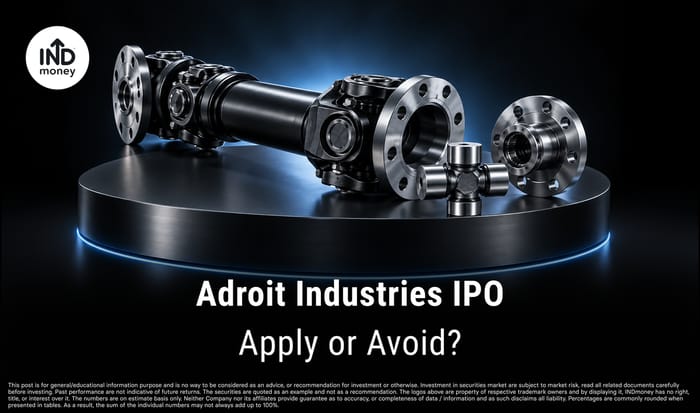
A propeller shaft essentially transfers the engine's rotating power to the wheels. Adroit manufactures these shafts along with more than 5,250 related components, including universal joints, yokes, flanges and stub shafts.
What matters for the investment story is that Adroit does not simply assemble components bought from elsewhere. Its three Madhya Pradesh facilities cover forging, machining and finishing. Steel is first shaped at Dewas, then precision-machined at Pithampur and finally finished and balanced at Sanwer.
This integration gives the company greater control over production, quality and specifications. That becomes particularly useful when supplying precision components to demanding industrial customers.
There is evidence that this capability has created customer stickiness. Repeat customers generated 90.26% of product sales in FY26, while customers associated with Adroit for more than three years accounted for 71.91%.
But the same customer relationships should not be mistaken for guaranteed demand. Most sales are made through short-term purchase orders, and customers are generally not committed to minimum purchase quantities. So, while Adroit has demonstrated its ability to retain customers, future volumes still depend on actual orders.
Its growth opportunity is larger than its own business, but not as straightforward as it looks
Adroit operates in a market supported by commercial vehicles, SUVs and applications such as defence, mining and construction. The global propeller shaft market is projected to grow from $32 billion in 2026 to $39 billion by 2030, while the Indian market is expected to increase from $2.5 billion to $3.3 billion over the same period.
This gives Adroit room to expand, but the company's actual growth story is quite different from India's domestic automobile growth story.
More than 95% of its FY26 product sales came from exports, with the US alone contributing 53.76% of product sales. Canada and Colombia are other important markets. Its subsidiaries in the US and Canada provide warehousing and customer support, helping the company serve overseas customers more directly.
This export-heavy model gives Adroit access to a much larger market than India alone. At the same time, it makes the company unusually dependent on conditions outside India. Changes in US trade policy or tariffs, shipping disruptions, and weakness in the North American vehicle market can affect demand.
There is also a longer-term product question. Electric vehicles generally require simpler drivetrains and can reduce the need for conventional propeller shafts. The immediate threat appears less significant in commercial vehicles, where EV penetration remains low, but electrification remains a structural risk to the traditional product category.
So Adroit's opportunity is not simply "a growing propeller shaft market". It is the company's ability to use its manufacturing capabilities and customer relationships to gain more overseas business while adapting to changes in the drivetrain market.
The numbers show why investors are willing to pay attention
Adroit's strongest evidence is its profitability.
Revenue increased from ₹124.53 crore in FY24 to ₹139.94 crore in FY26, roughly 6% annually. Profit grew much faster, from ₹14.53 crore to ₹26.16 crore.
The difference came largely from improved operating efficiency. EBITDA margin rose from 23.84% to 27.66%, while net profit margin increased from 11.67% to 18.69%.
Raw material costs also fell from 34.27% of total expenses in FY24 to 18.62% in FY26. Borrowings declined from ₹81.86 crore to ₹52.40 crore over the same period.
This is important because Adroit's investment case does not depend only on selling more products. It has already shown an ability to generate considerably more profit from its revenue base.
That profitability is also the main reason the IPO can command a premium. But it creates an important expectation: if the company is being valued for superior margins, investors will eventually need those margins to remain strong.
For investors wanting a broader framework for evaluating an IPO beyond individual numbers, “How to Analyse an IPO Before Applying” provides the wider framework.
The IPO is effectively asking whether this model can be scaled
A significant portion of the fresh issue is aimed at increasing manufacturing capacity.
Adroit plans to spend ₹19.91 crore on new forging equipment at Dewas, with annual forging capacity expected to rise from 3,000 metric tonnes to 5,500 metric tonnes. Another ₹43.96 crore will go into its subsidiary's Pithampur facility, where planned equipment upgrades are expected to double annual production capacity from 900,000 units to 1.8 million units.
This is where the company's opportunity and risk meet.
If customer demand grows sufficiently, additional capacity can allow Adroit to increase revenue without having to fundamentally change its business model. But machinery only creates potential capacity. It does not guarantee utilisation.
The company is also allocating ₹24.12 crore to repay high-cost loans at its subsidiary. That could reduce interest costs and improve cash flow, but it does not by itself create additional operating growth.
The bigger constraint may actually be cash tied up in the existing business. Adroit had 237 net working capital days in FY26. Inventory was ₹55.23 crore and trade receivable days stood at 111.
In simple words, the company can report strong profits while still having a large amount of money locked in inventory and unpaid customer bills. This is particularly relevant for an export-focused manufacturer and can increase dependence on short-term funding.
The valuation puts the quality of the business under a sharper test
At ₹134, Adroit's market capitalisation is ₹600 crore. Against FY26 profit of ₹26.16 crore, that implies a P/E of 22.95x.
That is above GNA Axles at 20.85x, Hindustan Hardy at 12.98x and Talbros Engineering at 10.70x. The average of these peers is 15.78x.
Adroit is much smaller than these companies by revenue, yet it earns significantly higher operating margins. Its 27.66% EBITDA margin compares with 16.09% for GNA Axles and roughly 11% for Hindustan Hardy and Talbros Engineering.
That explains why investors may be willing to pay more for Adroit. The question is whether the difference in profitability is large enough to justify paying a higher multiple for a much smaller company.
The valuation also leaves the working-capital profile, export concentration, and customer concentration important to watch. A premium valuation can work when the underlying advantage continues to strengthen. It becomes harder to defend if growth disappoints or margins normalise.
Author's Take: Should You Apply For This IPO?
Adroit's investment story rests on a clear combination: a specialised manufacturing capability, strong customer retention, high margins and an opportunity to expand capacity. Its integrated production model appears to have helped it generate substantially better profitability than the listed peers provided.
But investors are not buying that business at a modest valuation. At 22.95x FY26 earnings, Adroit is priced above larger listed peers despite having a much smaller revenue base. The premium is supported by its superior margins, but the business also carries meaningful export and US concentration, customer dependence, and a 237-day working-capital cycle.
The key question is therefore not whether Adroit has a good business today. It is whether the company can scale that business while preserving the profitability that makes the IPO valuation demanding in the first place.
Explore more open and upcoming IPOs at INDmoney’s IPO tracker. Read the RA disclaimer here.