


Zepto IPO
Last updated:
IPO Price Range: Not Announced Yet

Objectives of IPO
- Zepto’s Initial Public Offering (IPO) includes two parts. The first is a fresh issue of new shares worth ₹8,010 crore. The second is an Offer for Sale (OFS) of up to 11.34 crore existing shares.
- The money raised through the fresh issue will go directly to the company and will be used to expand the business. But the company will not receive any money from the OFS portion. That money will go to existing shareholders who are selling their stake, including investors such as Nexus Ventures VI Holdings, Contrary ZEP Holdings LLC, Razor Ventures Zepto LLC, and Kaiser Foundation Hospitals. The company plans to use the fresh issue funds in the following ways:
- It plans to spend ₹1,628.97 crore to open around 1,904 new dark stores. These are small delivery-only warehouses located close to customers so orders can reach quickly. The spending will cover things like cold storage rooms, cooling systems, storage racks, and security cameras. The company also wants to expand into newer cities where it currently has little or no presence, including Guwahati, Patna, and Ranchi.
- Since the company does not own most of its properties and mainly operates from rented locations, it will use ₹1,734.94 crore to pay lease rentals for its existing dark stores over the coming years.
- Around ₹1,324.78 crore will go toward upgrading its software systems and cloud infrastructure, which is basically the online storage and computing backbone that keeps the app running smoothly. Zepto heavily uses data analysis and artificial intelligence (AI) to predict customer demand and manage ultra-fast deliveries for its 4.79 crore users. As more people use the platform, the company needs stronger technology systems to handle the growing scale.
- The company will invest ₹520 crore into its subsidiary, Zepto Marketplace Private Limited, mainly for advertising and customer acquisition. This includes spending on digital ads, TV commercials, and billboard campaigns to attract new customers, retain existing users, and strengthen the brand’s visibility.
- A remaining portion of the funds will be reserved for general corporate purposes and possible future acquisitions. In simple words, the company may use this money to buy smaller businesses that can help improve its supply chain, technology, or service offerings. However, it has not identified any specific acquisition targets yet.
Financial Performance of Zepto
The company has witnessed extremely rapid growth over the last few years. Its total revenue surged to ₹23,128.4 crore by FY26, driven by a sharp rise in customers and order volumes. Annual Transacting Users, which refers to customers who placed at least one order during the year, increased from 10.57 million in FY24 to 47.97 million in FY26. As more users joined the platform, total deliveries also climbed significantly to 640.2 million orders.
This expansion came from multiple growth drivers working together. The company increased sales of products like groceries and daily essentials, earned higher platform commissions from sellers, expanded into newer cities, widened its product assortment, and rapidly scaled its advertising business. Because customer activity on the platform increased so sharply, Net Receivables Value, which reflects money expected to be collected from transactions, also grew in line with rising order volumes and platform engagement.
Even with this strong growth, profitability remains a major challenge. The company’s net losses widened sharply from ₹1,214.8 crore in FY24 to ₹5,905.2 crore in FY26. According to the company, these losses increased because it spent aggressively to expand its business. Major expenses such as buying inventory, delivery payouts, employee costs, and marketing campaigns all rose heavily as the company rapidly opened new dark stores and expanded its delivery network.
The sharp rise in total assets between FY24 and FY25 also reflects this heavy investment phase. A large part of the spending went toward setting up new dark stores, increasing working capital requirements, and adding right-of-use assets, which are accounting entries created when leased properties are used for operations.
That said, the company’s core unit economics are starting to improve. Adjusted EBITDA loss per order first worsened from ₹84.64 in FY24 to ₹136.15 in FY25 because the company expanded its infrastructure much faster than order growth in the initial phase. In simple words, it opened many new dark stores before enough customer demand had fully developed around them.
But as order volumes increased and these stores started handling more deliveries, the fixed costs began getting spread across a larger number of orders. Because of this, the Adjusted EBITDA loss per order improved meaningfully to ₹78.75 in FY26. The company says this improvement was mainly driven by operating leverage, meaning costs became more efficient at larger scale, along with shorter delivery distances from its densification strategy and stronger in-house technology systems.
Strengths and Risks

Strengths
The company has scaled at an extremely fast pace over the last two years. Its operating revenue jumped to ₹22,623.58 crore in FY26 from ₹4,454.52 crore in FY24. This growth came mainly from rising customer adoption and higher order volumes. In FY26 alone, it processed around 64.02 crore orders, helping it capture a strong 35% share in India’s quick commerce market.
One of the company’s biggest strengths today is its advertising business, which earns much higher margins than regular product sales. Brands pay the platform to show sponsored products and targeted ads to shoppers right when they are ready to buy. Because of this, advertisement revenue surged sharply from just ₹49.17 crore in FY24 to ₹1,635.73 crore in FY26, giving a major boost to overall profitability.
The company has made noticeable progress in improving its “unit economics,” which simply means how much profit or loss it makes on each order. Its adjusted operating loss per order reduced sharply from ₹136.15 in FY25 to ₹78.75 in FY26. A big reason behind this improvement is better delivery efficiency. By placing multiple delivery centers closer together within neighborhoods, it reduced the average delivery distance from 2.05 km in FY24 to 1.83 km by early 2026. This helped lower its overall cost per order to ₹127.79.
The platform is no longer limited to just groceries and daily essentials. By late FY26, it had expanded its product assortment to more than 49,000 unique items in several neighborhoods. This wider selection encourages customers to order more categories from a single app, which increases average cart sizes and gradually strengthens long-term customer loyalty.
The platform is no longer limited to just groceries and daily essentials. By late FY26, it had expanded its product assortment to more than 49,000 unique items in several neighborhoods. This wider selection encourages customers to order more categories from a single app, which increases average cart sizes and gradually strengthens long-term customer loyalty.
Its focus on fast and reliable deliveries has helped the company rapidly grow its customer base. The number of annual transacting users, meaning customers who placed at least one order during the year, increased from 1.06 crore in FY24 to 4.8 crore in FY26. This sharp rise highlights how quickly quick commerce has become part of everyday life for many consumers.

Risks
Even though the company’s sales have grown rapidly, it is still spending huge amounts of money to expand its business. In FY26, it reported a net loss of ₹5,905.19 crore and negative free cash flow of ₹4,329.54 crore. Free cash flow basically means the cash left after running and expanding the business. Since this number is still negative, it shows the company is continuing to burn cash heavily and profitability is still some distance away.
The company relies almost entirely on gig workers for deliveries and daily operations. In FY26 alone, delivery and handling costs reached ₹3,046.34 crore. This creates a major operational risk because any labor shortages, delivery partner strikes, or changes in wage regulations could disrupt deliveries and sharply increase costs almost overnight.
The quick commerce industry is becoming extremely competitive, especially with large players like Blinkit and Instamart aggressively expanding. While the company is still reporting heavy losses, competitor Blinkit already achieved a positive Adjusted EBITDA of ₹37 crore in late FY26. Adjusted EBITDA is a measure often used to track core operating profitability before certain costs. This rising competition could put pressure on pricing, margins, and future growth.
The company does not directly operate all of its dark stores. By March 2026, more than 36% of its 1,139 dark stores were being managed by third-party franchise partners. While this helps the company expand faster, it also creates risk. Any operational problems, disputes, poor service quality, or regulatory violations by these partners could hurt the company’s reputation and local operations.
The company follows an “asset-light” model, which means it does not own its dark stores, warehouses, or office spaces. Instead, it runs entirely from rented properties. While this reduces upfront investment costs, it also makes the business vulnerable to rising rents, lease disputes, or sudden property exits that may force expensive relocations and operational disruptions.
How to Apply for Zepto IPO on INDmoney
- Download the INDmoney app and complete your KYC.
- Go to INDstocks → IPO, or just search “IPO”.
- Tap on Zepto IPO from the list of live IPOs.
- View key details like price band, lot size, and dates.
- Tap Apply Now and choose your number of lots.
- Use INDpay UPI for instant mandate tracking.
- Your funds will be blocked until the share allotment is finalized.
Listed Competitors of Zepto
Zepto Shareholding Pattern
| Promoters & Promoter Group | 19.56% | |
| Name | Role | Stakeholding |
| Lazarus Trust | Promoter | 9.03% |
| The Vohra Trust | Promoter | 7.48% |
| Aadit Palicha | Promoter | 1.07% |
| Kaivalya Vohra | Promoter | 0.89% |
| Urvashi Kavit Palicha | Promoter Group | 0.57% |
| Seema Vohra | Promoter Group | 0.52% |
| Employee Trust | 7.46% | |
| Name | Role | Stakeholding |
| Zepto Employee Stock Option Trust | Employee Trust (Non-Promoter, Non-Public) | 7.46% |
| Public | 72.98% | |
| Name | Role | Stakeholding |
| Nexus Ventures VI Holdings, LLC | Public | 8.57% |
| Glade Brook Private Investors XXXIV LP | Public | 7.73% |
| StepStone VC Zepto, LLC | Public | 7.34% |
| Nexus Ventures VII Holdings, LLC | Public | 4.55% |
| LGF Scale II (Mars) Limited | Public | 2.86% |
| YCC20, L.P. | Public | 2.85% |
| LGF Scale (Mars) Limited | Public | 2.72% |
| GC India Investment Holdings - Bear Coast (Ventures), Ltd. | Public | 2.33% |
| YCC20 (India) Ltd. | Public | 2.18% |
| GC India Investment Holdings - Group XII - Endurance, Ltd. | Public | 2% |
| Goodwater Infinity III, L.P. | Public | 1.87% |
| ZPT Holdings Limited | Public | 1.72% |
| Oliver & Lish Jung | Public | 1.72% |
| Rocket Internet Capital Partners II SCS | Public | 1.6% |
| Razor Ventures Zepto LLC | Public | 1.14% |
| Contrary ZEP Holdings LLC | Public | 1.13% |
| AZO4 LLC | Public | 1.08% |
| Springblue Co-Investment SPV, LP | Public | 1.04% |
| Others | 18.55% |
About Zepto
Behind the scenes, Zepto sources fresh fruits and vegetables directly from farmers while also stocking popular brands like Coca-Cola and Nivea. On average, its dark stores carry around 49,602 different products. Once an order is placed on the app, workers use automated lights and sorting systems to quickly pick and pack items within seconds. After that, more than 2.86 lakh delivery partners handle the final delivery to customers.
Customers are drawn to Zepto mainly because of its speed, wide product selection, and “Everyday Low Prices” strategy. One of the company’s biggest strengths is something called “densification”. In simple words, Zepto opens many dark stores close to each other so delivery riders travel only short distances. Right now, the average delivery distance is just 1.83 km per order. That helps the company deliver faster while also reducing delivery costs. This strategy has helped Zepto secure around 35% market share among major quick commerce players.
The company earns money in multiple ways. First, it sells products directly to customers and charges small delivery fees on orders. Second, sellers and brands pay commissions to list products on the platform. But one of Zepto’s biggest revenue drivers today is advertising. Large consumer brands spend around ₹1,635.72 crore on ads that help their products appear prominently on the app when customers are actively searching and shopping.
Looking ahead, Zepto plans to use the IPO money to expand aggressively. The company aims to open new dark stores in untapped cities such as Guwahati, Patna, and Ranchi.
For more details, visit here: www.zepto.com
Know more about Zepto
Why Zepto Paused Its IPO: The Story Behind the Valuation Gap
Zepto has put its IPO on hold despite rapid growth. Here's why the valuation gap emerged, what it means for investors, and what could happen before the company returns to the public market.
Is Zepto Running Out of Cash? Why Its 9-Month Cash Runway Matters More Than Valuation
Zepto’s IPO comes as the company faces a shrinking cash runway, rising losses, and intense competition from Blinkit and Instamart. Here’s what investors should understand before investing.
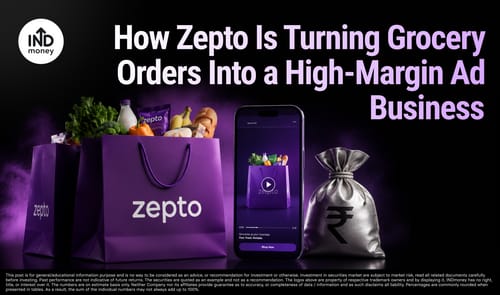
How Zepto Is Turning Grocery Orders Into a High-Margin Ad Business
Zepto’s ad revenue surged from ₹49 crore to ₹1,635.7 crore in two years. Here’s how grocery delivery, consumer data, and digital ads are shaping its future profits.
Frequently Asked Questions of Zepto IPO
Can we invest in Zepto IPO?
What would be the listing gains on the Zepto IPO?
What is 'pre-apply' for Zepto IPO?
When is the Zepto IPO coming?
Zepto has not announced the exact IPO launch date yet. However, the company has already filed its Updated Draft Red Herring Prospectus (UDRHP), which is an important regulatory document filed before an IPO. Through this offering, Zepto plans to raise ₹8,010 crore through a fresh issue of shares, along with an offer for sale of up to 11.34 crore equity shares. The official IPO dates are expected to be announced soon.
Who are the promoters of Zepto?
Zepto’s promoters include its founders, Aadit Palicha and Kaivalya Vohra, along with entities and family members such as the Lazarus Trust, The Vohra Trust, Kavit Palicha, and Jaideep Vohra. Before the IPO, the promoter group collectively holds around 19.56% ownership in the company.
Who are the competitors of Zepto?
Zepto operates in India’s highly competitive quick commerce market. Its biggest competitors are Blinkit, owned by Eternal, and Instamart, operated by Swiggy. These companies are considered Zepto’s main listed peers when comparing financial performance and market position. Apart from them, newer rapid-delivery services like Amazon Now and Flipkart Minutes are also entering the space and increasing competition.
How does Zepto make money?
Zepto earns revenue in multiple ways. Its biggest source of income comes from selling products like groceries, electronics, beauty items, and daily essentials, which generated ₹17,587.92 crore in FY26. The company also earns through delivery and handling fees, commissions charged to brands and sellers, and its fast-growing digital advertising business. In FY26 alone, advertisement revenue contributed ₹1,635.73 crore, making it one of the company’s fastest-growing and highest-margin business segments.