

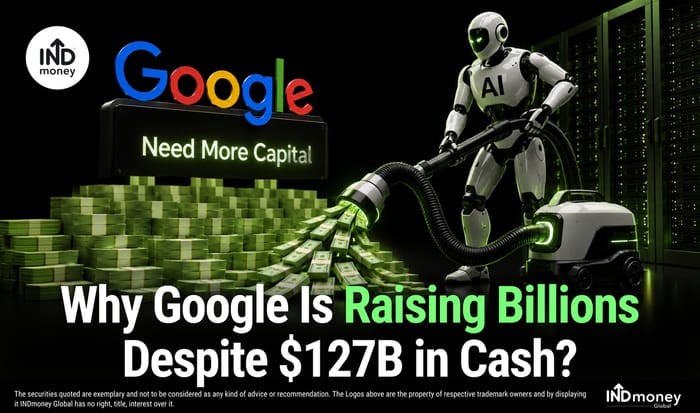
- Alphabet’s $137 Billion Fundraising Spree: Debt, Equity and AI Spending
- Why Google Is Raising Money Despite Having $127 Billion in Cash
- Why Speed Matters More Than Cash in the AI Infrastructure Race
- How Alphabet’s AI Capex Compares With Amazon, Microsoft, Meta and Oracle
- Where Alphabet’s AI Spending Is Going: Data Centers, GPUs and Google Cloud
- What Google’s Capital Raise Means for Investors
- Key Risks Behind Alphabet’s AI Infrastructure Bet
Just last week, Alphabet filed documents with the US Securities and Exchange Commission to price an $84.75 billion equity raise, one of the largest in US corporate history. This was after the company had already raised roughly $32 billion in global bond markets in February 2026 and $25 billion in bonds in November 2025. All of this while Alphabet's March 2026 balance sheet showed $126.84 billion in cash and short-term investments sitting on the books, backed by $174 billion in annual operating cash flow. The company isn't raising capital because it's running low on money. It's raising capital because, in the AI infrastructure race, moving fast enough has turned out to be a harder problem than having enough money.
Let's break down what Alphabet has actually raised, why the cash balance tells only half the story, what every major US tech giant is doing in parallel, and what it all means for anyone trying to make sense of the biggest corporate spending spree in a generation.
Alphabet’s $137 Billion Fundraising Spree: Debt, Equity and AI Spending
Between November 2025 and June 2026, Alphabet went to capital markets five separate times in roughly eight months.
| Date | Instrument | Amount | Notable Detail |
| November 2025 | Debt (bonds) | $25 billion | US dollar issuance |
| February 2026 | Debt (bonds) | ~$32 billion | First tech 100-year bond since Motorola (1997) |
| May 2026 | Debt (bonds) | ~$17.18 billion | €9 billion of euro-denominated senior notes, C$9.5 billion of Canadian dollar senior notes |
| June 1-2, 2026 | Equity: Public offering | $34.75 billion | Class A/C shares + mandatory convertible preferred stock |
| June 2026 | Equity: Berkshire Hathaway private placement | $10 billion | $5B in Class A at $351.81/share; $5B in Class C at $348.20/share |
| Q3 2026 (upcoming) | Equity: ATM program | $40 billion | Class A/C shares to be sold gradually over time |
Source: Alphabet SEC filings (Form 8-K, Form FWP), CNBC, Bloomberg
The debt numbers alone are striking. Alphabet raised over $85 billion in new debt in twelve months, pushing its total debt balance past $100 billion. That's quadrupling from where it stood at the start of 2025, as per CNBC. The February 2026 dollar bond offering attracted over $100 billion in investor orders for a $20 billion sale.
One detail worth pausing on: the 100-year sterling bond. On February 10, Alphabet became the first technology company to issue century debt since Motorola in 1997, according to Bloomberg data. The bond drew £9.5 billion in bids for a £1 billion tranche. Only three other non-government entities have sold century bonds in sterling before: Électricité de France, the University of Oxford, and Wellcome Trust. The signal being sent was as much about institutional confidence in Alphabet's longevity as it was about raising money at a particular rate.
On the equity side, the June raise was upsized from the announced $80 billion to $84.75 billion. Goldman Sachs, JP Morgan, and Morgan Stanley ran the books.
Why Google Is Raising Money Despite Having $127 Billion in Cash
The obvious question is why a company this profitable is raising external capital at all.
| Alphabet Financial Snapshot (Q1 2026) | Amount |
| Cash + cash equivalents + marketable securities | $126.84 billion |
| Operating cash flow (12 months ended March 31, 2026) | $174 billion |
| Trailing twelve-month free cash flow | $64.4 billion |
| 2026 capex guidance | $180-190 billion |
| Anthropic investment committed (April 2026) | $40 billion |
| Employee equity tax obligations (2026, from ATM) | ~$30 billion |
| Total debt post-raises | $100+ billion |
Source: Alphabet 10-Q (Q1 2026), CNBC, Yahoo Finance (Verdict/GlobalData), Tom Tunguz analysis
The math explains it. Alphabet's 2026 capex of $180-190 billion already exceeds its entire cash balance. Add the $40 billion Anthropic investment committed in April 2026, of which $10 billion is an immediate cash commitment, with the remaining $30 billion milestone-linked, plus roughly $30 billion in employee equity tax obligations that Alphabet will settle through the ATM program. Between these three line items alone, the 2026 spending commitments run to somewhere between $250 billion and $270 billion.
That's nearly double the cash on hand. It's also close to matching the entire year's operating cash flow, which doesn't all arrive on day one. CFO Anat Ashkenazi stated on the Q1 2026 earnings call that the goal is to fund the buildout "in a fiscally responsible way" while "maintaining a very healthy financial position." Raising through a mix of debt and equity is how they do that without draining the balance sheet.
Why Speed Matters More Than Cash in the AI Infrastructure Race
The constraint for Alphabet right now isn't money. It's time.
Consider how Reliance Industries launched Jio in 2016. Reliance already generated significant operating cash from its refining business. It had no survival problem. But to build a pan-India 4G network quickly enough to outmaneuver Airtel and Vodafone, it front-loaded billions ahead of when the cash would naturally arrive in its quarterly results. The cost of capital was irrelevant compared to the cost of being slow. Every month of delay was a subscriber permanently acquired by someone else.
The AI infrastructure race follows the same logic. Sundar Pichai said on the Q1 2026 earnings call that Alphabet's primary concern is "compute supply," not demand. Alphabet's own announcement for the equity raise stated that demand for its AI solutions is "exceeding the company's available supply." The company isn't demand-constrained. It's supply-constrained. Building more data centers, locking in power agreements, and securing Nvidia GPU allocations all require committing capital months before the cash from quarterly operations arrives. By raising proactively, Alphabet signs those contracts today rather than waiting until the cheques clear.
The debt portion makes sense because Alphabet holds strong investment-grade credit, and borrowing at current rates is cheaper than ceding infrastructure advantage to Amazon or Microsoft. The equity portion is more unusual for a company at this profitability level, and it's the part that tells you most about management's conviction: they believe the returns from AI infrastructure will more than offset the dilution they're accepting today.
How Alphabet’s AI Capex Compares With Amazon, Microsoft, Meta and Oracle
This isn't a Google-specific story. Every major hyperscaler is following the same playbook.
| Company | 2026 Capex Guidance | Capex as % of Revenue (2026E) |
| Alphabet (Google) | $180-190 billion | ~46% |
| Amazon | $200 billion | ~25% |
| Microsoft | ~$190 billion | ~47% |
| Meta | $125-145 billion | ~54% |
| Oracle | $45-50 billion | ~86% |
Source: CNBC, Reuters, CreditSights (February 2026), BofA Global Research, Yahoo Finance
The $750 billion combined capex estimate for 2026 is up approximately 67% from 2025's already-record levels, as per CreditSights. In 2025, the Big Five issued $121 billion in US corporate bonds, against an average of $28 billion per year between 2020 and 2024, according to BofA Global Research data cited by Reuters. After Amazon's $54 billion bond raise in March 2026, Bank of America raised its full-year 2026 hyperscaler debt issuance forecast to $175 billion.
The critical metric from Bank of America: aggregate hyperscaler capex now consumes approximately 94% of operating cash flows after dividends and buybacks. That's 18 percentage points higher than 2024. At that ratio, external financing stops being a choice and becomes a mathematical requirement. Morgan Stanley has projected that AI capex from 2025 to 2028 will require $2 trillion in total investment, with over $1 trillion of that financed through new debt across the sector.
Where Alphabet’s AI Spending Is Going: Data Centers, GPUs and Google Cloud
Roughly 75% of the collective $750 billion spend goes directly to AI infrastructure in GPU clusters, servers, networking equipment, and data center construction, as per CreditSights estimates. Traditional cloud expansion accounts for the rest.
For Alphabet, the build carries a strategic layer beyond raw compute. In April 2026, the company committed up to $40 billion to Anthropic.. Anthropic also committed to spend $200 billion on Google Cloud for 5 gigawatts of computing capacity. Mizuho analysts estimate this arrangement alone could add $61 billion to Google Cloud's pipeline. Google Cloud itself posted 63% revenue growth year-on-year in Q1 2026, reaching $20 billion in revenue for a single quarter, as per Alphabet's earnings report.
The structure is circular in a financially productive way: Alphabet builds compute, Anthropic uses and pays for that compute, Google Cloud grows, and the revenue from that growth funds more investment. The capital raise doesn't just fund the infrastructure. It accelerates how fast the loop spins.
One portion of the raise has a less glamorous purpose. Approximately $30 billion of the ATM program proceeds, as per Alphabet management guidance, is earmarked to cover employee equity compensation tax obligations which is a structural HR cost tied to vesting stock awards. That part of the story has been underreported, and it matters when assessing how much of the $84.75 billion is genuinely AI-directed.
What Google’s Capital Raise Means for Investors
Two distinct types of large capital raises exist. One is a company scrambling to survive. The other is a company trying to outrun a competitive clock. They look similar from the outside, but the implications are very different.
Alphabet's fundamentals sit clearly in the second camp. It generated $174 billion in operating cash flow in the twelve months to March 2026. Its Q1 2026 operating margin held at 36%, as per Alphabet's earnings report. Berkshire Hathaway, which began building its Alphabet position in Q3 2025, chose to expand that stake to $10 billion at $351.81 per share alongside this raise. Berkshire doesn't back distressed capital raises. Its participation here is a form of institutional validation for the business model, not a rescue.
Amazon is a different case. Morgan Stanley estimates that Amazon may face negative free cash flow of nearly $17 billion in 2026, given a $200 billion capex plan running against roughly $140 billion in annual operating cash flow. That gap is a funding hole, not an acceleration from a position of strength.
The framework worth carrying into any analysis of this space: hyperscalers with strong existing cash generation, clear near-term AI revenue growth, and the ability to slow capex if demand disappoints are structurally more resilient than those that have levered up heavily without the same revenue cushion. Alphabet's capex-to-revenue ratio of approximately 46% is elevated but supportable given its cash generation. Oracle's ratio of approximately 86%, is a different category of risk.
Key Risks Behind Alphabet’s AI Infrastructure Bet
The market consensus is heavily tilted toward "the spending is justified." But that deserves honest pressure-testing.
- AI services revenue across the industry currently runs at approximately $25 billion, as per Investing.com, against $725 billion being spent on infrastructure in 2026 alone. That's a 4% monetization rate against the capital being deployed. If AI adoption plateaus, or if the transition from AI tools to autonomous AI agents takes materially longer than the most optimistic projections, the returns on this infrastructure may take a decade or more to show up. Sundar Pichai himself acknowledged "elements of irrationality" in the current spending environment on a 2025 earnings call.
- Then there's the open-source risk. If open-weight models like Meta's Llama close the performance gap with proprietary models at a fraction of the cost, the competitive advantage from owning massive private compute clusters weakens. Building a $190 billion data center footprint makes sense if proprietary models maintain a large quality lead. That lead is not guaranteed.
- Alphabet's core revenue engine, Google Search, is also under serious regulatory pressure in the US. An antitrust ruling that disrupts Google's distribution agreements would directly reduce the cash generation capacity that makes all of this AI capex viable.
- And credit markets can reprice risk quickly. Oracle's recent situation, with CDS spreads widening at crisis levels, is an early signal that bond markets will not infinitely absorb AI-linked debt at favorable terms. Alphabet's stronger free cash flow makes it more resilient here than Oracle, but the direction of credit market pressure is worth watching.
Alphabet's capital raise isn't a sign of financial strain. It's the financial expression of a company that has concluded the AI infrastructure window is time-limited and does not want to arrive at it under-resourced. Whether the returns justify the investment be it for Google, for Amazon, or for all of them, will depend on whether AI monetization grows fast enough to justify the scale of what's being built. The infrastructure is going up regardless. The next question, for every investor watching US tech, is who gets paid back first.