

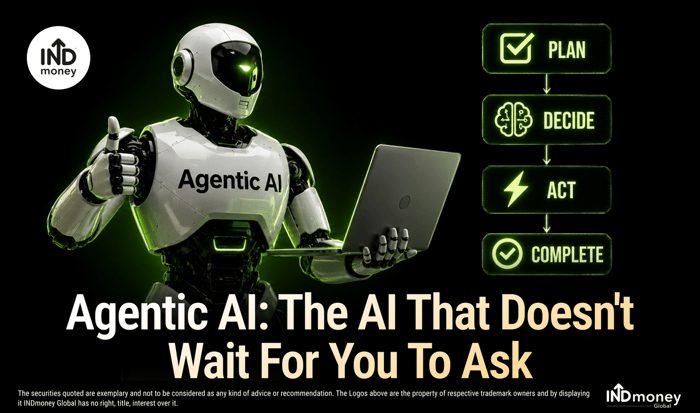
- What Is Agentic AI?
- Agentic AI vs Generative AI
- The Infrastructure Insight On Agentic AI
- What The Big Tech CEOs Are Actually Saying
- The $200 Billion Agentic AI Market Opportunity
- Top Agentic AI Stocks To Watch For Investment
- An Original Mental Framework: The Three Waves Of Agentic AI Value Creation
- What Would Make This Thesis Wrong? Risks Investors Should Know
- Final Thoughts On The Agentic AI Investment Opportunity
Every technology revolution in history has had a moment where it stopped being a tool and started being a participant. The printing press moved from "thing you operate" to "thing that changes what society knows." The internet moved from "place you visit" to "infrastructure you live in." And now, artificial intelligence is making the same jump; from a system that answers your questions to one that goes out and completes your tasks before you even finish asking.
That transition has a name: Agentic AI. And it is, without exaggeration, one of the most consequential shifts in enterprise technology since the cloud itself.
Let's break down what agentic AI actually is, why it's fundamentally different from the generative AI tools you've been hearing about, what some of the world's sharpest CEOs are betting on it, and most importantly which companies investors should be watching as this $200 billion Agentic AI wave builds.
What Is Agentic AI?
Agentic AI is a system that can perceive its environment, set its own goals, plan a sequence of steps, use tools (like searching the web, running code, sending emails, or calling APIs), and execute tasks autonomously, with limited or no human involvement at each step. It doesn't just answer. It does.
Here's the simplest possible definition: Generative AI responds. Agentic AI acts.
When you type a prompt into ChatGPT or Google Gemini and get an answer, that's generative AI. It's extraordinarily powerful, but it sits and waits. You bring the problem; it brings the output. You close the laptop; it stops.
Think of it like the difference between a brilliant intern who gives you a great research note when you ask for it (generative AI) versus a seasoned analyst who notices a problem on their own, researches it overnight, drafts the memo, schedules the follow-up meeting, and has the action items ready when you walk in (agentic AI). Same intelligence, entirely different relationship with work.
Agentic AI vs Generative AI
Here is the clearest possible breakdown of the difference between Agentic AI and Generative AI:
| Dimension | Agentic AI | Generative AI |
| Core Behaviour | Plans and executes tasks autonomously | Responds to a prompt |
| Human Involvement | Minimal as agent handles multi-step workflows | Required at every step |
| Memory | Persistent memory across sessions and tasks | Limited to conversation window |
| Tool Use | Native: calls APIs, runs code, browses web, sends emails | Rare or limited |
| Goal Setting | Agent can self-set sub-goals toward a broader objective | User defines every goal |
| Output | Completed workflows, decisions, actions taken | Text, images, code, content |
| Error Handling | Agent self-corrects and retries autonomously | User must re-prompt |
| Use Case Example | "Monitor 30 earnings reports, flag risks, and email me a digest every morning" | "Summarise this earnings report" |
| Key Risk | Cascading errors in autonomous actions: a wrong step triggers downstream mistakes | Hallucination in output |
| Compute Demand | GPU + CPU-heavy; inference at scale drives multi-layered compute needs | GPU-heavy for training/inference |
| Monetisation Model | Per-task, per-outcome, or outcome-based pricing | Per-token or subscription |
| Major Platforms | Salesforce Agentforce, Microsoft Copilot Studio, AWS Bedrock Agents, Google Agentspace | ChatGPT, Gemini, Claude, Copilot |
| Companies with Direct Exposure | Nvidia, AMD, Microsoft, Salesforce, ServiceNow, Broadcom, Amazon | OpenAI, Anthropic, Google, Meta |
The revenue model shift here matters enormously for investors. Generative AI monetises your attention. Agentic AI monetises your outcomes. That's a fundamentally larger and stickier market.
The Infrastructure Insight On Agentic AI
Everyone understands that Nvidia wins the GPU race. That's the obvious trade. But AMD CEO Lisa Su said something on her Q1 2026 earnings call that flips the conventional wisdom about what agentic AI actually needs under the hood.
Historically, AI infrastructure was built on a ratio of roughly 4-5 GPUs for every 1 CPU. GPUs did the heavy lifting; CPUs were just the host node. But as agentic AI scales, where thousands of agents are running in parallel, each spawning tasks, calling tools, managing memory, and coordinating with other agents, the CPU becomes load-bearing.
AMD CEO Lisa Su told analysts that the GPU-to-CPU ratio is compressing from 4-5:1 toward 1:1 as agentic AI and inference workloads increase CPU demand.
Think of it with a kitchen analogy. In a generative AI world, you need one incredible chef (GPU) and a basic assistant (CPU). In an agentic AI world, you have an entire restaurant running: multiple chefs working simultaneously, a head chef coordinating them, servers taking orders, a manager handling logistics. Now you need far more people at every layer. The CPU is suddenly as strategic as the GPU.
Su clarified that this CPU growth is largely additive to the overall AI TAM, not a substitution. This is not just a win for AMD's EPYC server CPUs. It reshapes how investors should think about the entire compute stack.
What The Big Tech CEOs Are Actually Saying
When people at the top of this industry align on a single direction, it is worth listening closely. Here is what they've said; from their actual earnings calls and investor releases.
Jensen Huang, Nvidia (Q1 FY2027 Earnings, May 2026):
"Agentic AI has arrived, doing productive work, generating real value and scaling rapidly across companies and industries. Nvidia is uniquely positioned at the center of this transformation as the only platform that runs in every cloud, powers every frontier and open source model, and scales everywhere AI is produced, from hyperscale data centers to the edge."
For context on what this means in numbers: Nvidia's Blackwell Ultra delivers up to 50x better performance and 35x lower cost for agentic AI compared with the Hopper platform, according to SemiAnalysis InferenceX benchmark results.
Lisa Su, AMD (Q1 FY2026 Earnings, May 2026):
"We are seeing strong momentum as inferencing and agentic AI drive increasing demand for high-performance CPUs and accelerators. Looking ahead, we expect server growth to accelerate meaningfully as we scale supply to meet demand. Customer engagement around MI450 Series and Helios is strengthening, with leading customer forecasts exceeding our initial expectations."
Satya Nadella, Microsoft:
Nadella predicts the demise of traditional SaaS applications, arguing that AI-powered agents will take over, fundamentally redefining enterprise software. He argued that agents will be capable of composing outcomes directly from data rather than relying on established SaaS platforms.
This is the exact opposite of what Salesforce CEO Marc Benioff believes.
Marc Benioff, Salesforce:
Benioff said that Salesforce's goal is to be "the number one provider of digital labor in the world" via the company's various agentic services. Salesforce's Agentforce platform is his bet that enterprises will want agents delivered through existing CRM infrastructure rather than replacing it.
Sam Altman, OpenAI:
Altman said agents would "join the workforce" in 2025 and while the timeline was ambitious, the direction was directionally correct. Enterprise deployments are now accelerating rapidly.
The $200 Billion Agentic AI Market Opportunity
Different research firms have different numbers, but the directional consensus is clear.
| Research Firm | Agentic AI Market (2024/2025) | Agentic AI Market (2034) | CAGR |
| Fortune Business Insights | $7.29B (2025) | $139.19B (2034) | ~40.5% |
| Precedence Research | $7.55B (2025) | $199.05B (2034) | ~43.8% |
| Grand View Research | $7.63B (2025) | $182.97B (2033) | ~49.6% |
| Market.us | $5.2B (2024) | $196.6B (2034) | ~43.8% |
Source: Fortune Business Insights, Precedence Research, Grand View Research, Market.us: all published 2025-2026. Note: Market size estimates vary by definition and scope; treat these as directional, not precise.
Boston Consulting Group, in their AI Radar 2026 report published in January, 2026, which is based on a survey of 2,360 executives across 16 markets and nine industries, including 640 CEOs; adds that 90% of CEOs expect to see measurable ROI from agentic AI investments as early as 2026, with many committing over 30% of their total AI budgets specifically to agentic capabilities.
The range across sources is wide enough to be honest about uncertainty. What is not uncertain is the direction. A market growing at 40-50% compounded annually for a decade tends to create significant value for early participants; both companies and investors.
Top Agentic AI Stocks To Watch For Investment
The agentic AI trade is not one stock. It's a layered ecosystem. Think of it like the infrastructure for a new city: you need land, electricity, roads, buildings, and then businesses that operate inside them. Each layer has different risk-reward profiles.
Layer 1: The Compute Backbone (Highest Direct Exposure)
| Company (Ticker) | Agentic AI Positioning |
| Nvidia (NVDA) | Dominant GPU provider; Blackwell Ultra delivers 50x better performance for agentic workloads vs Hopper |
| AMD (AMD) | Growing CPU play as agent workloads shift ratios; MI450 Series for accelerator demand; EPYC for server CPU gains |
| Broadcom (AVGO) | Custom AI accelerators (XPUs) for hyperscalers; AI networking; expects AI revenues to surge ~140% YoY in Q2 FY2026 |
| Micron Technology (MU) | HBM memory is critical for agent inference at scale; AI memory demand accelerating |
| TSMC (TSM) | Manufactures chips for Nvidia, AMD, Apple, Qualcomm; every AI chip runs through TSMC fabs |
Layer 2: The Cloud & Platform Layer (Scale Distributors)
| Company (Ticker) | Agentic AI Positioning |
| Microsoft (MSFT) | Copilot Studio for enterprise agents; Azure AI Foundry; $37B+ AI annual revenue run rate |
| Amazon (AMZN) | Bedrock Agents platform; $200B capex in 2026; AWS growing at 28% YoY |
| Alphabet (GOOGL) | Agentspace product; Gemini models; Cloud backlog surpassing $460B |
| Oracle (ORCL) | Cloud infrastructure buildout; AI agent tools for enterprise ERP; $50B capex plan |
Layer 3: Enterprise Software (The Revenue Realization Layer)
| Company (Ticker) | Agentic AI Positioning |
| Salesforce (CRM) | Agentforce: the most commercially visible pure agentic play; targeting "digital labor #1" position |
| ServiceNow (NOW) | AI agents for IT service management and workflow automation across enterprises |
| SAP (SAP) | Joule AI agent deeply embedded in enterprise ERP workflows globally |
| Adobe (ADBE) | Expanded into agentic AI for marketing, analytics, and operations teams |
Layer 4: Infrastructure Enablers (The Picks-and-Shovels Play)
| Company (Ticker) | Agentic AI Positioning |
| Arista Networks (ANET) | AI networking revenue expected to more than double in 2026 |
| Vertiv Holdings (VRT) | Data center cooling: the binding physical constraint as compute density rises |
| Eaton Corporation (ETN) | Power management for hyperscale data centers |
| Equinix (EQIX) | Colocation data centers that house the compute agents run on |
An Original Mental Framework: The Three Waves Of Agentic AI Value Creation
To help think about where we are in this cycle, here's a mental model I'd propose: The Three Waves Framework.
Wave 1, The Model Wave (2022-2024): Value accrued to whoever built the best foundational models. OpenAI, Anthropic, Google, etc. dominated the narrative. Investors who backed Nvidia early captured enormous value here, because every model needed compute to train.
Wave 2, The Application Wave (2024-2026): Value is shifting toward whoever builds the best applications on top of those models. Copilot, Agentforce, Gemini for Workspace; these are the revenue-generating layer. Enterprise software companies are now competing to embed AI agents into existing workflows.
Wave 3, The Infrastructure Wave (2026-2030): As agent counts scale from millions to billions, the bottleneck will shift to the physical infrastructure that can run them; think power, cooling, networking, memory bandwidth, and the CPUs needed to coordinate agentic workloads. This wave may be the largest in dollar terms, even if it gets less press.
Most investors are still in Wave 1 thinking (buy Nvidia, done). The more interesting analysis today is identifying which Wave 2 and Wave 3 plays are pricing in neither the opportunity nor the risk correctly.
What Would Make This Thesis Wrong? Risks Investors Should Know
Any serious investment analysis should include the honest bear case. Here is what would invalidate the agentic AI thesis, or delay it significantly:
1. The ROI Gap Widens, Not Closes
Over 80% of organizations believe that AI agents are the new enterprise apps; but belief and revenue are different things. If enterprises deploy agents, get burned by early failures, and pull back spending, the growth cycle could stall. Adoption curves in enterprise software are consistently slower than demos suggest.
2. Cascading Failure Risk Becomes a Crisis
Multi-agent systems where agents depend on each other for tasks introduce the risk of cascading failures. If a single specialized agent is compromised or begins to hallucinate, it feeds corrupted data to downstream agents; these downstream agents, trusting the input, make flawed decisions that amplify the error across the system. A single high-profile agentic failure in a bank, hospital, or government agency could trigger regulatory backlash that slows enterprise adoption by years.
3. The Hyperscaler Capex Doesn't Translate to Revenue
In 2024, the combined capex of the four biggest hyperscalers was just over $200 billion. Two years later, it's on track to approach $700 billion. Barclays analysts have already flagged the possibility of negative free cash flow for Meta in 2027 and 2028 from this spending. Gartner forecasts that organizations will abandon 60% of AI projects through 2026 due to lack of AI-ready data. If revenue growth does not justify this infrastructure spend, we could see a capex correction that hits infrastructure suppliers hard, including Nvidia, Arista, and Vertiv.
4. The CPU Upgrade Cycle Is Slower Than Lisa Su Expects
AMD's thesis around CPU-to-GPU ratio compression is compelling, but structural changes in data center infrastructure take years to roll through. Enterprise procurement cycles, existing vendor contracts, and the sheer physical complexity of rebuilding data center configurations mean this shift may be a 5-year story, not a 2-year one.
5. Regulatory Intervention
The EU AI Act is already in effect. If the US or India introduces aggressive agentic AI regulations, particularly around autonomous decision-making in financial services or healthcare, it could limit deployment in the highest-value sectors.
Final Thoughts On The Agentic AI Investment Opportunity
Agentic AI is not hype built on demos. It's a structural shift in how work gets done; from AI as a tool you use to AI as a participant in your workflows.
For investors, the key insight is to move beyond the obvious and think in layers. The compute backbone will remain critical. But the real asymmetric opportunities may be in the CPU revival story that Lisa Su is flagging, the enterprise software players who can actually convert agent deployments into recurring revenue, and the infrastructure enablers in power, cooling, networking, who face less competitive risk than chipmakers while benefiting from the same structural tailwind.
The biggest mistake an investor can make right now is to confuse "everyone is talking about agentic AI" with "everyone has already priced in agentic AI." Most of the enterprise revenue from this cycle has not been earned yet. The question is not whether the shift is happening as the CEOs with billions on the line have answered that. The question is which companies are positioned to capture it at a price that leaves room for returns.
That's the analysis worth doing.