

- What Tesla Revealed at the Roadster Event
- Can the Tesla Roadster Really Fly?
- Tesla Roadster Price and What the Reservation Buys
- Why the 2028 Roadster Production Target Matters
- Why Tesla Wants a Car Most People Will Never Own
- How Much Money Could the Tesla Roadster Make
- What the Roadster Means for Tesla Stock
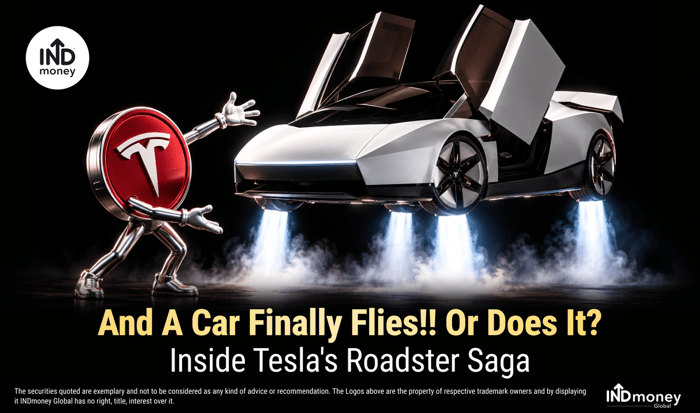
Tesla’s new Roadster drove up a curved ramp, turned upside down, flew off the surface and landed back on its wheels. At the company’s unveiling in Texas, an electric sports car had become an airborne spectacle. The Verge’s event coverage described a demonstration that also included a sub-second acceleration run.
Then came the less cinematic part.
Tesla wants $50,000 to reserve the base version. The final purchase price remains unsettled. And Elon Musk is targeting production in 2028.
So there are two very different clocks running here. One measures how quickly the Roadster reaches 60 miles per hour. The other measures how long customers and shareholders might wait for it to become a meaningful business.
The first is measured in fractions of a second. The second is measured in years. That gap makes the new Tesla Roadster interesting even if you never intend to own one. It could help Tesla sell excitement today. Turning that excitement into lasting value for Tesla stock is a more demanding job.
What Tesla Revealed at the Roadster Event
The unveiling took place on October 15 in Texas. Tesla presented a redesigned version of its next-generation Roadster, a project first shown in 2017.
That history matters as this is a fresh reveal of a long-running project, rather than a new name Tesla has just invented.
The car’s appearance has changed considerably. The rounded look of the earlier prototype has given way to a more angular design. The Wall Street Journal’s report describes a launch at SpaceX’s McGregor facility and a design that borrows from Tesla’s newer styling.
Tesla’s reservation page separates the offering into a Performance car and two increasingly ambitious upgrades, called Thrust and Rocket. Here is the useful distinction:
| Configuration | Seats | What changes | Claimed 0-60 mph |
| Performance | Two | Active aerodynamics and a suction system to improve grip | Under 1.6 seconds |
| Thrust | Two | Adds acceleration thrusters | Under 0.9 seconds |
| Rocket | One | Adds a full flight system; invitation only | Under 0.59 seconds |
The acceleration targets are Tesla’s claims, as detailed in Tesla North’s report. They are not independently verified results from customer production cars. Separately, Tesla showed an acceleration clip displaying 0-60 mph in 0.81 seconds, according to Business Insider. That is roughly 0-97 km/h.
The 0.81-second demonstration and the under-0.59-second Rocket claim should not be treated as the same measurement.
The new published claims also include more than 300 miles of driving range, roughly 483 km, and a Rocket top speed above 230 mph, about 370 km/h. Separate range figures for every configuration have not been supplied.
This is where old coverage can become confusing. The 2017 specifications advertised four seats, 620 miles of range and 0-60 mph in 1.9 seconds. Mixing those old promises with the new car’s flight demonstration would create a vehicle Tesla has not actually presented.
Can the Tesla Roadster Really Fly?
Tesla demonstrated brief airborne manoeuvres. That supports a narrower, more useful answer than the idea that you can now order a car and fly over your morning traffic jam.
The technology is also easier to understand than the phrase “defies gravity” suggests.
The Roadster uses cold-gas thrusters. Broadly, these release pressurised gas through nozzles to produce force. Gas goes one way; the vehicle is pushed the other way. NASA’s explanation of cold-gas propulsion makes an important distinction which is that this does not require combustion.
Think of releasing an inflated balloon, then replace the balloon with carefully engineered pressure tanks, valves and controls. The underlying idea is familiar. Controlling a heavy vehicle with it is the difficult part.
Gravity has not disappeared. The vehicle has another way to generate forces that move it.
There is a second system helping the car stay attached to a surface: suction. A fan-based system reduces pressure beneath the car, helping press it towards the road. Coverage of Tesla’s ramp demonstration describes the combination of suction and thrusters behind the stunt.
These systems have different jobs. Suction helps with grip. Appropriately directed thrusters can help with acceleration and airborne movement.
But a controlled demonstration answers only part of the ownership question. A customer would also need to know how long the flight system can operate, how it is replenished, which conditions it can handle and where its use is permitted. Those details determine whether a spectacular capability is something an owner can use regularly.
Tesla’s own Roadster page restricts the flight feature to Rocket and says it is not available in every region. It also warns that the headline features and specifications shown on the page relate to the optional Thrust upgrade.
The fair description today is a sports-car prototype with demonstrated aerial capabilities and unresolved practical limits. A production vehicle approved for routine flying would be a much bigger claim.
Tesla Roadster Price and What the Reservation Buys
This is the part worth reading slowly before the excitement turns into a bank transfer.
For the US Performance reservation, Tesla’s booking page asks for $5,000 immediately and another $45,000 within 10 days. The reservation is not final until payment is received. That adds up to $50,000. It does not add up to an announced purchase price.
The Thrust configuration requires a $250,000 deposit as Business Insider reports. Rocket is invitation only. Again, the deposit should not be presented as the final price of the car.
Tesla’s published US Roadster reservation agreement explains what a standard reservation actually secures: approximate priority to configure and order a vehicle. The price is confirmed later, once the vehicle is configured. Delivery timing is not guaranteed.
Under that agreement, the reservation can be cancelled before a Motor Vehicle Purchase Agreement is entered into, with the reservation payment refunded. Tesla does not pay interest on that money or keep it in a separate escrow account.
There is an additional wrinkle: the current booking page says, “Refunds for modifications will not be issued.” So describing every Roadster payment as fully refundable would be too broad. The standard reservation and money committed to modifications need to be distinguished, with the applicable terms checked for the chosen configuration.
Even a refundable payment has a cost if it earns nothing while you wait.
For illustration, $50,000 earning a hypothetical 4% annually would generate $4,080 over two years through compounding, before tax.
For Tesla, the same arrangement brings cash in before the car leaves a factory. Suppose 2,000 customers each placed a $50,000 reservation. That would bring in $100 million. But the company would still owe those customers something: a future vehicle transaction or, where the terms provide for it, a refund.
Tesla’s latest quarterly filing includes customer deposits within accrued liabilities. Reservation cash is therefore not evidence that Tesla has already earned Roadster sales revenue or profit. Nor should it automatically be treated as emergency fundraising. Tesla reported about $43.5 billion in cash, cash equivalents and short-term investments at June 30, 2026.
The more useful business interpretation is that reservations can supply advance funding and indicate interest. They cannot tell us how many customers will complete a purchase after learning the final price.
Why the 2028 Roadster Production Target Matters
Musk’s latest production target is 2028, according to the Financial Times’ event report. That is a target for production to begin. It is not a promise that every reservation holder receives a car in 2028.
The distinction matters for any new vehicle. It matters particularly here because the earlier Roadster proposal was unveiled in 2017 with a 2020 production ambition. If production starts in 2028, more than a decade will have passed since that original reveal.
The demonstration is progress: Tesla has shown hardware doing something remarkable. But there are still several business problems between a demonstration and a customer delivery. Tesla has to settle the specification, source components, build the car consistently, meet applicable requirements and support it after delivery. A small fleet of unusual cars also needs technicians, replacement parts and warranty arrangements.
Those costs do not disappear because the customer is wealthy. The production timetable matters to shareholders for another reason: money spent developing a car leaves before money earned delivering it arrives. A project can eventually be profitable and still absorb cash for years along the way. Another delay can extend that gap, while also testing customers’ patience.
The useful next milestone is therefore a firmer production plan: what Tesla intends to build, where, at what price and at what initial volume. Another acceleration video would tell us less about the business.
Why Tesla Wants a Car Most People Will Never Own
It is tempting to dismiss the Roadster because few people will be able to afford it. But selling in large numbers is not the only job a product can do.
A “halo car” is an expensive showcase intended to make the rest of a manufacturer’s range more desirable. Someone may watch the Roadster perform a stunt, start thinking differently about Tesla, and eventually consider a much more ordinary car.
That is the commercial possibility. It is not yet a measured outcome. The idea also has a place in Tesla’s history.
In his 2006 master plan, Musk described starting with an expensive sports car and using the business to help develop progressively more affordable models. The Roadster was supposed to make electric cars desirable while supporting the journey towards a broader market.
Today’s Tesla is operating at a very different scale. The new Roadster cannot simply replay that original funding story. Its strongest potential role now is to renew interest in Tesla’s engineering.
That could help in three ways.
- First, it gives people a reason to pay attention. A video of a car leaving the ground can travel further than a conventional product announcement. Your typical viewer does not need to understand a battery specification to understand what they have just seen.
- Second, it gives Tesla a distinctive product to talk about. If that attention leads to more enquiries, test drives or purchases elsewhere in the range, the Roadster’s value could extend beyond its own sales.
- Third, ambitious development can produce useful engineering knowledge. But it would be premature to assign a financial value to technology transferring into other Tesla products. A component that works in a costly, limited-volume sports car may be unsuitable for an affordable vehicle.
The downside follows the same logic.
If the car keeps slipping, the attention can turn into another reminder of missed promises. If it consumes too much engineering time or money, its benefits may not cover the resources taken away from other projects.
Since there’s no disclosed Roadster development budget, declaring it either a financial masterstroke or a waste of money would run ahead of the evidence.
Our view is that the Roadster makes sense as a tightly managed showcase. Its commercial case becomes weaker if Tesla needs it to justify an open-ended commitment of capital and attention.
How Much Money Could the Tesla Roadster Make
A little math helps bring the discussion back to earth.
Tesla has not announced the final selling price, annual Roadster production volume or model-level profit margin. So the following is a scale illustration, with all three inputs assumed.
Imagine Tesla eventually delivers 2,000 Roadsters a year at an average selling price of $300,000.
Annual revenue would be:
2,000 cars × $300,000 = $600 million.
Now assume a 25% gross margin. That would leave $150 million in gross profit after the costs included in cost of sales, before the remaining operating expenses and taxes.
For context, Tesla said in its Q2 2026 update that trailing 12-month revenue had exceeded $100 billion.
Our hypothetical Roadster business would therefore represent less than 0.6% of that revenue base. Doubling the assumed annual volume to 4,000 cars would produce $1.2 billion of revenue, still less than 1.2% of that benchmark.
The exercise shows why an extraordinary car can remain a small business within an enormous company.
It also explains why a high selling price does not settle the profitability question. A complicated vehicle can be expensive to build. Low production volumes spread development and manufacturing costs across fewer units. After-sales support adds another obligation.
At the same time, dismissing $150 million of hypothetical gross profit as worthless would be wrong. The question is what Tesla must spend to earn it, and whether there are additional benefits elsewhere in the business.
The Roadster’s best financial outcome may combine a profitable specialist product with improved demand for other Teslas. The reveal has not yet demonstrated either outcome.
What the Roadster Means for Tesla Stock
The market’s initial reaction was enthusiastic.
Tesla stock rose roughly 5% in premarket trading on October 16 following the reveal, according to MarketWatch.
A stock can react immediately even when a product’s revenue is years away. Investors may change their view of a company’s capabilities, reputation or future opportunities.
Our reading is that the Roadster gives investors a vivid example of Tesla attempting something difficult. That can strengthen confidence in the company’s engineering. It does not prove that its other ambitions will become profitable.
For a lasting improvement in the investment case, the excitement needs to connect to something shareholders can measure: completed customer orders, attractive product economics, stronger demand elsewhere or technology with a credible commercial use.
The rest of Tesla still matters much more to the near-term numbers.
In Q3 2026, Tesla delivered 486,532 vehicles, of which 478,237 were Model 3 and Model Y vehicles, according to its official production and delivery release. That is about 98.3% of deliveries. Tesla also deployed 13.7 GWh of energy storage in the quarter.
Its Q3 financial results are scheduled for October 21, after the US market closes; they had not been released as of this article’s date. That upcoming report is the more immediate test of how the business is performing. Investors will be able to examine profitability and cash generation, rather than infer them from vehicle deliveries or product demonstrations.
The latest available financial results already show why that distinction matters. In Q2 2026, Tesla generated about $4.7 billion in operating cash flow but reported negative free cash flow of roughly $1.1 billion after capital expenditure.
A successful demonstration does not remove the need to fund the business.
For investors considering Tesla after the reveal, our view is that the Roadster improves the story more clearly than it improves the earnings outlook. It deserves attention, but there is not enough disclosed information to give it a large, confident contribution in a valuation.
That assessment can change. A final price with firm orders would make demand easier to judge. A credible production ramp would make the timetable more believable. Delivered cars and disclosed economics would allow the discussion to move from possibility to performance.
Until then, the Roadster has given Tesla a memorable demonstration of what its engineers can do.
The next challenge is less dramatic to watch: building it, delivering it and earning enough money to make the effort worthwhile.