

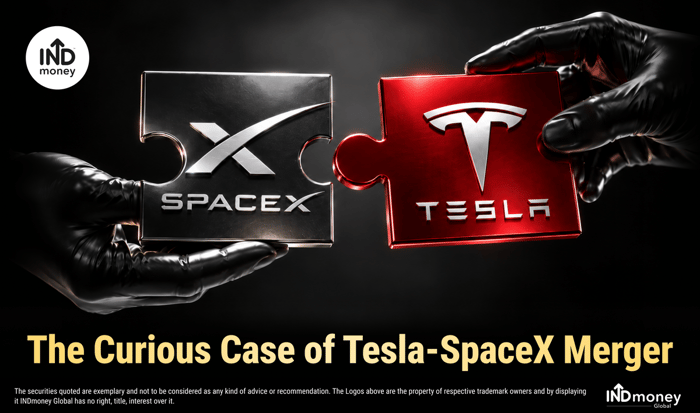
- Tesla-SpaceX Merger Date: Why Barclays Sees a Possible 2026 Announcement
- How Cars and Rockets Ended Up in the Same AI Story
- What Happens to Tesla (TSLA) and SpaceX (SPCX) Shares if They Merge?
- Tesla-SpaceX Merger Math: Who Would Own How Much?
- Everyone Would Inherit the Spending Bill
- Elon Musk Could Gain Something More Durable Than a Premium
- What Would Make the Tesla-SpaceX Merger Convincing
If you own Tesla stock (TSLA), a merger with SpaceX might sound like a rather good bonus. Keep the electric cars, batteries and robotaxis, and get rockets, satellites and artificial intelligence thrown in.
Except shareholders would have to pay for that extra exposure. In the scenario Barclays is discussing, the payment would be a portion of their ownership.
That is what makes the latest Tesla-SpaceX merger speculation interesting. These are businesses with products that could complement each other, enormous ambitions and the same man at the centre. But their shareholders do not all want the same thing.
Barclays analyst Dan Levy sees a possible merger announcement ahead of Tesla’s 2026 annual meeting, which his team says must happen by December 6. The structure he considers most likely is SpaceX acquiring Tesla through an exchange of shares.
So there is now a potential window attached to an old idea. It remains an analyst’s scenario, with no confirmed merger agreement.
For investors, the question is what their shares would represent afterwards, how much of the combined business they would own, and who would decide where its money goes.
Tesla-SpaceX Merger Date: Why Barclays Sees a Possible 2026 Announcement
When we explored the idea in our earlier Tesla-SpaceX merger analysis, the discussion centred on whether combining the companies made sense. Barclays has brought a nearer-term timetable into the conversation.
An annual meeting could give Tesla shareholders an occasion to consider a proposal. But preparing a transaction, explaining its terms and giving shareholders time to evaluate it all takes work. Barclays says even an announcement in late October or early November could make approval at that meeting more difficult.
It also outlines another possibility: an announcement separate from the annual meeting, potentially within the following six to 12 months. December 6 is therefore a date in the analyst’s reasoning. It is not a deadline by which the companies have promised to merge.
Even if a definitive agreement were announced, shareholder votes and regulatory reviews would still stand between a headline and a completed transaction. There is good reason to follow this closely. There is much less reason to treat the calendar as settled.
How Cars and Rockets Ended Up in the Same AI Story
Let’s start with the businesses people recognise.
Tesla makes electric vehicles and energy products. SpaceX launches rockets and operates Starlink, its satellite communications business. On that description alone, combining them sounds like a company trying to do a bewildering number of things.
Their AI ambitions explain why the conversation has become more serious.
Tesla is developing systems that act in the physical world: vehicles that can drive themselves and Optimus humanoid robots. SpaceX acquired xAI in February 2026, bringing an AI business into the group alongside rockets and connectivity.
That creates the outline of a shared business plan. AI needs computing capacity. Computing capacity needs chips and electricity. Vehicles and robots need hardware, software and connectivity. Tesla and SpaceX could supply several of those ingredients.
Barclays sees Terafab, their proposed semiconductor manufacturing initiative, as a particularly important connection. Separate boards must consider decisions involving the project but a common ownership could simplify that process.
The argument is easier to understand when you follow a potential product from start to finish. A robot needs computing hardware, power, software and a connection to the outside world. Coordinating those inputs could help the manufacturer improve the product or reduce its cost. But the shared ambition still has to become a better product at an attractive price. An AI model, a satellite connection and a factory each solve different problems. Ownership can help teams work together; customers ultimately decide whether the result is useful enough to pay for.
There are already financial ties, too. Tesla’s latest quarterly filing says it recognised $318 million of revenue from SpaceX’s Megapack purchases in Q2 2026. It also discloses a $2 billion investment in SpaceX common stock, completed in March following an earlier planned investment in xAI.
These companies already do business together. They can collaborate further without merging. That raises the standard a merger must meet. Shareholders need to understand what becomes possible under one owner that cannot be achieved through supply agreements, joint projects or licensing.
Sharing expensive development work, reducing duplicated investment or bringing a product to customers faster could create value. Putting several related technologies under one corporate name, by itself, does not establish how much value.
There is another detail hidden in those Megapack transactions. After a merger, Tesla supplying a battery system to SpaceX would become a transaction inside the group. It would no longer count as outside revenue in the combined company’s accounts.
The batteries would still be useful. Manufacturing costs would still exist. The group would need customers outside the group to turn that activity into additional cash.
What Happens to Tesla (TSLA) and SpaceX (SPCX) Shares if They Merge?
Under the all-stock structure Barclays describes, Tesla shareholders would exchange their Tesla shares for shares in the combined business at an agreed ratio. Existing SpaceX shareholders would own a smaller percentage of a company that now also included Tesla. Neither side would simply receive another company for free.
The number of shares received would not tell you whether you were better off. A share is simply a unit of ownership, and companies can divide their ownership into different numbers of units. The negotiated value and percentage of the business matter more than whether one old share becomes one new share or several.
For a Tesla shareholder, the attraction would include exposure to Starlink’s communications business, launch services and SpaceX’s AI operations. Starlink already contributes substantial operating earnings. In Q2 2026, SpaceX’s Connectivity segment reported $4.29 billion of revenue and $1.66 billion of operating income.
That could broaden the sources of earnings behind an investment currently tied to Tesla. A shareholder would also participate in any benefits from closer coordination between energy storage, chips, computing and robotics.
But the same share would carry exposure to Starship development, satellite investment and SpaceX’s AI spending. A Tesla investor who wanted a focused bet on cars, energy and autonomous driving would have to reassess the much wider business they owned.
For an existing holder of SpaceX stock (SPCX), Tesla would bring a large manufacturing operation, an established customer base, energy storage products and opportunities in autonomous vehicles and robotics. The price would be the ownership issued to Tesla shareholders.
Suppose Starlink performs exceptionally well after a merger. An existing SpaceX shareholder would participate through a smaller percentage of the expanded group. Whether that is a good exchange depends on what Tesla adds in return. Dilution can be perfectly reasonable when the acquired business contributes enough value. Shareholders need to judge the contribution against the ownership being issued.
And if you already own both stocks, the merger would bring another change: you could no longer adjust those two investments separately. You would have one security covering a broader set of businesses, spending commitments and risks.
Tesla-SpaceX Merger Math: Who Would Own How Much?
The share exchange would be one of the most consequential parts of any proposal.
Barclays’ reported analysis uses rounded market values of approximately $1.5 trillion for Tesla and $2.1 trillion for SpaceX. These are reference figures for the discussion, rather than a live valuation or agreed transaction price. We can use them to understand how ownership might work.
Assume, for this illustration, that both companies are valued at those amounts and SpaceX offers no takeover premium. Ignore existing cross-holdings, employee awards, taxes, fees and market movements.
The two values add up to $3.6 trillion. Tesla shareholders would receive about 41.7% of the combined company. Existing SpaceX shareholders would retain about 58.3%.
Now change one assumption.
Suppose Tesla shareholders negotiate a 25% premium. This is an illustrative assumption, not a forecast or a Barclays offer.
Tesla’s value for dividing ownership would rise from $1.5 trillion to $1.875 trillion. Against SpaceX’s unchanged $2.1 trillion, that would give Tesla shareholders approximately 47.2% of the combined company. Existing SpaceX shareholders would retain 52.8%.
| Illustrative transaction terms | Tesla shareholders’ ownership | Existing SpaceX shareholders’ ownership |
| No premium for Tesla | 41.7% | 58.3% |
| A 25% premium for Tesla | 47.2% | 52.8% |
Author’s calculations using the rounded reference values above. These percentages illustrate economic ownership, not voting power.
The premium has changed how ownership is divided. It has not, on its own, made the underlying businesses more valuable.
If investors still valued the combined group at $3.6 trillion after that premium deal, existing SpaceX shareholders’ 52.8% would be worth roughly $1.90 trillion. Their starting investment was worth $2.1 trillion. Under these simplified assumptions, their combined stake would have lost about 9.4% of its value.
For that same stake to remain worth $2.1 trillion, the combined company would need a market value of approximately $3.975 trillion. That is $375 billion above the original $3.6 trillion sum.
The merger would need to generate that additional value, or persuade investors to recognise it, for the original SpaceX shareholders to break even in this example. This is why a premium can look attractive to one group while creating a demanding hurdle for the other.
It also explains why an all-stock offer does not lock in a cash return for Tesla shareholders. The value of the shares they receive would move with the combined business. An attractive headline premium could shrink if those shares fell. The exchange ratio tells you how many shares arrive. The value of those shares determines what the transaction is worth.
This also gives Tesla stock and SpaceX stock reasons to respond differently to the same announcement. Tesla investors might welcome a proposed premium. SpaceX investors might question the amount of ownership being issued to fund it. Both groups could benefit if credible operating improvements outweigh the price and disruption of combining.
Before an agreement, share prices can also reflect investors’ guesses about the likelihood of a transaction. Anyone valuing either stock mainly on a possible merger would therefore be relying on a negotiation whose outcome is still unknown.
Everyone Would Inherit the Spending Bill
The combined company would have access to remarkable businesses. It would also inherit their investment requirements.
In Q2 2026 alone, SpaceX reported $18.37 billion of capital expenditure on assets such as equipment and data centres. Of that, $15.83 billion went to AI, accounting for roughly 86% of the quarter’s capital spending.
Those numbers help explain why the SpaceX name can now give an incomplete impression of the investment. Much of its current spending is directed towards computing infrastructure.
Tesla is investing heavily as well. In its latest financial quarter, Q2 2026, it generated $4.70 billion of operating cash flow and spent $5.79 billion on capital expenditure, leaving negative free cash flow of $1.09 billion.
Tesla’s Q2 filing also put expected 2026 capital expenditure above $25 billion. That makes it difficult to describe the prospective merger as simply bringing together a steady cash generator and an ambitious spender. Both are funding expensive expansion.
They have substantial resources. SpaceX reported approximately $100 billion in cash, cash equivalents and marketable securities at June 30, while Tesla reported $43.5 billion in cash, cash equivalents and short-term investments. Those are gross liquidity figures, before considering debt and other commitments.
The resources give them room to invest. Shareholders still need the investment to earn an adequate return.
There is a credible positive case. A larger group might allocate money more efficiently, share infrastructure and avoid building the same capability twice. Profits from established products could finance promising new ones.
The difficult case is also easy to picture. Several major projects could need more time and money at once, while management has greater freedom to move funding between them.
For Tesla shareholders, that could mean more capital directed towards space and computing. For SpaceX shareholders, it could mean funding automotive or robotics expansion alongside their existing commitments.
A wider collection of businesses could also become harder to value. Investors comfortable analysing satellite subscriptions might have a different view of automotive margins or robotics development. Some may pay more for access to the whole group; others may prefer a simpler investment and attach a lower valuation to the combination.
Clear reporting would help. Shareholders should be able to follow which businesses earn money, which consume it, and how much funding moves between them. Otherwise, improving results in one division could make it harder to notice deteriorating returns elsewhere.
The useful question is how much the merger would reduce the combined funding requirement, or improve the returns earned on that spending. A larger balance sheet provides capacity; investment discipline determines what shareholders get from it.
Elon Musk Could Gain Something More Durable Than a Premium
Musk’s position makes this transaction unusual. He has interests on both sides, and the merger could change his voting power across the businesses.
SpaceX has different classes of shares. Its publicly traded Class A shares carry one vote each; Class B shares carry ten. That allows economic ownership and voting control to differ substantially.
Under Barclays’ assumptions, Musk could own approximately 37% of the combined company while controlling about 56% of its voting power. Those are scenario estimates, dependent on the transaction structure.
That could give him a majority of votes while owning considerably less than half the financial stake. This projected control belongs to the hypothetical combined company; it does not resolve the approvals needed before a transaction can close.
For investors who back Musk’s long-term plans, stronger control may be appealing. It could make it easier to pursue projects whose benefits take years to appear and to coordinate decisions across the group. For minority shareholders, it would also affect their ability to influence those decisions.
That trade deserves a place beside any discussion of a takeover premium. Tesla shareholders could receive additional value upfront while moving into a structure where the founder has more durable control. SpaceX shareholders could see their economic ownership diluted while the founder retains a voting majority.
Musk’s involvement on both sides would make the negotiating process especially important. Shareholders would need to understand who assessed the valuations, how conflicts were managed and what independent directors concluded about the terms.
A founder can see strong reasons to combine his companies. Each board still needs a convincing explanation of why the exchange serves its own shareholders.
What Would Make the Tesla-SpaceX Merger Convincing
A formal proposal would give investors something more useful than another hint: terms they could evaluate.
The first would be the ownership split. Shareholders should be able to see what they are receiving, the premium embedded in the exchange and the assumptions behind both valuations.
Next would come the financial benefits. Management would need to explain which costs disappear, which investments can be shared, and which additional customer revenues require a merger to achieve. A timetable would help distinguish near-term improvements from longer-term possibilities.
The capital plan would matter just as much. Investors would need a clear account of how much funding the combined business requires and how management would choose between competing projects.
Then there are the approvals. Barclays flags shareholder and antitrust reviews, along with potential national-security considerations arising from SpaceX’s U.S. government work and Tesla’s significant operations in China. These could complicate a transaction; they do not establish that it would be blocked.
Tesla’s next confirmed financial event is its October 21 earnings release. Its operating update already reported 486,532 vehicle deliveries and 13.7 GWh of energy storage deployments for Q3 2026. The financial results will show what those volumes meant for profit and cash generation.
Those results matter even if management says nothing about a merger. Each company’s standalone performance helps determine what its shareholders should demand in an exchange.
Our view is that the business connections justify taking the possibility seriously. Energy storage, computing, chips, connectivity and physical AI offer plausible opportunities for coordination.
The shareholder case will depend on the price and the terms. A costly premium could consume much of the benefit. A poorly defined spending plan could leave investors financing ambitions they had not intended to fund. Greater founder control could be valuable to some shareholders and a meaningful concession for others.
The strongest version of this deal would give both groups a fair share of demonstrable benefits, with a capital plan they can understand.
Until those details emerge, Tesla stock and SpaceX stock remain claims on two separate businesses. Barclays has supplied a possible timetable. Shareholders still need to see what they would be asked to exchange.