

- SpaceX, Anthropic and OpenAI: How the $5.2 Trillion Valuation Adds Up
- How Much Were 46 Years of US Tech IPOs Worth at Their Debut?
- OpenAI and Anthropic Valuations: What Their Latest Funding Rounds Tell Us
- Why Are SpaceX, Anthropic and OpenAI Valued So Highly?
- SpaceX Stock: A Profitable Starlink Business Alongside Heavy AI Spending
- Anthropic IPO: Claude’s Growth Is Real, but the Offering Price Is Unknown
- OpenAI IPO: ChatGPT Has Enormous Reach. What Will That Reach Earn?
- What Makes This Different From Earlier Tech IPOs?
- What Should Investors Examine When These AI Companies Go Public?
- Author’s View: A Powerful Story About AI, and an Even Bigger Story About Entry Prices
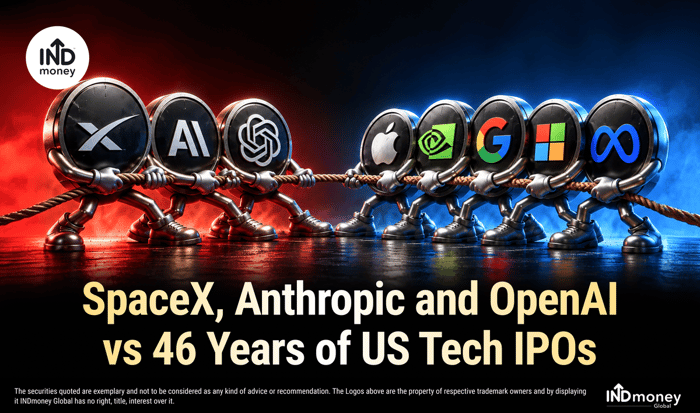
What if the combined value of just three companies exceeded the value of thousands of technology companies when they first arrived on the US stock market?
That is the possibility we found when comparing SpaceX, Anthropic and OpenAI with US technology IPOs going back to 1980. Using an approximate $2 trillion value for SpaceX, a $2 trillion potential IPO value for Anthropic, and a $1.2 trillion potential value for OpenAI, the three add up to $5.2 trillion.
Now consider the other side. The 3,365 qualifying US tech companies that went public from 1980 through 2025 had a combined market value of approximately $4.07 trillion when they first began trading, according to IPO data compiled by University of Florida professor Jay Ritter. That period includes the IPO eras of companies such as Apple, Microsoft, Nvidia, Google and Facebook.
The possible value of three companies is therefore about $1.13 trillion higher than the combined debut value of those 3,365 US IPOs.
It sounds absurd. But before deciding what it says about AI stocks, we need to understand what is being compared. Two of the three valuations are still possibilities, and the historical figure measures companies at their IPOs, not at their values today. Once those details are clear, the comparison tells a much more useful story about how technology companies reach the public market and what investors may be paying for future growth.
SpaceX, Anthropic and OpenAI: How the $5.2 Trillion Valuation Adds Up
The math is simple. The certainty behind each number is different.
| Company | Value used in the comparison | What the number represents |
| SpaceX | About $2 trillion | An approximate reference value for a company that is already publicly traded |
| Anthropic | $2 trillion | A possible valuation for a future IPO, not a final offering price |
| OpenAI | $1.2 trillion | A possible future valuation, not a completed IPO price |
| Combined | $5.2 trillion | An illustrative scenario |
SpaceX began trading in June 2026 under the ticker SPCX. Anthropic and OpenAI have both announced confidential IPO filings. Neither has announced a final offering price, and OpenAI has said its timing remains undecided. That means $5.2 trillion is a scenario, not the combined value of three completed IPOs.
The historical number is more precise. Ritter’s dataset puts the combined first-day market value of the qualifying tech IPOs at $4.0656 trillion, which we have rounded to $4.07 trillion. It covers 1980 through 2025, or 46 calendar years when both years are included.
This gives us a surprising possibility, but it does not tell us that SpaceX, Anthropic and OpenAI are worth more than every older tech company today. That is a completely different comparison.
How Much Were 46 Years of US Tech IPOs Worth at Their Debut?
Think of the dataset as a collection of photographs taken on IPO debut days.
Apple’s photograph comes from 1980. Microsoft’s comes from 1986. Nvidia’s comes from 1999. Google’s comes from 2004, and Facebook’s from 2012.
Ritter’s calculation adds up company valuations at the point each qualifying business first traded, along with thousands of other IPO debut values. It does not follow their market values through the decades that came afterwards.
That distinction matters. Much of the value associated with those familiar companies was created after they went public. An investor looking at Nvidia in 1999 was looking at a very different business from the AI infrastructure company investors examine today.
There are two further limits to the comparison.
First, Ritter’s figures are in the dollars of each IPO year. The total is not adjusted for inflation. Second, the dataset has defined inclusion rules. It covers qualifying US tech IPOs, including internet and telecommunications companies, while excluding biotech and several categories of offerings. “Every tech IPO” is convenient shorthand, but the precise figure refers to the 3,365 IPOs in that dataset.
The $4.07 trillion figure is also market value, not money raised in IPOs. The companies in Ritter’s sample raised a combined approximately $424.5 billion through their offerings. An IPO can sell only a portion of a company’s shares, while market value puts a price on the whole company.
OpenAI and Anthropic Valuations: What Their Latest Funding Rounds Tell Us
The $5.2 trillion result depends heavily on what Anthropic and OpenAI are eventually valued at. We can see how much by replacing the future estimates with valuations the companies have already announced.
Anthropic said its May 2026 funding round valued it at $965 billion after the investment. OpenAI said its March 2026 round valued it at $852 billion after the investment. Keeping SpaceX at the same approximate $2 trillion reference level gives us:
$2 trillion + $965 billion + $852 billion = $3.817 trillion.
That is approximately $249 billion below the $4.066 trillion historical IPO total. In other words, the conclusion changes when we change the assumptions.
| Comparison | Combined value |
| SpaceX plus the possible Anthropic and OpenAI values | $5.2 trillion |
| SpaceX plus Anthropic’s and OpenAI’s disclosed funding valuations | $3.817 trillion |
| Qualifying US tech IPOs from 1980 to 2025, valued at debut | $4.066 trillion |
Private funding valuations are not identical to public market prices either. The important point is that the three-company total does not automatically exceed the historical IPO total. It does so if Anthropic and OpenAI achieve sufficiently high future valuations.
Why Are SpaceX, Anthropic and OpenAI Valued So Highly?
The first reason is that companies can now become enormous while staying private.
Earlier technology businesses often listed at a smaller size. Public investors then saw them expand their products, reach new markets and build much larger businesses. Anthropic and OpenAI have raised vast sums privately and reached global users or customers before their IPOs. A considerable amount of their expected growth is being reflected in valuations before a public investor gets a conventional stock market entry point.
The second reason is the size of the opportunity investors believe AI could create. If AI tools become a regular part of office work, software development, customer service and other tasks, spending on them could grow substantially. SpaceX adds a different mix: an existing satellite connectivity business alongside rockets, AI products and computing infrastructure.
But a large opportunity does not guarantee that one company will keep a large share of the resulting profits. To judge these valuations, investors need to examine how much customers pay, what it costs to serve them, and how much cash is left after growth spending.
The latest disclosed numbers show both the appeal and the difficulty of that exercise.
SpaceX Stock: A Profitable Starlink Business Alongside Heavy AI Spending
SpaceX is already a public company, making SPCX stock the one share price investors can follow today. Its operations extend well beyond rockets. In its second-quarter 2026 results, SpaceX reported three segments: Space, Connectivity and AI. Its AI activities include Grok and related infrastructure, so Grok or xAI should not be treated as a separately listed stock in this comparison.
SpaceX reported $7.814 billion in second-quarter revenue, up from $4.071 billion a year earlier. Its Connectivity segment, which includes Starlink, generated $4.291 billion in revenue and $1.656 billion in operating income. SpaceX reported 12 million Starlink subscribers at the end of the quarter.
The AI segment tells a different part of the story. It brought in $2.561 billion in quarterly revenue, but reported an operating loss of $1.257 billion and $15.828 billion in capital expenditure for the quarter. Across the whole company, SpaceX reported a $541 million net loss.
For an investor, this is more informative than simply calling SpaceX a $2 trillion company. Starlink has a large subscriber base and is already generating operating profit. AI revenue is rising quickly, while the company is committing extraordinary amounts of money to expand computing capacity. The question for SPCX stock is whether that investment will eventually produce enough additional cash to justify its cost.
As a rough scale check, multiplying second-quarter revenue by four produces an annualised figure of about $31.3 billion. A $2 trillion valuation would be roughly 64 times that figure. This is not a full-year forecast: revenue can change substantially from quarter to quarter. It illustrates how much future growth and profitability a valuation of that size depends on.
Anthropic IPO: Claude’s Growth Is Real, but the Offering Price Is Unknown
Anthropic’s Claude products have found demand among both individuals and businesses, including customers using AI for coding and other work. When Anthropic announced its May 2026 funding round, it said its revenue run rate had passed $47 billion earlier that month. The round valued the company at $965 billion after the investment.
A run rate takes a recent level of revenue and expresses it as an annual pace. It helps show how quickly a business is growing, but it is not revenue already earned over a completed year. That distinction becomes particularly important when growth is moving fast.
The $2 trillion value used in our comparison would be more than double Anthropic’s last disclosed funding valuation. At a $47 billion revenue run rate, it would equal about 43 times that pace of sales. The eventual numbers could look different by the time Anthropic goes public, which is precisely why investors need the public prospectus and final offering price.
Anthropic has confirmed a confidential draft IPO filing. It has also stated that the number of shares and their price have not been set. Once full IPO documents are published, investors will have a better basis for judging actual revenue, losses, computing costs and cash needs.
OpenAI IPO: ChatGPT Has Enormous Reach. What Will That Reach Earn?
OpenAI has built one of the most recognisable products of the AI era. In March 2026, it reported more than 900 million weekly active ChatGPT users and more than 50 million subscribers. It said enterprise products accounted for more than 40% of revenue, and that it was generating $2 billion in revenue per month at that point. Its funding round valued the company at $852 billion after the investment.
These figures explain why an OpenAI IPO attracts attention. ChatGPT gives the company a direct route to consumers, while its business and developer products create other ways to earn revenue.
They do not, by themselves, establish what OpenAI shares would be worth. A large user base must translate into lasting payments. Revenue must also cover the cost of developing and running models, obtaining computing capacity and competing for customers.
As an illustration, $2 billion a month would amount to $24 billion over 12 months if that exact pace continued. A $1.2 trillion valuation would be 50 times that annualised figure. OpenAI’s revenue could grow before an IPO, so this is a way to understand the scale of the valuation, not a projection of its eventual accounts.
OpenAI has confirmed that it confidentially submitted an IPO filing, while saying that the timing remains undecided. The $1.2 trillion value in our comparison is therefore a possibility to examine, not a price investors have already paid in an OpenAI IPO.
What Makes This Different From Earlier Tech IPOs?
Ritter’s data gives us a sense of the typical starting point in the historical sample. Across the 3,365 qualifying tech IPOs, the average first-day company value was about $1.2 billion. The median was $216 million, meaning half of the companies were valued below that amount.
A potential trillion-dollar Anthropic or OpenAI debut would start at a vastly different scale. Investors would not be getting the same kind of early public market starting point that existed for many past technology companies.
That has two possible consequences. A much larger business may arrive with substantial revenue, recognised products and more evidence of demand. At the same time, a high starting value already assumes an enormous amount of future success.
Consider the arithmetic. A company valued at $2 trillion would need to reach $4 trillion for its value to double. A company valued at $200 billion would need to reach $400 billion. Both outcomes represent the same percentage gain, but the larger company must add $2 trillion in value to get there.
That does not mean a trillion-dollar company cannot grow much larger. It means its future revenue and profits have to support a far bigger starting price.
What Should Investors Examine When These AI Companies Go Public?
A headline valuation makes an IPO interesting. The following figures will help determine whether its price makes financial sense.
- The final offering price and company value. Anthropic’s and OpenAI’s potential valuations may change before listing.
- Revenue earned over a full year. This gives a firmer base than a single month’s revenue or a run rate.
- Operating profit or loss. Rapid sales growth is more valuable when the cost of serving customers does not rise just as quickly.
- Cash spent on infrastructure. AI requires computing capacity, and the timing of that spending can differ greatly from the timing of revenue.
- Dependence on partners and large customers. Investors should understand who supplies computing power, who brings in customers and how the economics are shared.
- The growth already assumed by the price. An excellent product can still be difficult to value attractively if the share price anticipates years of near-perfect execution.
These checks also apply to SpaceX. Its public reports already allow investors to compare Starlink’s operating income with the substantial investment and losses in its AI segment. Anthropic’s and OpenAI’s eventual public documents should allow a clearer comparison across all three.
Author’s View: A Powerful Story About AI, and an Even Bigger Story About Entry Prices
The possibility that three companies could exceed $4.07 trillion, the combined debut value of 3,365 historical tech IPOs, is genuinely striking. It reflects real demand: SpaceX has a large and profitable connectivity operation, Anthropic has reported an exceptional Claude revenue pace, and OpenAI has brought ChatGPT to a vast audience.
We think the investor lesson lies in the price at which that demand becomes available on the stock market. The strongest businesses of earlier tech eras created much of their value after their IPOs. Anthropic and OpenAI may arrive with far more of their expected success already reflected in their valuations.
The $5.2 trillion comparison may eventually become reality, or market prices may produce a very different figure. It cannot be confirmed until Anthropic and OpenAI have actual public market values. What we can say now is that a potential $2 trillion or $1.2 trillion debut sets a demanding starting line.
For investors, the question is not whether ChatGPT, Claude, Grok or Starlink matter. Their use and reach provide plenty of evidence that they do. The harder question is how much profit these businesses can ultimately generate, and how much of that future has already been priced into their shares.