

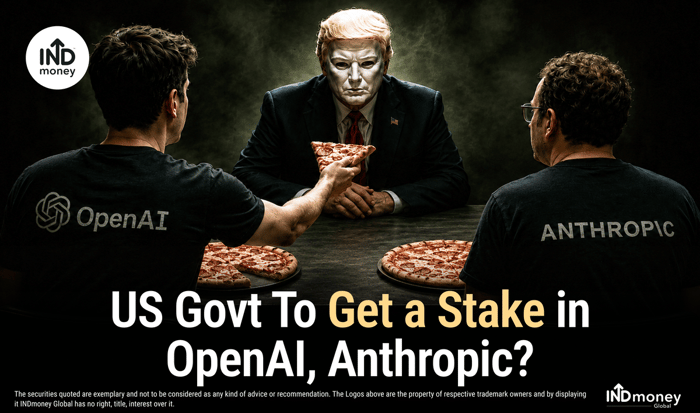
OpenAI has proposed handing the US government a stake of between 1 and 5 percent in the company. At the top end of that range, and at OpenAI's current $852 billion valuation, that is $42.6 billion on paper. The Intel reflex is immediate: Washington's 10% stake in the chipmaker, purchased for $8.9 billion in August 2025, is now sitting on roughly $28 billion in unrealized gains. Intel's stock rose over 84% in 2025 after the deal.
If OpenAI follows the same script, the trade writes itself. Except the two transactions are structurally opposite. When the Trump administration took a stake in Intel, it paid $8.9 billion. OpenAI is proposing to donate equity to the government, no cash changes hands. That is not Washington betting on OpenAI's future. It is OpenAI buying political insurance against its own future.
Meanwhile, Anthropic has refused any government equity arrangement and is now valued at $965 billion, more than OpenAI's $852 billion. Both companies have filed confidentially for IPOs. Both are on track for potentially trillion-dollar listings. But one cooperated with Washington and one didn't, and the market has priced the independent one higher.
Let's break down what is actually happening in this government-AI equity story, why the Intel narrative is a seductive but faulty comparison, and what investors should watch before either company lists.
What OpenAI’s Proposed Government Stake Really Means
The OpenAI proposal, as reported by the FT, involves OpenAI donating a 1%-5% equity stake to the US government. No final figure has been agreed, and no formal deal has been signed. Altman has discussed the terms with President Trump, Commerce Secretary Howard Lutnick, and Treasury Secretary Scott Bessent
Those shares would seed what OpenAI called a "Public Wealth Fund" in a 13-page policy paper titled "Industrial Policy for the Intelligence Age," published in April 2026. The fund would invest in "diversified, long-term assets" across AI companies and distribute returns to American households.
OpenAI CEO Sam Altman first pitched this concept to the Trump administration in early 2025. The government has been in discussions for over a year. The mechanics matter enormously. This is donated equity, not purchased equity. It is passive ownership with no board seats, no governance rights, and no voting power, structurally similar to the Intel deal in that respect, but opposite in terms of who is taking the financial risk.
In the Intel transaction, the government converted $8.9 billion in previously committed but unpaid CHIPS Act grants into shares, effectively putting taxpayer money to work in the equity markets. In the OpenAI proposal, existing OpenAI shareholders would be diluted by 5% to create a government position. The government gets the upside without the risk. OpenAI's existing investors absorb the cost.
The proposal is also envisioned as industry-wide, not company-specific. Altman has reportedly suggested other leading US AI companies including Anthropic, Google, and Meta, hand the government similar stakes under the same framework. Whether any of those companies would participate is unclear.
How Trump’s Tech Equity Strategy Sets the Stage for OpenAI
The OpenAI proposal does not arrive in isolation. Over the past year, the Trump administration has built a meaningful equity portfolio in strategic technology sectors.
| Company / Entity | Deal Type | Govt Investment | Stake | Outcome |
| Intel (INTC) | Grants converted to equity | $8.9 billion | ~9.9% | ~$28B+ unrealized gain by April 2026 |
| US Steel / Nippon | "Golden share" (governance, no equity) | No cash outlay | Veto rights only | Company delisted; government holds veto over key decisions |
| IBM and 8 quantum companies | Grant-for-equity swap | $2 billion total ($1B to IBM subsidiary) | Minority stakes | IBM up 12% on announcement; D-Wave, Rigetti up 25-33% |
| OpenAI (proposed) | Donated equity | $0 from government | 5% (proposed) | No formal deal yet; discussions ongoing |
Sources: Intel press release, FT, Commerce Department, Federal News Network
The pattern is real: the Trump administration has been converting subsidy relationships into equity relationships across semiconductors, steel, rare earths, quantum computing, and now AI. Commerce Secretary Howard Lutnick has framed it consistently as "taxpayer upside" rather than grants with no return.
But each deal has a different structure. Intel was a genuine equity purchase. US Steel is governance control without equity. The IBM and quantum deals involved grant-to-equity conversions for relatively small, early-stage businesses. OpenAI's proposal is a donation, the most favorable structure for the government and the most costly for existing investors.
Why Anthropic’s Higher Valuation Changes the OpenAI IPO Debate
This is the key Anthropic risk investors need to understand. In February 2026, the Trump administration banned federal agencies from using Anthropic after the company refused to give the Pentagon unrestricted access to Claude. Anthropic wanted two guardrails:
- No mass surveillance of Americans
- No fully autonomous weapons without human oversight.
The Pentagon rejected both. OpenAI chose the opposite path. It signed a Pentagon deal the same day, becoming Washington’s preferred AI partner, while Anthropic became the difficult counterparty.
The legal picture has since improved for Anthropic, but only partly. A California court blocked the ban for civilian agencies, calling it “likely retaliatory,” but Anthropic remains excluded from Pentagon contracts under a separate designation.
A second issue came in June, when Commerce restricted exports of Anthropic’s Fable 5 and Mythos 5 models over jailbreak concerns. Anthropic added a safety filter blocking the technique more than 99% of the time, and the restrictions were lifted on July 1.
The bigger investor takeaway: Anthropic is resisting government ownership. Instead of giving Washington equity, it has proposed a “digital dividend” funded by future AI-sector taxes. OpenAI’s model gives the public upside through ownership. Anthropic’s model shifts the cost to the sector after it becomes profitable. For investors, that is not just a policy debate. It changes the IPO math.
| Metric | OpenAI | Anthropic |
| Latest valuation | $852 billion (March 2026) | $965 billion (May 2026) |
| Annualized revenue run rate (ARR) | ~$25 billion (Q1 2026) | ~$47 billion (May 2026) |
| Revenue growth rate | ~3.4x year-on-year | ~10x year-on-year |
| IPO filing | Confidential S-1, June 8, 2026 | Confidential S-1, June 1, 2026 |
| IPO target timing | 2026-end or 2027 | October 2026 (target) |
| Government equity status | Proposing 1-5% donation | Exploring "digital dividend" (tax-funded) |
| Federal contract access | Pentagon deal active | Pentagon excluded (FASCSA designation active); California preliminary injunction in place) |
| Cash burn (2026E) | ~$27 billion | ~$19 billion |
| Path to profitability | 2030 | 2028 |
Sources: Sacra, CNBC, FT, BitMEX, SmartAsset, Reuters (June 2026)
Anthropic is worth $113 billion more than OpenAI despite active Pentagon litigation, a California preliminary injunction that is still being appealed, and a separate Fable/Mythos export control episode that was resolved yesterday. Its ARR is nearly double OpenAI's and growth rate is three times faster. And it is targeting profitability two years earlier.
The market has voted: protecting shareholder equity, growing faster, and maintaining governance independence appear to matter more than a White House handshake. If anything, the direction of the legal battles, suggests the government conflict is resolving faster than Anthropic's IPO timeline requires.
The ‘Regulatory Put’ Behind OpenAI’s IPO Strategy
A put option is like downside insurance. The buyer pays a premium for the right to protect themselves if the stock price falls. So when a company buys a put option on its own stock, it is paying to limit the impact of a decline in its share price.
OpenAI's proposed 5% donation is a Regulatory Put. The company is paying an insurance premium, diluting existing shareholders by $42.6 billion in equity value, to buy protection against aggressive legislative action. The most immediate threat is Senator Bernie Sanders' American AI Sovereign Wealth Fund Act, introduced in June 2026, which proposes a one-time 50% stock tax on AI companies generating more than $200 million in annual AI-related revenue.
Sanders estimates the fund would be worth approximately $7 trillion. If that bill passed in anything close to its current form, it would wipe out roughly half of OpenAI's private equity value.
The Regulatory Put Math:
| Item | Figure |
| OpenAI current valuation | $852 billion |
| Proposed 5% donated stake value | $42.6 billion |
| OpenAI estimated 2026 annualized revenue | ~$25 billion |
| Cost of Regulatory Put as multiple of revenue | 1.7x annual revenue |
| Value at risk under Sanders bill (50% stake) | ~$426 billion |
| Ratio of insurance cost to maximum loss avoided | ~10x protection per dollar of premium |
In insurance terms, OpenAI is paying a 5% premium to protect against a 50% loss. That is rational, assuming the political risk is real and the bill has any probability of advancing. The question for existing investors is whether they should be paying that premium or whether the government would accept a smaller stake and still provide adequate political cover.
For Anthropic, there is no Regulatory Put in place. If Sanders-style legislation advanced, Anthropic would face the same exposure as OpenAI without the government's financial interest acting as a floor. That is a real risk and possibly one the market is underpricing relative to Anthropic's current valuation premium.
Why AI Regulation Makes OpenAI’s Dilution Math Look Rational
The AI ownership debate is unusual because both Bernie Sanders and the Trump White House are moving toward the same broad idea: if AI companies reshape the economy, the public should share in the upside. Sanders’ bill goes much further. It would place a one-time 50% tax on the stock of AI companies with more than $200 million in annual AI revenue.
That stock would go into a sovereign wealth fund, giving eligible Americans voting shares and possible annual payouts of around $1,000 per person. OpenAI and Anthropic have also supported versions of public wealth-sharing, but with an important difference: control.
OpenAI’s proposal would make the government a passive financial holder, with no board seats or voting power. Sanders’ plan would give the government voting shares and board representation. That distinction matters for IPO investors. A 5% passive stake is a financial arrangement. A 50% voting stake changes the governance of the company itself.
Five OpenAI and Anthropic IPO Risks Investors Should Watch
1. The deal may never happen: There is still no clear legal framework for OpenAI to give equity to the U.S. government. If the deal fails before IPO, OpenAI loses the political protection but keeps the uncertainty.
2. A 5% passive stake may not be enough: Sanders’ proposal asks for 50% stock ownership with voting rights. OpenAI’s proposed 5% passive stake may not satisfy lawmakers and could even strengthen the argument for public ownership.
3. Dilution is costly when cash burn is high: OpenAI is expected to burn about $27 billion in 2026 and $63 billion in 2027, with cash-flow breakeven not expected until 2030. Giving away equity means less capital available for AI infrastructure and model training.
4. Anthropic could expose the governance discount: If Anthropic lists near OpenAI and gets a stronger valuation without a government stake, investors may treat OpenAI’s government relationship as a risk, not a benefit.
5. Passive ownership does not remove political control risk: Even without voting rights, the government can still influence OpenAI through contracts, regulation, procurement, and national-security pressure. The stake may reduce optics risk, but not political risk.
Bottom Line: OpenAI vs Anthropic IPO — Which Story Looks Stronger?
OpenAI's proposed 5% equity gift to Washington is a Regulatory Put as shareholders absorb $42.6 billion in dilution to buy political insurance against legislation that could cost ten times more. It is rational corporate risk management, not a government endorsement. Anthropic's refusal to play the same game, followed by its $113 billion valuation premium over OpenAI, is the market's clearest signal that governance independence and faster revenue growth matter more than White House goodwill at these valuations.
When AI giants of this scale go public, approximately 80-90% of IPO shares are allocated to institutional investors, large mutual funds, banks, and hedge funds. Retail investors, including those buying through Indian brokers on the first day of trading, typically access secondary market prices, not the IPO price. The day-one premium on a listing of this magnitude could be significant in either direction.
The real decision for investors is not whether to own AI, but whether to enter at IPO (at whatever valuation the market sets) or to buy listed proxies now at known prices. Microsoft, Amazon, Google, and Nvidia all offer structured AI exposure with public market liquidity.