

- Anthropic IPO Date: Why It Could List Before OpenAI
- Anthropic vs OpenAI IPO: Why First Listing Could Set Valuation Benchmark
- Anthropic vs OpenAI Valuation: ARR, Margins and Profitability Compared
- Amazon and Google’s Anthropic Stake: Why the IPO Matters for Big Tech
- What SpaceX IPO Means for Anthropic, OpenAI IPOs
- Anthropic and OpenAI IPO Risks: Regulation, Governance and Compute Spending
- Anthropic and OpenAI IPO Timeline: Key Dates and Milestones to Watch
- Our Take on Anthropic, OpenAI IPOs
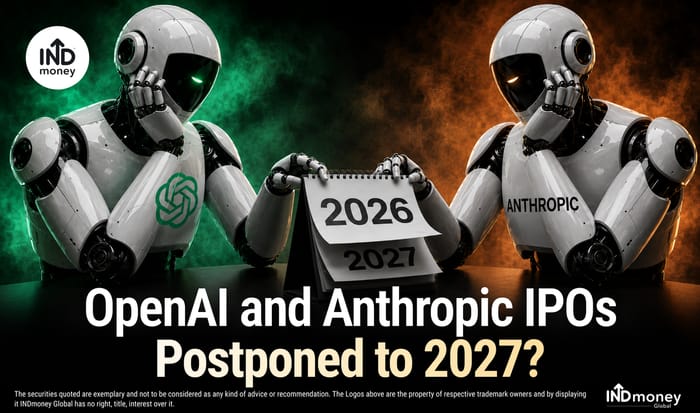
The most anticipated IPO race in market history has quietly split in two. Anthropic, fresh off a $965 billion private valuation and a confidential S-1 filed with the SEC on June 1, 2026, is still targeting an October listing on Nasdaq, potentially making it the first company to debut on public markets at a $1 trillion valuation.
ChatGPT parent OpenAI, which filed its own S-1 just a week later on June 8, is now leaning toward 2027 according to Bloomberg's June 26 reporting, citing market volatility and CEO Sam Altman's hard floor of a $1 trillion listing price.
This comes after the SpaceX IPO priced at $135 on June 11, rocketed to $225 within days, then gave back roughly 32% of its gains. The AI IPO market watched that retracement and drew very different conclusions.
Let's break down what actually happened with the Anthropic and OpenAI IPO timeline, why it matters for investors tracking these names, and what the diverging timelines reveal about the state of the AI business model heading into 2027.
Anthropic IPO Date: Why It Could List Before OpenAI
The headline that circulated after Bloomberg's June 26 report, "AI IPOs delayed to 2027" was, at best, half right. OpenAI is leaning later. Anthropic is not.
Anthropic's confidential S-1 filing started the SEC clock on June 1. For a company of this scale, confidential review typically runs three to six months. That puts a public S-1 release in roughly September 2026, an institutional roadshow through September and early October, and a first trade date targeting October.
The company has Goldman Sachs, JPMorgan, and Morgan Stanley as lead underwriters. It cleared a material political hurdle on June 19 when President Trump told Axios he no longer viewed Anthropic as a national security threat. The window is open.
OpenAI filed a week later on June 8, but then immediately played down urgency. In a public statement, the company said it had "not decided on timing" and that "it may be a while." Bloomberg reported that OpenAI's leadership expects Anthropic to list first. CFO Sarah Friar has reportedly told associates that 2027 is the timeline she has been advocating internally, citing OpenAI's cash burn, over $600 billion in compute infrastructure commitments through 2030, and the company's readiness to meet public-company reporting obligations. Sam Altman has also told executives that any valuation below $1 trillion is off the table.
These are two very different problems. Anthropic's October race is a strategic choice, win the first-mover pricing advantage. OpenAI's IPO delay is a constraint, the math doesn't work at $1 trillion without either more revenue quarters or a friendlier market.
Anthropic vs OpenAI IPO: Why First Listing Could Set Valuation Benchmark
This is the analytical framework that most coverage misses when discussing these two IPOs.. Call it the Benchmark Trap.
In a two-company race where both companies sell near-identical products to overlapping enterprise customers, the second company to go public does not get a clean valuation debate. It gets priced relative to the first.
Anthropic's October IPO will not just be an event, it will become the market-clearing multiple for AI inference revenue. Whatever price-to-ARR multiple public investors assign to Anthropic in October 2026 becomes the denominator for every banker's OpenAI model in 2027.
If Anthropic lists at, say, 20x forward ARR, OpenAI in 2027 must either command the same multiple with stronger financials, or explain why it deserves a premium despite higher burn. That is a harder pitch after twelve months of Anthropic trading as a public company, accumulating disclosures, and letting institutional research settle into consensus.
OpenAI IPO Financials: Revenue, Losses and Compute Costs to Watch:
| OpenAI Financials | Amount | Simple meaning |
| Q1 2026 revenue | ~$5.7 billion | OpenAI generated strong sales in just one quarter. |
| Q1 2026 net loss | ~$21.3 billion | OpenAI still lost a very large amount of money. |
| Non-cash charges | ~$12.4 billion | A big part of the loss was accounting-related, not direct cash burn. |
| Estimated 2026 GAAP loss | ~$25–26 billion | Full-year reported losses could remain very high. |
| Common non-GAAP loss figure | ~$14 billion | Some coverage uses a lower adjusted loss number. |
The key takeaway is that OpenAI’s GAAP loss appears much higher than the adjusted loss figure used in much of the coverage. By the time OpenAI lists in 2027, it will have multiple quarters of audited losses on record. Those numbers will already be inside every institutional financial model.
Anthropic's burn is also substantial, roughly $19 billion in annual compute spending as of early 2026, but its gross margin trajectory is improving faster, and its path to cash-flow breakeven is 2028 versus OpenAI's 2030.
Anthropic vs OpenAI Valuation: ARR, Margins and Profitability Compared
A few important caveats upfront. Neither company has filed a public S-1 yet. The revenue figures below are company-disclosed run-rate numbers, not audited annual revenue. Treat them as directional data, not accounting truth.
| Metric | Anthropic | OpenAI |
| Last private valuation | ~$965 billion | ~$852 billion |
| ARR (self-reported) | ~$47 billion (May 2026) | ~$25 billion (early 2026) |
| Implied valuation / ARR multiple | ~20x | ~34x |
| Q1 2026 net loss (reported) | Not public | ~$21.3 billion |
| Projected 2026 GAAP loss | Not disclosed | ~$25–26 billion (estimates) |
| Current gross margin | ~40% | ~39% |
| Target gross margin | 77% by 2028 | Not disclosed |
| Cash-flow positive target | 2028 | ~2030 |
| IPO target timeline | October 2026 | 2027 (leaning) |
| Lead underwriters | GS, JPMorgan, Morgan Stanley | GS, Morgan Stanley |
The valuation-to-ARR gap is the most striking number in that table. At last private valuation, OpenAI is priced at approximately 34x its current run-rate revenue versus Anthropic at approximately 20x. For OpenAI to justify that premium at its $1 trillion floor, it either needs to demonstrate significantly higher margin expansion potential, or the market must accept a structurally higher loss multiple for a company that generates more absolute revenue but burns proportionally more cash.
Anthropic's revenue acceleration is also worth noting separately.
| Period | ARR |
| End-2024 | ~$9 billion |
| February 2026 | ~$14 billion |
| May 2026 | ~$47 billion |
That is approximately a 5x increase in six months, the kind of growth rate that is almost impossible to verify without audited disclosure but which, if directionally correct, changes the valuation-to-revenue calculation significantly.
A key driver is Claude Code, Anthropic's coding agent product, which reached over $2.5 billion in annualized revenue by February 2026 and is now one of the largest enterprise software products by growth rate in the market. The number of enterprise customers paying more than $1 million annually doubled from 500 to over 1,000 between February and April 2026. Eight of the Fortune 10 are reported customers.
Amazon and Google’s Anthropic Stake: Why the IPO Matters for Big Tech
In Q1 2026, Amazon recorded approximately $16.8 billion in pre-tax gains from its Anthropic position. Amazon's disclosure stated that Q1 net income "includes pre-tax gains of $16.8 billion included in non-operating income from our investments in Anthropic." That figure alone represented more than half of Amazon's pre-tax income for the quarter.
Amazon's $13 billion investment in Anthropic is now reportedly worth approximately $135 to $160 billion on paper, a 10x to 12x return on invested capital, all on paper.
Google parent Alphabet's situation is structurally similar. Court documents confirmed the search giant holds roughly 14% of Anthropic, hard-capped contractually at 15%. At Anthropic's $965 billion valuation, that 14% stake is worth approximately $135 billion. Nearly half of Alphabet's record $62.6 billion Q1 profit, approximately $28.7 billion, came from updating the value of private equity holdings, primarily Anthropic.
These gains are marked against private-round valuations set by investors who participated in the same rounds. When Anthropic prices in public markets, the mark moves to a real traded price.
If Anthropic’s IPO values the company below $965 billion, Amazon and Alphabet may have to record write-downs in the next quarter. If it values Anthropic above that level, they could book further gains. That makes the October IPO a direct trigger for Big Tech earnings, not just Anthropic’s own market debut.
What SpaceX IPO Means for Anthropic, OpenAI IPOs
SpaceX stock closed its first day up 19% at $161. It hit an intraday peak of $225.64 on June 16, an all-time high reached within five days of listing. By June 26, it was trading around $153, essentially back to first-day close levels and 32% below its peak.
OpenAI read this as a warning sign about market appetite. But the lesson is more specific than "markets are not ready for trillion-dollar AI listings."
SpaceX's S-1 disclosed a complex entity: a profitable satellite internet business (Starlink) carrying a heavily loss-making AI venture (xAI) that accounted for 76% of group capital expenditure in Q1 2026. Former Nasdaq CEO Robert Greifeld said on IPO day that SpaceX trades more on narrative than fundamentals, while Anthropic and OpenAI have clearer business models.
The retracement happened not because AI is uninvestable, but because SpaceX's first-quarter loss in its xAI segment was approximately $6 billion and its full 2025 GAAP net loss was approximately $4.94 billion despite strong Starlink performance.
Anthropic and OpenAI have the opposite profile. Their entire business is the thing investors came to buy. There is no profitable Starlink segment to anchor the valuation and no xAI drag to explain away. If market conditions stabilize between now and October, Anthropic's cleaner narrative may actually benefit from the SpaceX comparison.
Anthropic and OpenAI IPO Risks: Regulation, Governance and Compute Spending
- Regulatory risk is already live: On June 12, the same day SpaceX listed, a U.S. Commerce Department export-control order reportedly took Claude Fable 5 and Mythos 5 offline globally just three days after launch. This reportedly added SEC comment cycles and pushed Anthropic’s downside IPO timeline to April 2028 in tail scenarios. A Pentagon supply-chain-risk designation involving Anthropic was also reportedly under D.C. Circuit review in late June. These risks will matter when the S-1 becomes public.
- OpenAI’s governance and losses are still hard to read: Its shift from non-profit to for-profit public benefit corporation remains contested, with Elon Musk planning to appeal after his May 2026 legal setback. The S-1 should finally show audited governance disclosures, related-party transactions, and compute commitments. The biggest financial debate will likely be the gap between the estimated $14 billion non-GAAP loss and $25–26 billion GAAP loss.
- Compute costs remain the core pressure point: Anthropic has committed over $100 billion to AWS, $200 billion to Google Cloud, plus additional deals with SpaceX, Microsoft, Nvidia, and Broadcom. OpenAI has committed over $600 billion in infrastructure through 2030. Revenue is scaling fast, but these multi-year obligations will become harder to ignore once both companies are public.
Anthropic and OpenAI IPO Timeline: Key Dates and Milestones to Watch
| Milestone | Company | Timeline | Why It Matters |
| Public S-1 release | Anthropic | August–September 2026 | First audited financials; gross margin, burn rate, compute obligations visible |
| Institutional roadshow | Anthropic | September–October 2026 | Pricing signal; how institutional investors value the name |
| Anthropic first trade | Anthropic | October 2026 (target) | Sets public AI valuation benchmark; direct read on AMZN/GOOGL Anthropic mark-to-market |
| Public S-1 release | OpenAI | Late 2026 (if still targeting early 2027) | GAAP loss disclosure; compute commitments on balance sheet; governance clarity |
| SpaceX first earnings | SPCX | August 6, 2026 | Proxy for how public markets handle high-valuation, loss-making frontier tech |
| D.C. Circuit ruling on Anthropic designation | Anthropic | Unknown | Regulatory clearance or additional IPO delay risk |
| Lockup expiration | SPCX | December 2026 | SpaceX insider supply hits the market; tests AI valuation sentiment ahead of Anthropic lock-up dates |
Our Take on Anthropic, OpenAI IPOs
Anthropic IPO is not delayed. It is racing to claim the first-mover pricing advantage in what may be the most important IPO in AI history. OpenAI's decision to wait may preserve Altman's $1 trillion floor in the short term, but it hands Anthropic the authority to set the public market multiple for AI inference revenue, and that benchmark will not be kind to the second mover if market sentiment shifts between October 2026 and March 2027.
Bull case number: Anthropic self-reports approximately $47 billion in ARR as of May 2026, with enterprise customers paying $1 million+ having doubled in under two months. If the public S-1 confirms double-digit billion-dollar gross margins and a credible path to 77% gross margin by 2028, the October IPO could price at a significant premium to the last private round.
Bear risk: The Commerce Department export control action that pulled Claude Fable offline on June 12 is not resolved. A live regulatory overhang adds uncertainty to the IPO timeline and creates a scenario where Anthropic's worst-case listing date shifts to 2028.
For investors, the key question is not just when OpenAI goes public, but whether its financials, governance, and compute-heavy model can justify a premium after Anthropic defines the public-market playbook.