

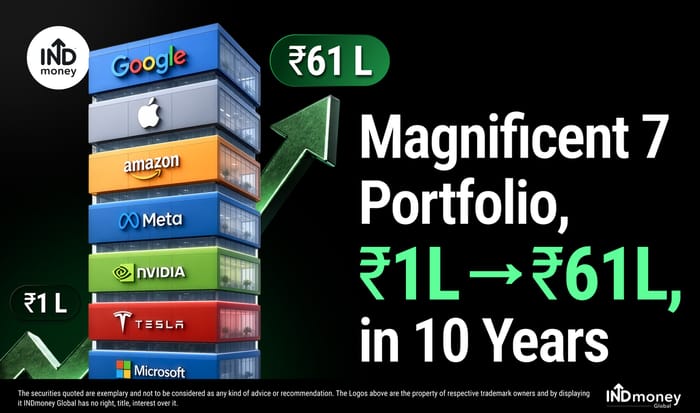
- The Setup: ₹1 Lakh, Magnificent Seven Companies, One Decade
- Stock by Stock: What Actually Drove These Returns
- The Secret Weapon: The US Dollar Against The Indian Rupee
- The Takeaway For Indian Investors
Imagine it is May 2016. You have ₹1 lakh sitting in your Fixed Deposits account, quietly earning 6-7% a year. But then you decide to do something different, you split it equally across seven American companies: Google, Apple, Amazon, Meta, Nvidia, Tesla, and Microsoft. You forget about it. Then, ten years later, you open your portfolio app and see ₹61.19 lakhs staring back at you. That is not a typo. That is a 61x return. And here's the twist Indian investors rarely hear about, a whopping ₹18 lakhs of that didn’t even come from the stocks. It came for free, just because you are Indian.
Let's break down exactly how ₹1 lakh turned into ₹61.19 lakhs; stock by stock, rupee by rupee, covering what each Mag-7 company did right, where the monster returns came from, and why the currency in your pocket quietly compounded your wealth even while you slept.
The Setup: ₹1 Lakh, Magnificent Seven Companies, One Decade
The math is straightforward. ₹1 lakh split equally means ₹14,286 per stock. In May 2016, with the dollar at ₹67, that translated to roughly $213 per company. Here is where that money went and where it ended up.
| Stock | Stock Return | Your ₹14,286 Became |
| Nvidia (NVDA) | 22,800% | ₹46,38,593 |
| Tesla (TSLA) | 2,740% | ₹5,75,267 |
| Apple (AAPL) | 1,100% | ₹2,43,070 |
| Alphabet (GOOGL) | 990% | ₹2,20,789 |
| Amazon (AMZN) | 739% | ₹1,69,947 |
| Microsoft (MSFT) | 726% | ₹1,67,313 |
| Meta (META) | 415% | ₹1,04,318 |
| Total | 4,216% (in $) | ₹61,19,296 |
Source: Google Finance, Internal calculation as of May 5, 2026. Dollar/INR rate: ₹67 in 2016, ₹95 in 2026.
But wait, if the return is 4,216%, how come the total amount is ₹61,19,296? Well, that’s exactly where the currency hedge does its magic. That extra return is purely from a dollar exposure as the US Dollar appreciated against the Indian Rupee over time. But more on that later!
Stock by Stock: What Actually Drove These Returns
Nvidia: The One That Rewrote the Rules (22,800%)
Nvidia was a gaming chip company in 2016. Nobody could have predicted that its GPUs which were originally built for rendering graphics would become the engine of the entire artificial intelligence revolution. When ChatGPT launched in 2022 and the world woke up to generative AI, every hyperscaler and startup needed Nvidia's H100 chips. Revenue soared 122% in FY2024 alone, reaching $60 billion. By early 2026, Nvidia had crossed a $5 trillion market cap and CEO Jensen Huang had built an order backlog of $1 trillion through 2027. A ₹14,286 bet on Nvidia became ₹46.38 lakhs. That is the single biggest stock return in this entire portfolio.
Tesla: The EV Dream Priced Like a Rocket (2,740%)
Tesla in 2016 was barely delivering 76,000 cars a year and losing money on each one. Elon Musk was treated as either a visionary or a fraud depending on the week. What happened next was the EV supercycle as Model 3 scaled to millions, Tesla cracked the charging network, and Musk turned the company into a story about autonomy and robots. The stock touched extraordinary highs through 2023-2024. Even after significant volatility in 2025 and the EV growth slowdown, a ten-year hold still turned ₹14,286 into ₹5.75 lakhs. Bet on the narrative early enough, and patience does the rest.
Apple: The Services Machine Nobody Saw Coming (1,100%)
In 2016, Apple was seen as a one-product company: the iPhone. What followed was a masterclass in business model transformation. Services like the App Store, iCloud, Apple TV+, Apple Pay, Apple Music, grew from an afterthought to a $109 billion annual revenue engine by 2025, with margins above 76%. The iPhone 17 lineup in 2025 became the most popular iPhone lineup in history. Revenue for Q2 FY2026 hit a record $111.18 billion, up 17% year-on-year. Apple stopped being a hardware company and became an ecosystem. That shift took ₹14,286 to ₹2.43 lakhs.
Alphabet: Search, YouTube, and the Cloud (990%)
Alphabet is the kind of stock that never makes headlines for fireworks, it just compounds, quietly and relentlessly. Google Search remained the world's dominant discovery engine while YouTube monetization scaled dramatically. Google Cloud crossed $100 billion in annual revenue run-rate by 2025. Alphabet also made early AI bets with DeepMind and Gemini, keeping it relevant in the generative AI era. Nearly a 10x stock return in ten years as ₹14,286 became ₹2.21 lakhs on the back of boring, dominant cash flow.
Amazon: From Books to the Cloud (739%)
Amazon's stock return looks the "smallest" among the big earners here, but calling 739% underwhelming is a stretch. What changed between 2016 and 2026 was AWS becoming the profit engine of the internet itself, it became the platform every startup, enterprise, and government agency runs on. Amazon also scaled its advertising business to rival Meta and Google in size, adding another high-margin revenue layer on top of its retail empire. ₹14,286 became ₹1.70 lakhs.
Microsoft: The Boring Giant That Bet on OpenAI (726%)
Microsoft in 2016 was synonymous with Windows and Office, legacy softwares basically. What CEO Satya Nadella did was quietly pivot the entire company to cloud computing with Azure, then made the most crafty partnership call of the decade by backing OpenAI before AI became a household word. Copilot embedded into Office 365, Teams becoming the backbone of enterprise communication, Azure competing with AWS at scale; the compounding just kept going. ₹14,286 became ₹1.67 lakhs.
Meta: The One That Almost Fell Apart, Then Didn't (415%)
Meta's journey in this ten-year window is the most dramatic. The stock hit a wall in 2022, it was down over 65% in a single year as Zuckerberg burned billions on the metaverse while advertising revenue cratered. Then came the 2023 "Year of Efficiency": 21,000 layoffs, a renewed focus on the core ad business, and the AI-powered Reels recommendation engine that turned Instagram into the most addictive scroll on the internet. Meta went from $88 in early 2023 to a peak of $796 by August 2025. Q1 2026 revenue came in at $56.31 billion, up 33% year-on-year. Even with the metaverse detour, ₹14,286 became ₹1.04 lakhs.
The Secret Weapon: The US Dollar Against The Indian Rupee
Here is the part most investors never talk about. In May 2016, one US dollar cost you ₹67. By May 2026, that same dollar now costs ₹95. That is a 41.8% depreciation of the rupee against the dollar over ten years.
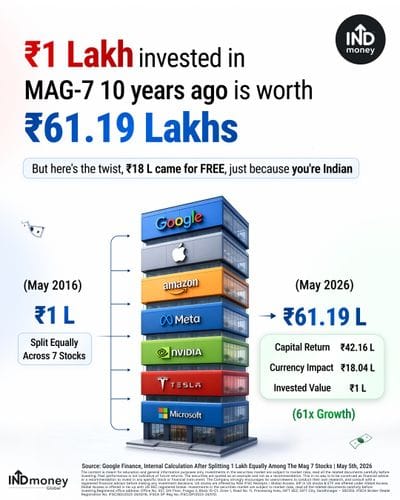
For Indian investors in US stocks, this is a silent return booster. Every dollar your portfolio earned was worth more rupees when you brought it home. Out of the total ₹61.19 lakhs, ₹18.04 lakhs came purely from this currency tailwind, not from any stock picking or market timing. Just from the structural reality that the dollar strengthens against the rupee over time.
But wait, if the dollar appreciated by 40%, shouldn’t a 40% return on ₹1,00,000 be ₹40,000? Well, if you look at the dollar individually, yes. But that’s not how compounding works. Here’s the catch. The dollar appreciation does not apply only on your original ₹1 lakh. It applies to the much larger portfolio value you created over 10 years through stock compounding.
Think about it this way: in 2016, your ₹1 lakh bought you a certain number of dollars when the exchange rate was ₹67 per dollar. As Nvidia, Tesla, Apple, and the others kept rising over the decade, your portfolio wasn’t just growing in rupee terms, it was growing into a much bigger pile of dollars.
So when the dollar itself became stronger against the rupee by 2026, that currency boost got applied on your entire final dollar portfolio value, not just on the dollars you originally invested. That is why the currency impact alone added ₹18 lakhs to the final outcome, far more than a simple 40% gain on ₹1 lakh.
Understand this concept further with a simple mango analogy here.
Return breakdown:
- Stock appreciation (capital return): ₹42.16 Lakhs
- Currency impact (INR depreciation): ₹18.04 Lakhs
- Original investment: ₹1 Lakh
- Total: ₹61.19 Lakhs
Nearly 30% of your total gains were currency gains. Free money, if you were invested.
The Takeaway For Indian Investors
This is not a story about getting lucky. All seven of these companies were already dominant in 2016 as Google owned search, Apple owned the smartphone, Amazon owned e-commerce, Microsoft owned enterprise, Meta owned social. The discipline was simply staying invested in businesses with genuine moats and letting a decade of compounding do what compounding always does.
If you are an Indian investor looking at US markets today, the Mag-7 story is a useful reminder: time in the market beats timing the market, and geography is a return category all by itself.