

- The Magic Formula First That Explains The Currency Impact
- What Actually Built the Nvidia Empire
- What Happened to Jensen Huang’s Networth?
- But Have You Missed the Bus?
- So, Does Nvidia Still Make Sense?
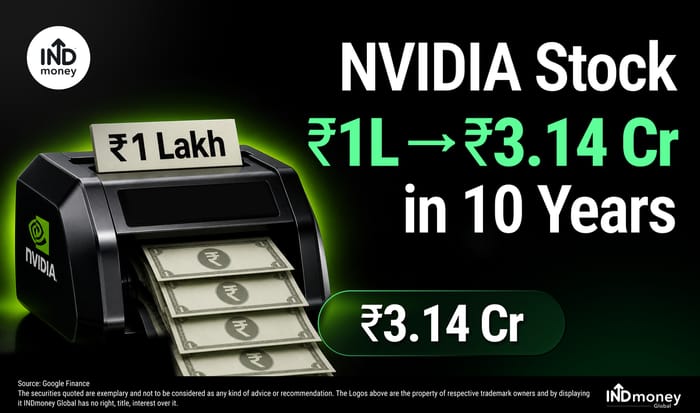
Ten years ago, if you had quietly put ₹1 lakh into Nvidia, a California-based chipmaker that most Indians associated with PC gaming and not much else, your portfolio screen today would show ₹3,14,37,839. One lakh rupees. One stock. One decade. That is a 31,337% return. And tucked inside that number is something even more striking: nearly ₹94 lakh of your gains came not from Nvidia going up, but from the US Dollar going up against the Indian Rupee. You made almost a crore by simply holding a dollar-denominated asset while the currency did its quiet, reliable thing.
Let's break down how ₹1 lakh turned into ₹3.14 crore, why the dollar's rise added ₹94 lakh on top, what Jensen Huang built to make this possible and the math that explains why currency gains are far bigger than most Indian investors assume.
The Magic Formula First That Explains The Currency Impact
The reason Indian investors in US stocks earn more than just the stock's return comes down to one equation:
Total INR Return = [(1 + Stock Return in USD) × (1 + Currency Return)] − 1
Nvidia returned approximately 21,800% in dollar terms over the past ten years. The rupee moved from roughly ₹66 per dollar in 2016 to roughly ₹95 today, a currency return of about 44%. When you multiply these two engines together:
(1 + 218) × (1 + 0.44) − 1 = (219 × 1.44) − 1 = ~314x or 31,300%+
That multiplication is the secret. A bit complex, no? Let me make it very easy for you with an analogy using Mango!
The Mango Analogy
Imagine it's 2016 and you buy mangoes worth ₹1 lakh at ₹66 apiece. You get about 1,515 mangoes. Instead of throwing away the seeds, you take these seeds, plant them in a field, and walk away for ten years.
When you return in 2026, your trees have become an orchard. Those 1,515 seeds have produced something close to 3.3 lakh mangoes, that is what Nvidia's stock growth did to your dollars. Your original dollars multiplied by over 218 times.
Now here is the part that surprises people. Mango prices have moved too. Each mango that fetched ₹66 a decade ago now commands ₹95; that's ₹29 extra per mango. With 3.3 lakh mangoes in your orchard, that is ₹29 × 3.3 lakh = roughly ₹95 lakh in bonus income; from the price shift alone.
Mango Analogy Breakdown
| Component | 2016 (Start) | 2026 (After 10 Years) | What It Represents |
| Number of Mangoes | 1,515 seeds | ~3,30,000 mangoes | Nvidia stock growth (~218x) |
| Price per Mango | ₹66 | ₹95 | Rupee depreciation vs dollar |
| Price Increase per Mango | — | ₹29 increase | Currency impact |
| Total Value from Price Change | — | ~₹95 lakh | Extra gains purely from currency movement |
Replace mangoes with dollars. Replace planting seeds with investing in US markets. Replace the price of mangoes going up with rupee depreciation. That is exactly what happened.
The crucial insight: the currency gain is not just ₹29 on your original ₹1 lakh. It is ₹29 on every dollar your investment has already grown into. That is why ₹94 lakh came from currency and why this number compounds harder the longer you stay invested.
What Actually Built the Nvidia Empire
Three decisions, made years before the world noticed, created this outcome.
Nvidia GPUs & CUDA in 2006
Nvidia launched CUDA, allowing its GPUs to handle general-purpose computing. For years, it remained niche until a 2012 breakthrough called AlexNet proved GPUs could power AI, quietly making Nvidia the backbone of a future few had priced in.
The Nvidia H100 Chip Monopoly
When generative AI took off in 2023, demand for compute exploded. Nvidia’s H100 chips, priced up to $40,000, saw massive shortages, with tech leaders like Larry Ellison and Elon Musk scrambling for supply. Today, Nvidia controls over 80% of the AI accelerator market, with newer architectures pushing performance even further.
Nvidia CEO Jensen Huang's Patience
Jensen Huang founded Nvidia and led it through near-bankruptcy and multiple boom-bust cycles in gaming, long before AI became mainstream. What made the difference was Huang’s patience and conviction. He continued investing in CUDA when few paid attention and kept building AI infrastructure well before markets began to recognise its value.
What Happened to Jensen Huang’s Networth?
In 2016, Jensen Huang's net worth sat in the low single-digit billions. Today, Forbes estimates his fortune at over $180 billion, placing him among the seven wealthiest individuals on the planet.
Nearly all of it is tied to Nvidia stock, the same stock available to any Indian investor. Nvidia itself crossed $5 trillion, making it the most valuable company in the world.
But Have You Missed the Bus?
It's the question every investor asks after seeing a 31,000% return chart. On INDmoney's analyst recommendation page, 92.06% of the 63 analysts covering Nvidia currently rate it a Buy, zero have a Sell, with an average 12-month price target of $269.17 against a current price of $198.42, implying a 26.28% upside in dollar terms before the rupee adds its usual layer.
What Are Top Analysts Saying About Nvidia?
| Institution | Price Target ($) | What It Signals |
| JPMorgan | 265 | Strong confidence, but relatively measured upside |
| Goldman Sachs | 250 | Bullish, but slightly conservative vs peers |
| Bank of America | 300 | Higher conviction on continued AI momentum |
| Evercore ISI | 352 | Most aggressive bull case on the Street |
Even when most analysts agree on direction, there is still a wide range of outcomes being priced in. The debate is not whether Nvidia grows, but how much more it can grow from here.
So, Does Nvidia Still Make Sense?
The real question is not whether Nvidia has already delivered extraordinary returns, it clearly has. The question is whether its future justifies its present.
That comes down to a few things: whether its next-generation chips like Blackwell stay ahead, whether global AI spending continues at this pace, and whether demand from hyperscalers and governments holds up. These are real variables, not certainties.
But beyond all of that, the decision is personal. No price target, no analyst rating, and no past return can tell you whether this stock fits your portfolio today. That depends on how long you are willing to stay invested and how much volatility you can sit through.