

- NVIDIA: The Company That Ate the AI Economy
- Apple Inc: The World’s Richest Cash Machine
- Microsoft: The Smartest AI Monetizer
- Why Only Nvidia Ruled 2025?
- Alphabet: Hovering Right Outside the Door
- The real takeaway for investors
For years, $1 trillion market capitalisation was the gold standard. Then came $2 trillion. Then $3 trillion. By 2025, markets stopped being polite and started breaking ceilings.
This year, global equities witnessed a moment that permanently reset scale economics: the first company ever crossed not just $4 trillion market capitalisation but also scaled the $5 trillion Mcap peak. Not a sovereign fund. Not a government-backed behemoth. A listed tech company.
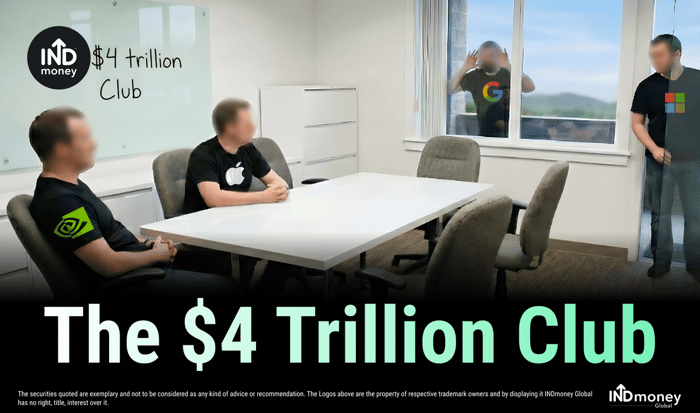
But here’s the twist. While headlines screamed “$4 trillion club,” for some other companies only two companies actually made it in. The others hovered close enough to feel the heat, some even crossed the line briefly only to drop again.
Let’s break it down. No fluff. No dull theory. Just how this actually played out.
NVIDIA: The Company That Ate the AI Economy
Nvidia didn’t just cross $4 trillion in 2025. It kicked the door down and even knocked the $5 trillion door, peaked in, stayed inside for a little while and walked out. So, what changed? AI stopped being a feature and became infrastructure. And Nvidia owned that infrastructure.
Every major AI model you have heard of needs one thing before anything else: compute. Training, inference, scaling, fine-tuning, all roads lead to Nvidia’s data centre GPUs. By 2025, hyperscalers were no longer experimenting. They were racing.
Amazon, Microsoft, Meta, Google — everyone was pouring tens of billions into AI capex, and Nvidia was first in line to collect. The financial impact was unreal. Revenues surged at a pace markets rarely see at this scale. Margins expanded instead of compressing. Free cash flow exploded.
Most importantly, demand visibility stretched quarters ahead, turning what used to be a cyclical chip business into something that looked suspiciously like a utility for the AI age. Investors didn’t just reward growth. They rewarded inevitability. Nvidia became the toll booth on the AI highway. That’s how you get to $4 trillion and more.
Apple Inc: The World’s Richest Cash Machine
Apple spent most of 2025 doing what Apple does best: printing money with surgical consistency. Its ecosystem remains unmatched. iPhones anchor the platform, services keep margins fat, and customer loyalty borders on irrational. Cash flows remain enormous. Balance sheet strength is unquestioned.
The company entered the $4 trillion club multiple times this year and is still just hovering barely above the $4 trillion mark. But why? Because Apple’s story in 2025 was stability, not acceleration. AI upgrades improved devices, but they didn’t trigger a new supercycle.
Apple’s hardware growth stayed mature. Services grew steadily, not explosively. Regulators continued circling. Markets love Apple, but they price it like a global utility with luxury margins, not a hyper-growth disruptor. As a result, Apple stayed firmly in the “Just $4 trillion-plus” zone. Powerful, profitable, but not disruptive enough to force a valuation reset.
Microsoft: The Smartest AI Monetizer
If Nvidia built the engine, Microsoft built the control panel. By 2025, Microsoft had AI embedded everywhere: Azure, Office, Windows, GitHub, cybersecurity, enterprise workflows. Instead of selling AI as a product, it sold AI as an upgrade to everything businesses already use.
Financially, this worked beautifully. Cloud revenues grew, enterprise stickiness increased, margins held strong, and cash flows stayed resilient. But here’s the catch. Microsoft’s AI upside was spread out. Gains were real but distributed across segments.
There was no single line item exploding the way Nvidia’s data centre revenues did. Markets rewarded Microsoft with a premium, but not a frenzy. The result was a valuation that crossed the $4 trillion line but was not enough to sustain it. Microsoft didn’t lose the race. It just chose consistency over spectacle.
Why Only Nvidia Ruled 2025?
Crossing $5 trillion isn’t about being big. It’s about being unavoidable. In 2025, Nvidia was the only company where growth, margins, demand visibility, and strategic importance all peaked at the same time.
Apple offered certainty. Microsoft offered resilience. Nvidia offered dominance in the most capital-intensive technology shift of the decade. That combination is rare. That’s why the club still has one member.
Alphabet: Hovering Right Outside the Door
If there was one company in 2025 that felt permanently camped outside the $4 trillion club, it was Alphabet. Google had everything going for it: dominance in search, YouTube’s advertising scale, and a rapidly improving AI stack through Gemini and its custom Tensor chips. Cloud growth accelerated as enterprises leaned harder into AI workloads, and ad revenues held up far better than skeptics expected in a maturing digital ad market.
Yet, Alphabet’s problem was perception. Investors continued to view it as an advertising-first business rather than a full-stack AI platform, keeping valuation multiples in check. Regulatory overhangs in the US and Europe added another layer of caution. The result was a company with the technology, talent, and cash flows to compete at the very top, but still priced just short of a historic breakout.
In 2025, Google wasn’t inside the $4 trillion club, but it was definitely knocking.
The real takeaway for investors
The $4 trillion moment wasn’t a flex. It was a signal. Markets are rewarding companies that sit at chokepoints, not endpoints. Those that enable entire ecosystems, not just participate in them. AI made that distinction brutally clear in 2025.
The ceiling has moved. Permanently. And the next company to touch it won’t get there by accident.
Disclaimer:
The content is meant for education and general information purposes only. Investments in the securities market are subject to market risks, read all the related documents carefully before investing. Past performance is not indicative of future returns. The securities quoted are exemplary and are not a recommendation. This in no way is to be construed as financial advice or a recommendation to invest in any specific stock or financial instrument. Readers are encouraged to verify the exact numbers and financial data from official sources such as company filings, earnings reports, and financial news platforms and to conduct their own research, and consult with a registered financial advisor before making any investment decisions. All disputes in relation to the content would not have access to an exchange investor redressal forum or arbitration mechanism. INDmoney Global (IFSC) Private Limited, Registered office address: Office No. 507, 5th Floor, Pragya II, Block 15-C1, Zone-1, Road No. 11, Processing Area, GIFT SEZ, GIFT City, Gandhinagar – 382355.