

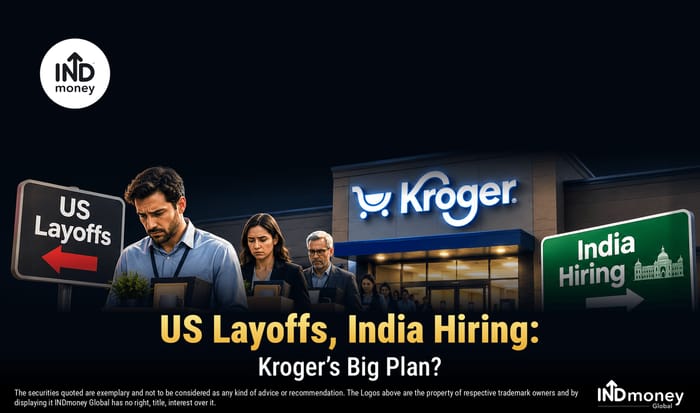
- What is Kroger and how does it make money?
- What has happened at Kroger and how many jobs are being cut?
- Why is a grocery chain cutting corporate jobs?
- Why is Kroger hiring in Bengaluru while cutting jobs in the US?
- What could change for someone buying groceries at Kroger?
- Why does Walmart matter to Kroger's pricing strategy?
- Where will Kroger find the money for its $5 billion plan?
- How can Kroger earn more money if it charges less for groceries?
- Could Kroger's plan to make groceries cheaper increase its stock valuation?
- Author’s Take: What should investors watch when Kroger reports earnings?
Imagine an American supermarket cutting office jobs in the US and hiring employees in India to make groceries more affordable for its customers. That is part of what Kroger, one of America's largest grocery retailers, is trying to achieve.
The company has started sending layoff notices to corporate employees while building a team in Bengaluru to handle some of its office operations. These changes are part of a broader $5 billion plan to offer better value to customers by 2029, including lower everyday grocery prices.
The idea is simple: spend less on running the business and use those savings to make groceries more affordable. By doing so, Kroger hopes to attract more shoppers, increase sales and compete more effectively with rivals like Walmart.
But can a supermarket make more money by charging its customers less? That is the business strategy behind Kroger's latest moves. Let’s understand this in more detail:
What is Kroger and how does it make money?
Kroger is one of America's largest supermarket chains, selling everything from fresh fruits, vegetables and dairy products to packaged foods, household essentials and medicines. The company operates supermarkets under several brands, including Kroger, Ralphs, Fred Meyer and Harris Teeter.
Unlike businesses that depend on occasional big purchases, Kroger sells products that people need almost every day. Its business relies on customers regularly returning to its stores and filling their shopping carts.
Apart from groceries, Kroger also generates revenue through pharmacies, fuel stations, online grocery deliveries and advertising services offered to consumer brands.
The grocery business, however, is highly competitive and operates on relatively thin profit margins. This makes keeping operating costs low, offering competitive prices and encouraging customers to shop frequently particularly important to Kroger's profitability.To understand the scale of its operations, consider these numbers:
| Kroger's business at a glance | Scale |
| Stores across the US | Around 2,700 |
| US states served | 35 |
| Customers served daily | Around 11 million |
| Employees | Around 400,000 |
| Fuel centres | Over 1,700 |
Sources: Kroger's official corporate website and business overview.
What has happened at Kroger and how many jobs are being cut?
Kroger has started issuing layoff notices to corporate employees, a company spokesperson confirmed on November 24, 2026. These cuts are part of a plan announced in October to eliminate approximately 3,000 corporate positions over three years.
The distinction is important: Kroger has not announced that all 3,000 employees have already lost their jobs. It has not disclosed the number of employees affected in this round either. The announced programme concerns corporate roles rather than a blanket reduction in supermarket staff.
Kroger, which trades on the New York Stock Exchange under the ticker KR, serves more than 11 million customers daily through its stores and online shopping business. It employs more than 400,000 people across its family of companies. The current restructuring is focused on the office functions supporting that much larger retail operation.
Sources: Grocery Dive and Drug Store News, November 25, 2026; Kroger's November 5, 2026 earnings-call announcement.
Why is a grocery chain cutting corporate jobs?
Running a supermarket involves much more than stocking shelves and serving customers. Behind the stores are teams that plan inventory, manage suppliers, prepare budgets, analyse sales and organise deliveries.
Kroger's CEO, Greg Foran, believes some of this work has become unnecessarily complicated. Different teams may perform similar tasks, while decisions can pass through several levels of management before reaching the people who need to act on them.
Imagine several regional offices preparing similar weekly reports for their stores. If one central team can prepare those reports using a common system, the retailer may need fewer people performing the same administrative work. Technology can also automate parts of the process, such as collecting and organising sales data.
Kroger wants to simplify these functions and redirect resources towards its stores, including better customer service and more competitive prices. That does not mean every eliminated role will be replaced by technology or relocated abroad.
Why is Kroger hiring in Bengaluru while cutting jobs in the US?
Kroger is establishing a shared operations centre in Bengaluru called the Kroger Capability Center. Its purpose is to bring recurring corporate tasks together rather than have separate teams perform them across different parts of the company.
Recruitment listings for the centre include financial analysis, supply chain planning and logistics-related positions. These are jobs that support the US grocery business, not an announcement that Kroger is opening supermarkets in India.
For example, a finance team in Bengaluru could help several US business units prepare budgets and track expenses using the same reporting process. A supply chain team could analyse inventory and delivery data to help the retailer manage the flow of products to stores.
Management expects the centre to reduce expenses by relocating suitable work, standardising procedures and using technology to make those procedures more efficient. However, Kroger has not disclosed how many of the planned US job reductions correspond to positions in India. It would therefore be misleading to say that all 3,000 jobs are moving to Bengaluru.
Sources: Kroger Investor Update, October 20, 2026, CFO David Kennerley's remarks.
What could change for someone buying groceries at Kroger?
Kroger wants to make its discounts easier to understand and put more of them directly into the everyday shelf price.
At the October investor update, Foran described a familiar problem with grocery promotions: a single shelf label can display three different prices, each with a different condition.
| Example price | How the shopper gets it |
| $3.99 | Regular price |
| $2.99 | Eligible digital deal |
| $1.99 per item | Purchase six or more |
Source: Kroger Investor Update, October 20, 2026, CEO's illustrative shelf-label example.
Imagine you only need one packet of a product. The lowest advertised price looks attractive, but you would have to purchase six to qualify for it. Alternatively, you might need to use the retailer's app to access another discount.
Kroger wants shoppers to find competitive prices without having to navigate so many conditions. It plans to keep effective promotions while shifting some spending on less effective deals towards lower regular prices, both in stores and online.
For customers who shop in small quantities, this could make the supermarket more attractive even when there is no special offer running.
Why does Walmart matter to Kroger's pricing strategy?
Grocery retailers compete not just to sell individual products but to capture a larger share of each family's weekly grocery spending.
Suppose a shopper visits Kroger for discounted milk but finds the rest of the groceries cheaper or easier to shop for at Walmart. The shopper may purchase the milk at Kroger and do the rest of the weekly shopping elsewhere. Kroger wins one sale but misses much of the customer's grocery budget.
A more competitive everyday price can give that shopper a reason to complete more of the weekly shop at Kroger. The company does not necessarily need to be the cheapest on every product. Fresh produce, product availability, convenient locations and a better shopping experience can also influence where customers shop.
There is a financial reason for this urgency. In its latest reported quarter, Kroger's sales growth at established operations slowed significantly.
| Financial metric | Q2 2025 | Q2 2026 |
| Total sales | $33.9 billion | $34.6 billion |
| Identical sales growth excluding fuel | 3.4% | 0.2% |
| Reported gross margin | 22.5% | 22.4% |
| Adjusted EPS | $1.04 | $1.09 |
Source: Kroger Q2 2026 earnings release, September 11, 2026. Identical sales growth in Q2 2026 included a 1.38-percentage-point adverse impact associated with the Inflation Reduction Act.
Kroger also lowered its full-year identical sales growth outlook excluding fuel from 1-2% to 0.2-0.8% in September, while maintaining its adjusted earnings forecast. The revised sales outlook illustrates why attracting more customers is a priority, although pharmacy-related policy changes also contributed to the slowdown.
Where will Kroger find the money for its $5 billion plan?
Kroger plans to invest $5 billion by 2029 to offer customers lower grocery prices, better products and an improved shopping experience. The company aims to fund this by reducing operating costs and making its business more efficient.
It expects to fund the plan internally, rather than rely on new external financing specifically for the programme.
The company is targeting approximately $4 billion in annualised structural cost savings by 2029. Annualised savings refer to the recurring yearly savings expected once the measures are in place, not the total money saved across all three years.
The main sources are:
- Buying more directly from producers and manufacturers, reducing intermediary costs.
- Improving purchasing terms and managing the cost of groceries more efficiently.
- Reducing spending on goods and services needed to operate the business, such as store equipment.
- Centralising recurring corporate work through the Bengaluru centre and using technology to simplify operations.
Kroger also plans to redirect some spending from complex or ineffective promotions into everyday prices. Together with structural savings, this supports its customer-value investment.
The $4 billion annualised savings target and the $5 billion customer-value investment are different measures. The job cuts are one part of the savings plan, not the entire source of funding. Management intends to adjust the pace of price reductions to the savings achieved and the results seen in stores.
How can Kroger earn more money if it charges less for groceries?
Lowering prices can reduce the profit earned on each item. For the strategy to work, Kroger needs to sell more products, reduce the cost of supplying them or achieve a combination of both.
Imagine Kroger sells cartons of eggs at $4 each, with a direct product cost of $3 per carton. If it reduces the price to $3.80 while the cost remains unchanged, this is how the numbers could work:
| Illustrative example | Before price reduction | After price reduction |
| Selling price per carton | $4.00 | $3.80 |
| Product cost per carton | $3.00 | $3.00 |
| Gross profit per carton | $1.00 | $0.80 |
| Cartons sold | 100 | 125 |
| Total sales | $400 | $475 |
| Total gross profit | $100 | $100 |
Source: Author's illustrative calculations. These are not Kroger's actual egg prices, product costs or margins.
Kroger would need to sell 25% more cartons to earn the same gross profit from eggs alone. But the benefit could extend beyond eggs: a customer drawn in by cheaper groceries may also purchase bread, vegetables, milk and other products. Meanwhile, if Kroger reduces its purchasing costs, it needs less additional volume to recover the lost profit.
The example also shows the risk. Higher revenue alone does not guarantee higher earnings. If the additional sales are insufficient to compensate for lower prices and other costs, profits could come under pressure.
Kroger's management is targeting approximately 3% comparable sales growth excluding fuel and pharmacy in 2029, alongside annualised adjusted EBITDA growth of 3-6% and adjusted earnings per share growth of 7-11% over FY2027-FY2029. EBITDA measures earnings before interest, taxes, depreciation and amortisation. These targets exclude the pending Giant Eagle acquisition and are management ambitions, not guaranteed results.
Source: Kroger's official Investor Update press release, October 20, 2026.
Could Kroger's plan to make groceries cheaper increase its stock valuation?
Kroger's ability to attract more customers while reducing operating costs could help it grow earnings over the coming years. The question is how much of this potential growth is reflected in its current share price.
Investors generally value a company based on how much profit it can generate in the future and how reliably it can grow that profit. For Kroger, the opportunity lies in attracting more regular shoppers while reducing the cost of running its business.
How is Kroger stock valued currently?
As of November 25, 2026, Kroger shares closed at $69.83. The company expects a price-to-earnings (P/E) ratio of approximately 13.4 times based on the midpoint of its earnings forecast.
| Valuation metric | Current figure |
| Share price (November 25, 2026) | $69.83 |
| Market capitalisation | $41.24 billion |
| FY26 adjusted EPS guidance | 5.10–5.30 |
| Adjusted EPS guidance midpoint | $5.20 |
| P/E based on FY26 adjusted earnings guidance | 13.4x |
| Targeted annual adjusted EPS growth (FY27-FY29) | 7-11% |
Sources: Kroger Q2 2026 earnings release, SEC filings, October 20 Investor Update, Stock Analysis and Yahoo Finance. P/E calculated using management's adjusted EPS guidance.
In simple terms, investors are currently paying approximately $13.40 for every $1 of adjusted earnings Kroger expects to generate in FY26.
What could earnings growth mean for Kroger's share price?
Using the FY26 adjusted EPS guidance midpoint of $5.20, consider three scenarios based on Kroger's earnings growth targets.
| Metric | Lower growth | Moderate growth | Higher growth |
| Annual EPS growth | 7% | 9% | 11% |
| Estimated FY29 adjusted EPS | $6.37 | $6.73 | $7.11 |
| Assumed P/E ratio | 13.4x | 13.4x | 13.4x |
| Illustrative share price | $85.36 | $90.22 | $95.33 |
Source: Author calculations using Kroger's earnings guidance and growth targets. Illustrative scenarios, not price forecasts; excludes dividends.
The calculation shows that Kroger's share price could benefit from earnings growth alone, even if investors continue to value the company at the same P/E ratio.
However, if lower grocery prices fail to attract enough additional customers, profit margins and earnings growth could suffer. This could also result in investors assigning Kroger a lower P/E ratio.
The key for investors is to assess how much of Kroger's future earnings growth comes from selling more groceries rather than simply cutting expenses. Cost savings can improve profitability, but sustained growth in customer spending would provide a stronger foundation for its long-term valuation.
Author’s Take: What should investors watch when Kroger reports earnings?
Kroger has scheduled its third-quarter earnings call for Thursday, December 3, 2026, at 8:00 AM ET (6:30 PM IST). The quarter ended November 7, before the latest publicly reported layoff notices. Investors should therefore not expect the new round of job reductions to be fully reflected in the quarterly figures.
The next earnings report can provide an early benchmark for judging the longer-term strategy:
| What to track | Why it matters |
| Customer visits and items sold | Shows whether better prices are attracting shoppers and encouraging larger purchases, if management discloses these figures. |
| Identical sales excluding fuel | Helps track sales growth across established operations; pharmacy effects should be considered separately where possible. |
| Gross margin and operating expenses | Shows whether lower prices and cost savings are improving or weakening the economics of the business. |
| Progress on restructuring | Reveals whether savings are materialising and whether implementation costs could offset them in the short term. |
Use the December results to establish a starting point, then compare the same measures over the following quarters. A useful signal would be stronger customer visits and product volumes alongside stable or improving profitability. If sales improve only because Kroger is offering deeper discounts while margins and operating earnings deteriorate, the strategy may need more time or greater cost savings. The number of jobs eliminated, on its own, cannot establish whether the plan is working.