

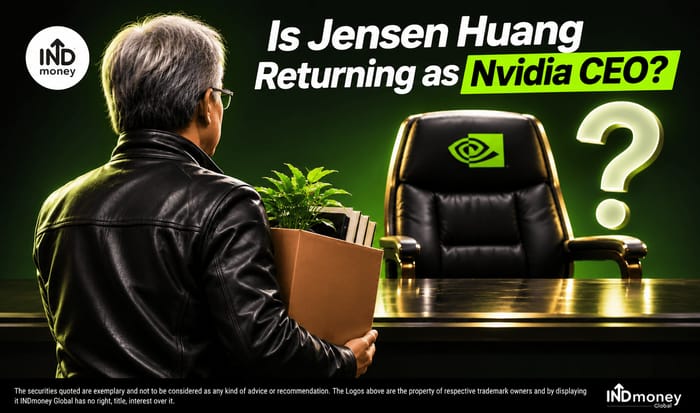
- What Do the Reports Say About Jensen Huang’s Nvidia Return?
- Can Jensen Huang Return as Nvidia CEO After Resigning?
- Does Sam Altman’s OpenAI Comeback Offer a Precedent?
- Why Do Nvidia Employees and Investors Want Huang Back?
- What Could Jensen Huang’s Return Mean for Nvidia Stock?
- What Would Make a Jensen Huang Comeback Convincing?
On Thursday, Nvidia announced that the man who had led it for 33 years was leaving. By Sunday, his allies were trying to bring him back. Within a few days, the conversation had moved from finding Jensen Huang’s successor to asking whether Nvidia could reverse the departure itself.
Jensen Huang’s return as Nvidia CEO is a reported possibility, but it has not been confirmed. Reuters, citing the Financial Times, reported on November 15 that Huang had discussed a possible comeback with confidants. That is a meaningful development, although it falls short of an agreement with Nvidia’s board.
For anyone following Nvidia stock, the appeal is easy to understand. Bringing back a familiar founder could remove some of the uncertainty created by his sudden exit. The harder question is whether the terms of his return would also help restore confidence in how the company is run.
What Do the Reports Say About Jensen Huang’s Nvidia Return?
The latest development starts with conversations around Huang, rather than an announced change inside Nvidia.
The Financial Times reported that Huang had discussed returning with people close to him. One ally described an effort to assemble Silicon Valley executives to press the board and seek White House support. Nvidia and Huang’s spokespeople declined to comment to the FT. Reuters subsequently carried the central report about the comeback discussions.
While a campaign can persuade directors to reconsider. It cannot make the appointment for them, and the reporting does not establish that the board has agreed to negotiate his reinstatement.
The departure followed reports about Huang’s personal relationships, including relationships involving Nvidia employees, alongside allegations involving a foreign intelligence effort. Nvidia has confirmed an independent investigation. Its resignation announcement did not publish a completed account of what that inquiry established.
The confirmed leadership arrangement remains the one in Nvidia’s November 12 filing. It records that directors accepted Huang’s resignation as president, CEO and a board member on November 11. Colette Kress became interim CEO while retaining her CFO role, and Harvey C. Jones became board chair. [2]
The search for Nvidia’s next permanent CEO therefore remains relevant. A possible Huang comeback adds another outcome to that discussion; it does not establish that the search has ended.
Can Jensen Huang Return as Nvidia CEO After Resigning?
Yes, Nvidia’s corporate rules provide a route for the board to appoint him again. Resigning does not, by itself, settle every future appointment.
Nvidia’s published bylaws put the appointment and removal of corporate officers under board authority. Sections 28 and 29 cover the CEO role and allow directors to fill an officer vacancy. The transition filing announces Huang’s departure; it does not announce a prohibition on a future appointment.
Huang would still need the board’s agreement. Nvidia’s 2026 annual shareholder filing disclosed his ownership stake at 3.58% as of March 23, 2026. That historical figure helps explain the difference between his influence as a founder and the power to decide the matter himself. He does not have a controlling shareholding that lets him override the directors.
His former board seat is another decision. A CEO appointment and a director appointment are separate corporate actions, so any return announcement would need to clarify which roles he was receiving. Restoring his executive position would not automatically restore the entire previous arrangement.
The difficult part is giving a convincing reason for the reversal.
On November 8, Nvidia’s board announced an independent investigation into reporting that Huang had been targeted by a foreign intelligence effort. At that time, it said it had no reason to believe national security or Nvidia’s secrets had been compromised. On November 10, independent directors named outside counsel to conduct the investigation.
The November 8 statement was an initial assessment, rather than a completed investigation. Equally, allegations involving intelligence activity or improper chip sales should not be treated as established findings. The board would need to explain how the available evidence, the personal-conduct concerns and any safeguards support its next leadership decision.
That is why the possibility of a return is easier to establish than its likelihood. The rules tell us who can make it happen. The evidence and the directors’ judgement will determine whether they do.
Does Sam Altman’s OpenAI Comeback Offer a Precedent?
There is a useful precedent, although it comes with a lesson that goes beyond bringing back a popular leader.
OpenAI’s board removed Sam Altman as CEO on November 17, 2023. A decision to rehire him followed on November 21, and OpenAI’s November 29 announcement confirmed his return alongside a new initial board. An independent review followed.
The sequence shows how quickly a leadership decision can be reconsidered when the organisation and its stakeholders struggle to accept the alternative. It also shows that reinstatement can come with a different structure for overseeing the CEO.
Altman’s executive role and board membership were handled separately. He returned as CEO in November, then rejoined the board in March 2024. A returning founder does not necessarily regain every position at once.
But the underlying cases need to be assessed on their own facts. OpenAI was governed by a nonprofit board at the time of Altman’s removal. Nvidia is a publicly traded company whose disclosures identify export restrictions as a material business risk.
OpenAI’s later summary of the WilmerHale review attributed its crisis to a breakdown in trust between Altman and the previous board. It said the removal had not arisen from concerns about product safety, security or the company’s finances. Those findings cannot tell us what Nvidia’s investigation will establish.
The useful lesson is about process: a return can happen before an independent review is finished, as Altman’s did, but that makes the credibility and independence of the continuing review especially important. Employee loyalty and investor support can change the pressure on directors. They do not answer the underlying questions for them.
Why Do Nvidia Employees and Investors Want Huang Back?
The public support reflects how closely some people associate Nvidia’s future with the person who helped build it.
The independent “Stand with Jensen” campaign calls for his reinstatement while an investigation establishes the facts. Its public list includes Elon Musk, Epic Games CEO Tim Sweeney and people identifying themselves as Nvidia employees. The site explicitly says affiliations are self-reported and unverified, so its signature totals should not be read as an audited measure of staff opinion.
One entry, attributed to senior distinguished engineer Erwin Coumans, says Huang’s leadership was a major reason he joined. That helps explain the employee argument: a CEO can influence where talented people choose to spend their working lives, especially when they believe in the direction that leader has set.
There is also a shareholder argument. Altimeter’s Brad Gerstner and Atreides Management’s Gavin Baker urged the board to preserve the option of Huang’s return while taking time over the leadership decision. Their letter also acknowledged the board’s authority to decide against a return after the facts were known.
For investors, the business case for considering Huang is his ability to connect decisions across the company.
Nvidia’s platform combines processors, networking and a large software ecosystem, including CUDA, which helps developers put its chips to work. The company also relies on outside manufacturers to produce the hardware. A decision about the next computing platform therefore affects engineering teams, suppliers and customers planning their own investments.
A leader with experience across those relationships can help the parties agree on what to build, how to deliver it and why customers should commit to it. Our assessment is that Huang’s potential value during this transition lies in that coordination, alongside his technical judgement.
Why Does His Relationship With TSMC Matter?
TSMC manufactures semiconductor wafers for Nvidia. In a May 31 announcement, Nvidia described a relationship stretching nearly three decades and detailed how TSMC was using Nvidia technology in semiconductor design and manufacturing. The relationship involves substantial work in both directions.
That gives context to the argument that Huang’s industry connections would be difficult to replace quickly. When suppliers and customers make plans years ahead, familiarity with the people making those commitments can help a CEO resolve competing priorities.
But those relationships also exist between organisations. Nvidia retains its engineering teams, software and supply-chain organisation. In its transition announcement, the board said it expected operations, customer commitments and the product roadmap to continue without interruption.
The sensible argument for Huang’s return is that he could help preserve the speed and confidence with which that network works. The available evidence does not establish that Nvidia’s manufacturing relationships have stopped functioning in his absence.
What Could Jensen Huang’s Return Mean for Nvidia Stock?
A confirmed return could support Nvidia stock by reducing uncertainty about who will lead the business. Whether that improvement lasts would depend on how much uncertainty remains elsewhere.
Consider a customer planning an AI data centre. It wants confidence that Nvidia’s future systems will arrive, work as promised and remain supported. An experienced returning CEO could help reassure that customer about the direction of the platform.
Employees and suppliers face related decisions about where to commit their time and resources. If Huang’s return made those decisions easier, investors could become more confident in execution even before analysts changed their earnings estimates.
That is the business logic behind a possible relief rally. Its size would depend partly on what investors already expected when the announcement arrived. A return that had become widely anticipated could produce a different reaction from a surprising, well-supported agreement.
A Return Would Address Only Part of the Uncertainty
The stock also faces questions about oversight and access to markets.
On November 15, Treasury Secretary Scott Bessent called for major leadership changes and urged Nvidia to choose an outside CEO, according to CNBC’s account of his Fox News interview. Those comments show that influential voices in Washington are pushing in a different direction from Huang’s supporters.
The board chooses the CEO, while government rules govern which products Nvidia can export and to whom. Nvidia’s own annual filing explains that changes in export restrictions can limit sales and disrupt its business. Reappointing Huang would not, on its own, resolve those restrictions or establish the outcome of any investigation.
That creates an important possibility: a comeback could reduce concern about leadership while leaving concern about oversight unresolved. If the announcement looked like a response to pressure without a credible explanation of the board’s reasoning, some investors could become more doubtful about its ability to supervise management.
The circumstances of the return would therefore matter as much as the name on the announcement.
| Possible development | What it would tell Nvidia investors | Potential implication for NVDA Stock |
| Discussions and public lobbying continue | Huang’s return remains an option, without an agreed appointment | More attention to comeback headlines, with substantial uncertainty remaining |
| Huang returns while important questions remain unanswered | The leadership decision is settled, but confidence in oversight still needs rebuilding | A relief rally is possible, while unresolved concerns could limit its durability |
| Huang returns with a credible board explanation, protected investigation and clear responsibilities | Investors have more information about both leadership and accountability | A stronger basis for rebuilding confidence, provided operating performance supports it |
These are conditional scenarios, rather than forecasts of the board’s decision or Nvidia’s share price.
A comeback announcement would also arrive close to earnings. Any subsequent move in NVDA could reflect guidance, customer demand and wider market conditions alongside the leadership news. Reading the entire move as a verdict on Huang would risk missing what investors were learning about the business at the same time.
What Would Make a Jensen Huang Comeback Convincing?
The most useful announcement would explain why the board believes the arrangement can work.
First, investors would need to understand what changed after his departure. That could involve new information, a revised assessment or conditions attached to his return. The important point would be a reasoned account that people outside the boardroom could assess.
Second, the investigation would need to retain its independence. The person whose conduct is being examined should not be able to determine its scope or outcome. A return before the review finishes would make clear supervision by independent directors especially consequential.
Third, the leadership team would need a workable division of responsibilities. Nvidia has already appointed a board chair and placed Kress in charge during the transition. A returning Huang could bring technical and commercial experience while operating within an arrangement that gives the board and other senior leaders the authority to challenge decisions. That is a possible structure, rather than an announced plan.
There is a longer-term issue here too. If investors believe the company cannot operate successfully without one person, bringing that person back offers immediate reassurance but leaves the dependence in place. Nvidia would strengthen its position by preserving Huang’s contribution while also showing that decisions, relationships and future leadership can endure beyond him.
The next scheduled opportunity to assess the company is its third-quarter fiscal 2027 results on November 17.
Alongside the leadership discussion, useful evidence would include whether product commitments remain on schedule, whether senior teams stay in place and how management describes its relationships with major customers and suppliers. Those are measures to watch; they should not be mistaken for evidence that departures or disruptions have already occurred.
A Huang return supported by a credible process could improve Nvidia’s position by reducing disruption and preserving valuable relationships. A hurried reinstatement with little explanation would leave investors having to judge the same unresolved questions under another leadership arrangement. The stronger outcome for Nvidia stock would be a return that helps the company deliver on its promises while earning confidence in its oversight.