

- Three Agreements Changed the Story: Corning’s AI Deals With Meta, NVIDIA and Amazon
- Copper vs Optical Fiber in AI Data Centers: Why Corning Benefits
- Corning’s Optical Fiber Technology and AI Data Center Moat
- Why Meta, NVIDIA and Amazon Chose Corning
- Corning Competitors in Optical Fiber and AI Networking
- Corning Q2 2026 Earnings: Is AI Growth Showing Up in the Numbers?
- The Hidden Cash-Flow Detail Investors Should Not Miss
- Why Did Corning (GLW) Stock Fall From ATH of $271.78 to $114.50?
- What Drove the 38% Recovery in Corning (GLW) Stock in Nine Trading Sessions?
- Corning (GLW) Stock Valuation: What Is the Market Pricing In?
- Can Corning (GLW) Stock Become a Multibagger From Here?
- Corning AI Investment Thesis: The Bottleneck-to-Cash Scorecard
- Key Risks to the Corning (GLW) Stock Thesis
- Corning (GLW) Analyst Price Targets
- Is The Current Area of Corning (GLW) Stock Sensible for Building Exposure?
- 5 Key Metrics Corning Investors Should Track
- Final Word
Every AI data center has a glamorous shopping list: NVIDIA chips, liquid cooling and enough electricity to power a small city. But none of those chips can behave like one giant computer unless data moves between them fast enough.
That is where a 175-year-old glass company has suddenly become one of AI's most important infrastructure suppliers. Corning is not merely selling more fiber. It is being asked to redesign, manufacture and connect the nervous system of the AI factory.
Let's break down why copper runs out of road, what Meta, NVIDIA and Amazon have actually committed to Corning, whether its moat can become durable cash flow, and what GLW's wild trip from $271.78 to $114.50 and back to $157.76 says about the opportunity already priced into the stock.
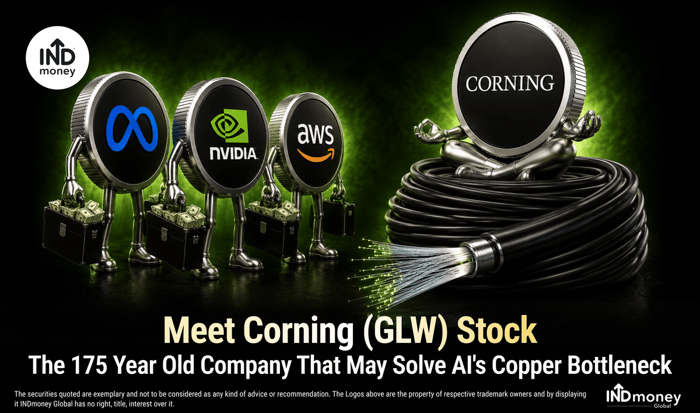
Three Agreements Changed the Story: Corning’s AI Deals With Meta, NVIDIA and Amazon
Corning's AI opportunity moved from an investor presentation to signed customer commitments in less than five months.
| Date | Partner | What was announced | Capacity and strategic impact |
| January 27, 2026 | Meta | Multiyear agreement worth up to $6 billion for optical fiber, cable and connectivity solutions | Meta becomes anchor customer for a new cable facility in Hickory, North Carolina; Corning expects 15% to 20% more employment in the state |
| May 6, 2026 | NVIDIA | Multiyear technology and manufacturing partnership | Corning plans to raise US optical-connectivity capacity 10x, lift US fiber capacity by more than 50%, and build three facilities in North Carolina and Texas |
| June 8, 2026 | Amazon | Multiyear, multibillion-dollar agreement for fiber, cable and connectivity solutions | Supports US data center construction and about 1,000 additional Corning jobs in North Carolina; exact contract value was not disclosed |
Sources: Corning-Meta announcement, Corning-NVIDIA announcement and Amazon's announcement.
The first analytical trap is to add these announcements together and call the total guaranteed Corning revenue. That would be wrong. Meta disclosed a ceiling, Amazon did not disclose a dollar value, and NVIDIA's announcement did not state a minimum purchase commitment.
The NVIDIA economics also needs careful reading. Corning sold NVIDIA warrants covering 15 million common shares at a $180 exercise price and 3 million pre-funded shares. NVIDIA paid Corning $500 million upfront. If the traditional warrants are eventually exercised, Corning could receive another $2.7 billion, but that is potential equity proceeds, not contracted product revenue. Corning initially recorded $296 million as the fair value of consideration payable to the customer.
The more important signal is not the headline dollar figure. Three of the world's largest AI infrastructure spenders are helping one supplier expand before the product is delivered. Customers usually do that only when capacity, qualification and execution matter more than finding the lowest bidder.
Copper vs Optical Fiber in AI Data Centers: Why Corning Benefits
Not literally. Copper does not suddenly stop working at 91 centimetres. But the hook captures a real engineering problem.
As the data rate through an electrical link rises, signal loss, heat and the power required to clean up the signal rise with it. At cutting-edge per-lane speeds, the practical reach of passive copper can shrink towards roughly one metre. Longer electrical links need heavier cables, signal conditioning or more power. Eventually, optical fiber becomes the more efficient way to move data.
Think of copper as shouting instructions across a crowded restaurant. It works perfectly across the same table. Add distance, noise and more simultaneous conversations, and people must shout louder or repeat themselves. Optical fiber is closer to sending the message through a private beam of light.
There are two different AI networks inside a data center:
| Network layer | Simple meaning | Current medium | Where Corning fits |
| Scale-up | Connects accelerators inside one computing domain so they act like a larger machine | Mostly copper at the shortest distances, with optics beginning to move closer to chips and racks | Large future option through fiber-to-the-chip, co-packaged optics and dense rack connectivity |
| Scale-out | Connects racks, clusters and data halls into one AI factory | Already heavily optical | Meaningful revenue today from fiber, cable, connectors and installed solutions |
This distinction matters. The most promotional version of the Corning thesis says fiber will immediately replace all copper. The more credible version says the architecture will remain hybrid. Copper keeps the shortest links where its latency and economics remain attractive; optics takes over as bandwidth, distance and density increase. IEEE Spectrum's discussion of NVIDIA's architecture describes that hybrid reality, while NVIDIA's own explanation of co-packaged optics shows why moving light closer to the chip can improve power efficiency.
Corning does not need the entire scale-up network to turn optical tomorrow. Management said in its Q2 earnings call that second-quarter generative-AI growth came from scale-out, with no meaningful scale-up or photonics revenue yet. In other words, today's engine already runs, while optical scale-up remains a potentially large option.
Corning’s Optical Fiber Technology and AI Data Center Moat
Corning invented the first low-loss optical fiber in 1970. Its advantage today is not a single patent or one piece of glass. It is an end-to-end manufacturing system:
- The glass science and process used to draw extremely pure optical fiber.
- The cable that protects and packs that fiber into usable density.
- Connectors, cassettes, housings and assemblies that let installers deploy thousands of links reliably.
- Factory scale and customer qualification that turn laboratory performance into millions of repeatable components.
This matters because an AI rack does not purchase “fiber” in the abstract. It needs a complete connection that fits into limited space, installs quickly, survives heat and handling, and loses almost no light.
Corning's new multicore fiber makes the content opportunity easier to see. One standard-sized 125-micron fiber can contain four optical cores. Corning says the resulting system can offer 4x the capacity, use up to 75% fewer connectors, reduce cable mass by 70% and cut installation time by 60%. Its PRIZM technology uses precision microlenses to couple dense arrays of fiber close to chips.
The apparent contradiction is useful: a multicore system can reduce the number of physical fibers per connection, yet Corning's revenue opportunity can still expand because AI creates vastly more connections, requires denser and more sophisticated products, and pulls optics deeper into the rack. Investors should track Corning content per unit of AI compute, not merely kilometers of fiber sold.
We call this the AI connectivity multiplier:
Corning AI revenue = Data Centers Built × Compute Density × Optical Links Per Unit of Compute × Corning Content Per Link × Factory Sell-Through
Most AI investment arguments stop at the first factor. Corning has four ways to grow even if the number of new data centers eventually slows: denser racks, more optical links, higher-value connectivity products and better capacity utilization.
Why Meta, NVIDIA and Amazon Chose Corning
Four advantages explain why Corning sits unusually close to the bottleneck.
1. It controls several critical layers
Corning can supply fiber, cable and connectivity hardware as one engineered system. A hyperscaler dealing with an urgent buildout values fewer qualification points and faster deployment. The integrated offer can also lift Corning's content per data center beyond commodity fiber.
2. Its manufacturing process is hard to copy quickly
The barrier is not simply building a factory. Optical fiber needs extraordinarily consistent chemistry, geometry and draw quality. Connectors then need micrometre-level alignment. A competitor can announce capacity, but customers still need to test and qualify its product.
3. It already has a large US footprint
AI infrastructure has become an industrial-policy priority. Local capacity reduces logistics and geopolitical risk. Meta, NVIDIA and Amazon are effectively reserving a domestic supply chain while Corning expands around their demand.
4. Customers are sharing expansion risk
Corning's 10-Q disclosed a $1 billion non-refundable customer deposit under a long-term agreement running through December 2029. The filing does not name the customer, but the timing and linked warrant accounting strongly indicate that it relates to the NVIDIA partnership. The deposit secures product rights and helps finance capacity. This is an inference from the filing, not a separately named disclosure.
That structure is better than Corning building billions of dollars of capacity on hope. It reduces financing risk and makes the customer's intention more credible. It does not remove execution risk or guarantee attractive margins.
Corning Competitors in Optical Fiber and AI Networking
Corning is the integrated leader, not a monopoly. Its own 2025 annual report names Amphenol, Fujikura, Sumitomo Electric and Prysmian as principal Optical Communications competitors.
| Competitive layer | Important companies | How Corning compares |
| Optical fiber and cable | Prysmian, Fujikura, Sumitomo Electric | Corning combines historic fiber know-how, large-scale production and a broad US manufacturing base |
| Connectors and interconnect systems | Amphenol, Fujikura, Sumitomo Electric | Amphenol is formidable in connectors; Corning's edge is combining connectivity with its own fiber and cable |
| Lasers and optical transceivers | Coherent, Lumentum, Applied Optoelectronics, Innolight | Adjacent competition and partnership territory; these companies make the optoelectronics that convert electrical and optical signals |
| Networking chips | Broadcom, Marvell | These firms influence how fast networks move from pluggable optics and copper to co-packaged optics |
| Network systems | Arista Networks, Ciena and equipment vendors | They assemble higher-level systems and can influence component selection, but do not directly replicate Corning's entire materials stack |
Source: Corning's 2025 Form 10-K.
Corning's strongest position is where glass science, cable density, precision connectivity and scale all matter together. Its weaker position is in parts of the optical stack it does not control, including lasers, digital signal processors and network switches. That makes the company a picks-and-shovels supplier, but not the sole owner of the AI networking profit pool.
There is also a timing competitor: better copper. Broadcom and other chipmakers continue to improve electrical links, especially inside racks. In early August, comments from Broadcom's CEO about copper's near-term latency, power and cost advantages caused another sharp move in Corning shares. Barron's reported that investors had been expecting a faster optical transition. Copper does not have to win forever to hurt Corning's valuation. It only has to delay optical scale-up by a year or two.
Corning Q2 2026 Earnings: Is AI Growth Showing Up in the Numbers?
Yes. It is no longer a concept story.
Corning's Q2 2026 results showed:
- Core sales of $4.74 billion, up 17% year over year.
- Core EPS of $0.78, up 30%.
- Optical Communications sales of $2.07 billion, up 32%.
- Enterprise optical sales of about $1.27 billion, up 65%.
- Generative-AI sales that nearly doubled year over year.
- Core gross margin of 39.6%, up 120 basis points.
- Core operating margin of 20.9%, up 190 basis points.
- Q3 core sales guidance of $4.9 billion to $5.0 billion and core EPS guidance of $0.85 to $0.89.
| Q2 2026 segment | Sales | Segment net income | What investors should notice |
| Optical Communications | $2.07B | $438M | Largest growth engine; AI enterprise demand is already material |
| Display Glass | $1.46B | $354M | High-profit cash generator, but exposed to panel pricing and consumer demand |
| Automotive | $471M | $82M | Stable diversification, not the current valuation driver |
| Solar | $438M | -$7M | Sales nearly doubled, but the ramp is not yet profitable |
| Life Sciences and emerging businesses | $294M | -$21M | Portfolio optionality with weaker near-term earnings contribution |
The quality of growth is encouraging. EPS grew faster than sales, and both gross and operating margins expanded. This supports management's claim that its Springboard plan is not simply about adding low-margin volume.
But the quarterly release also exposed the bottleneck inside the bottleneck: Corning cannot yet make enough of its most advanced optical products. Management effectively said it could sell more if it could manufacture more.
That explains the three new plants, but it also limits near-term revenue and creates a heavy capital-spending cycle. Corning expects roughly $2 billion of capital expenditure in 2026.
The Hidden Cash-Flow Detail Investors Should Not Miss
Corning reported impressive cash generation, but headline cash flow needs one important adjustment.
For the first half of 2026, operating cash flow was $2.08 billion and capital expenditure was $754 million, implying simple free cash flow of about $1.33 billion. However, operating cash flow included the $1 billion upfront customer deposit.
| H1 2026 cash-flow view | Amount |
| Reported operating cash flow | $2.08B |
| Capital expenditure | -$0.75B |
| Simple reported free cash flow | $1.33B |
| Less: upfront customer deposit | -$1.00B |
| Rough underlying free cash flow before other timing effects | $0.33B |
This is not an accusation that the deposit is fake cash. It is real, non-refundable funding and a valuable form of customer risk-sharing. But it is not recurring cash generated from that quarter's product sales. Treating the entire amount as normal annual free cash flow would make the stock look cheaper than it is.
The same issue appears in trailing cash-flow data. GLW generated about $2.40 billion of trailing free cash flow. Against a market capitalization near $136 billion, that is a free-cash-flow yield of only 1.8%. If the $1 billion deposit is removed as a rough normalization, the yield is closer to 1.0%. This rough adjustment is not a GAAP measure, but it shows how much future growth the current price still assumes.
As of June 30, Corning held $2.50 billion of cash and about $8.42 billion of debt, leaving net debt near $5.92 billion. The balance sheet is manageable, but it is not excess-cash rich. Capacity must translate into orders, margins and recurring cash flow.
Why Did Corning (GLW) Stock Fall From ATH of $271.78 to $114.50?
The fall was a valuation accident, a timing debate and an earnings-expectation reset rolled into one.
Chapter 1: The price outran the earnings
At its June 30 all-time high of $271.78, GLW traded at roughly 125 times trailing EPS of about $2.18 and approximately 83 times the 2026 analyst EPS estimate of $3.28. Those are software-like multiples for a capital-intensive materials manufacturer.
The market was no longer valuing Corning on the business it had. It was capitalizing a near-perfect 2028 to 2030 outcome immediately: rapid AI capacity additions, early scale-up optics, clean factory ramps and sustained premium margins.
Chapter 2: Investors questioned the optical timetable
The market began separating demand from revenue timing. Customers may want more fiber, but factories still have to be built, qualified and ramped. Meanwhile, copper remains compelling for the shortest scale-up links. Delayed co-packaged optics does not destroy Corning's thesis, but it pushes earnings farther into the future and lowers their present value.
Chapter 3: Q2 was strong, but not strong enough for the price
On July 28, Corning delivered healthy Q2 growth, but its Q3 outlook did not provide the large upside surprise that the peak valuation required. Management flagged production constraints in advanced optical products and weaker consumer-electronics demand. The shares touched $114.50, a 57.9% drop from the high. The Wall Street Journal highlighted the uncomfortable combination: hot AI demand, capped output and smartphone weakness.
That is an important lesson. A company can report 32% segment growth and still disappoint if its share price had been discounting something much faster.
What Drove the 38% Recovery in Corning (GLW) Stock in Nine Trading Sessions?
From the July 28 low to the August 10 close of $157.76, GLW rose 37.8% across nine trading sessions. It was a violent re-rating after an equally violent de-rating.
Three factors explain it:
- The valuation became less extreme. At $114.50, the stock had fallen below 35 times estimated 2026 EPS. That was still not conventionally cheap, but it was far removed from 83 times at the peak.
- The demand thesis remained intact. Optical sales grew 32%, enterprise grew 65%, generative-AI sales nearly doubled and capacity was the constraint. Investors had evidence of a timing problem, not an AI order collapse.
- Catalysts restored confidence in domestic suppliers. Truist upgraded GLW on August 3 and set a $175 target. A Reuters report the following day said US regulators were considering restrictions on certain Chinese optical transceiver suppliers, lifting domestic optical names. The policy proposal is not central to Corning's fiber thesis, but it improved sentiment around US optical supply chains.
The rebound did not settle the argument. At $157.76, GLW remained 41.9% below its high but about 80% higher year to date. The stock is now cheaper than the June mania, but the valuation still assumes major earnings growth.
Corning (GLW) Stock Valuation: What Is the Market Pricing In?
At the August 10 close, Corning's market capitalization was approximately $135.9 billion. Using current FactSet consensus estimates reported by The Wall Street Journal:
| Valuation reference | EPS | Price/EPS at $157.76 |
| Trailing 12 months | $2.18 | 72.4x |
| FY2026 consensus | $3.28 | 48.1x |
| FY2027 consensus | $4.32 | 36.5x |
| FY2028 consensus | $5.93 | 26.6x |
The table shows why GLW can look both exciting and expensive. If earnings nearly triple from trailing levels to the 2028 consensus, today's valuation becomes tolerable. If the ramp slips, the multiple is exposed.
Here is a simple scenario model. It is not a price target. It asks what different 2028 outcomes could be worth at the end of 2028, then discounts that value back at 10% a year for roughly 2.4 years.
| 2028 scenario | EPS assumption | Exit P/E | End-2028 value | Implied present value |
| Slow ramp | $4.75 | 22x | $105 | $83 |
| Execution close to consensus | $5.93 | 28x | $166 | $132 |
| Strong optical ramp | $7.00 | 34x | $238 | $189 |
The conclusion is blunt: $157.76 sits above the discounted value of a consensus-like case and below a strong-execution case. The stock is no longer priced for perfection, but it is still priced for success.
Investors may reasonably choose different multiples. Corning's integrated optical moat deserves more than a slow-growth materials multiple if AI growth and margins persist. But 30x-plus earnings is a demanding terminal valuation for a company that still has cyclical display, smartphone, automotive and solar exposure.
Can Corning (GLW) Stock Become a Multibagger From Here?
It can, but the math makes clear that it is not the easy base case.
A doubling from $157.76 means a share price of about $315.52 and, using roughly 880 million diluted shares including the potential NVIDIA warrant shares, an equity value near $278 billion.
Corning's internal Springboard plan targets a $40 billion annualized sales run rate by the end of 2030. Suppose it reaches that target and earns an 18% net margin. Net income would be $7.2 billion, or roughly $8.18 per diluted share. At $315.52, the stock would still trade near 39 times that illustrative 2030 EPS.
Alternatively, at a 30x P/E, a $315.52 price requires EPS of about $10.52. That implies roughly $9.3 billion of net income, or a 23% net margin on $40 billion of revenue. Corning's Q2 core net margin was around 14%. Reaching 23% would require an exceptional mix shift, pricing, utilization and cost performance.
So a doubling by 2030 likely needs all three:
- Corning reaches or exceeds the $40 billion run-rate ambition.
- Optical and higher-value connectivity drive far more margin expansion than today's base.
- Investors still award a premium multiple after the fastest growth phase.
A strong but sub-doubling return is easier to defend mathematically. Over a longer period, a multibagger outcome becomes more plausible if optical links keep moving closer to chips and Corning maintains high content per unit of compute.
Corning AI Investment Thesis: The Bottleneck-to-Cash Scorecard
Being attached to a bottleneck does not automatically make a stock attractive. The supplier must capture the scarcity economically, then the investor must avoid paying for it twice.
| Test | Corning score | Evidence | What could weaken it |
| Technical necessity | High | Scale-out is already optical; higher bandwidth and distance favor light | Better copper can preserve the shortest links |
| Scarce qualified capacity | High | Management says advanced optical output is constrained; hyperscalers are reserving capacity | Rivals add qualified capacity faster than expected |
| Commercial capture | High | Meta, NVIDIA and Amazon signed multiyear agreements | Disclosed ceilings are not guaranteed revenue |
| Cash conversion | Medium | Customer deposits reduce buildout risk and margins are rising | Heavy capex and upfront deposits flatter near-term cash flow |
| Valuation support | Low to medium | Price is 42% below the peak | Current price still exceeds a discounted consensus-like case |
This is the core of our view. Corning scores exceptionally well as a business positioned at an AI constraint. It scores much less comfortably as a stock whose expectations are already high.
Key Risks to the Corning (GLW) Stock Thesis
- Optical scale-up arrives later than expected. Corning's current AI growth is scale-out. The larger scale-up opportunity is not yet contributing, and management itself describes timing as a major variable.
- Factories ramp slowly or expensively. Corning must convert a 10x connectivity expansion into qualified, high-yield production. Delays would hold back sales while depreciation and fixed costs rise.
- A few customers gain bargaining power. In 2025, two customers represented 28% of Optical Communications sales. Meta, NVIDIA and Amazon improve visibility but can also concentrate negotiating power.
- The rest of Corning still matters. Consumer electronics, display glass, automotive and solar can offset optical strength. Q2 already showed smartphone pressure and a loss in solar despite strong sales growth.
- Core accounting can obscure economic returns. Management's core measures are useful for comparing operations, but investors should reconcile them with GAAP profit, capital expenditure and recurring cash flow.
- The valuation leaves little room for ordinary execution. A good company can be a disappointing investment if the starting multiple assumes an extraordinary outcome.
Corning (GLW) Analyst Price Targets
The following are the latest publicly reported targets we could verify as of August 11, 2026.
| Firm | Analyst | Target | Official rating | Date reported |
| Bank of America | Wamsi Mohan | $243 | Buy | July 6 |
| Citigroup | Asiya Merchant | $220 | Buy | July 29 |
| Mizuho | John Roberts | $210 | Outperform | July 29 |
| Oppenheimer | Martin Yang | $200 | Outperform | July 29 |
| UBS | Joshua Spector | $196 | Buy | July 29 |
| Susquehanna | Mehdi Hosseini | $180 | Positive | April 29 |
| Truist Securities | Matthew Niknam | $175 | Buy | August 3 |
| JPMorgan | Samik Chatterjee | $170 | Neutral | July 29 |
| Morgan Stanley | Meta Marshall | $165 | Equal-Weight | July 29 |
| Barclays | Tim Long | $129 | Equal-Weight | July 29 |
Sources: Benzinga's analyst-action history, UBS target report and Susquehanna target report.
WSJ/FactSet's current consensus page shows an average target of $192.38, a $200 median and a $129 to $226 range. The difference between that range and individual published targets above, such as Bank of America's earlier $243 figure, reflects coverage sets and update timing.
The $129 to $243 range is more useful than the average. It tells investors what the debate is really about. Barclays is effectively assigning more weight to delayed earnings and multiple compression. Bank of America is assigning more weight to Corning's long-duration AI content opportunity. The difference is not whether AI needs fiber. It is how fast Corning converts that need into EPS and what multiple remains after the conversion.
Is The Current Area of Corning (GLW) Stock Sensible for Building Exposure?
Our view is positive on the company and selective on the price.
At around $158, GLW offers a credible route to exceptional earnings growth, supported by signed hyperscaler relationships, scarce US capacity and a widening optical product stack. This is not a speculative pre-revenue story. The Q2 numbers show that AI demand is already moving the income statement.
However, the current area is better treated as a starter-exposure zone for patient investors, not a price that removes valuation risk. The shares still trade near 48 times 2026 and 36 times 2027 consensus EPS, while reported free-cash-flow yield is below 2%.
| GLW price area | How the valuation changes | Our interpretation, assuming the thesis remains intact |
| Above $190 | More than 44x FY2027 and 32x FY2028 consensus EPS | Execution must be faster and cleaner than consensus |
| $150 to $160 | About 35x to 37x FY2027 EPS | Reasonable only for gradual exposure and a multi-year horizon |
| $135 to $145 | About 31x to 34x FY2027 and 23x to 24x FY2028 EPS | A more balanced trade-off between moat and execution risk |
| Below $130 | Under 30x FY2027 and about 22x FY2028 EPS | A materially stronger margin of safety if orders and capacity plans have not weakened |
These are analytical zones, not mechanical instructions. A falling price is not attractive if the underlying thesis has broken. A rising price is not automatically excessive if estimates have moved up faster.
The most sensible way to approach GLW is to size exposure in stages and demand proof at each stage. The stock's 58% collapse and 38% rebound show why making one all-or-nothing decision around a precise price can be costly.
5 Key Metrics Corning Investors Should Track
Investors do not need to predict every optical standard. They can watch five operating signals:
- Enterprise optical growth: It should remain well above company-wide growth as new capacity comes online.
- Advanced optical capacity: Plant openings, qualification milestones and utilization matter more than factory announcements.
- Recurring free cash flow: Remove customer deposits and other working-capital timing items before judging cash conversion.
- Operating margin: Corning's higher-value connectivity mix must produce durable margin expansion, not only sales growth.
- Scale-up and photonics revenue: Management should eventually move from discussing the opportunity to quantifying its contribution.
Final Word
Corning is one of the clearest ways to invest in the physical movement of AI data rather than the chips doing the computation. Its opportunity is broader than raw optical fiber: it can earn more from denser cables, precision connectors, multicore designs and optics moving closer to the chip. Meta's up-to-$6-billion agreement, NVIDIA's capacity partnership and Amazon's multibillion commitment validate the strategic position.
But the market has already discovered the story. The decisive question is no longer whether AI needs more fiber. It is whether Corning can turn reserved capacity into high-margin, recurring free cash flow quickly enough to justify a valuation that still looks into 2028.
At $157.76, we see an outstanding bottleneck business at a demanding, though no longer euphoric, price. The long-term setup is strong enough to deserve serious portfolio consideration. The near-term valuation is demanding enough to reward patience, staged exposure and close attention to execution.