

- What happened in the Apple layoffs in 2026?
- Why is Apple cutting jobs while revenue and R&D spending are rising?
- Are Apple layoffs being driven by artificial intelligence?
- What do the Vision Pro and Fitness+ cuts reveal about Apple's priorities?
- What do the layoffs mean for Apple's earnings and AAPL stock valuation?
- What do Apple layoffs mean for technology jobs and India?
- What should global and Indian investors track next?
- Analyst view: Apple's layoffs are a strategy signal, not an earnings catalyst
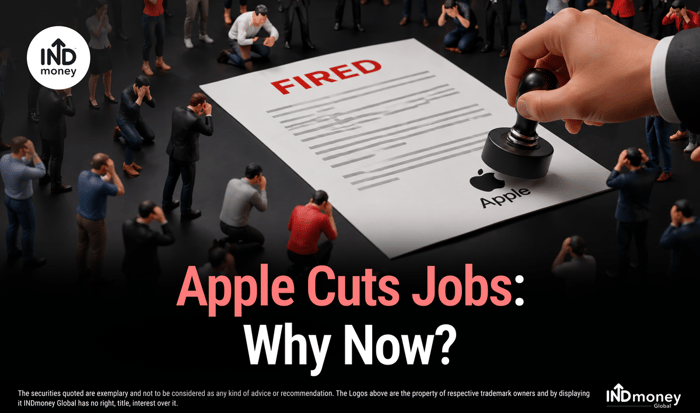
Apple is cutting jobs at a time when its revenue, profit and research spending are all rising. That may sound contradictory, but it reveals the real story behind the Apple layoffs in 2026. The company is not broadly shrinking to protect profits. It is moving people and money away from selected activities while raising investment in artificial intelligence and the products it believes can drive its next phase of growth.
The latest reductions have reached the audio-content team within Apple Fitness+. They follow a larger August restructuring that affected more than 200 roles across Siri, software, artificial intelligence and Vision Pro. For investors, the number of jobs being removed is less important than where they are being removed and where Apple is creating new roles.
Let's break down what happened, why Apple is reorganising teams despite reporting record quarterly revenue and what the changes could mean for technology workers, Indian investors and the valuation of Apple shares.
What happened in the Apple layoffs in 2026?
Apple reportedly reduced a small number of roles in its Fitness+ business in September 2026. The cuts mainly affected people working on audio-led features such as Time to Walk and Time to Run. These programmes allow Apple Watch users to follow guided content without watching a screen.
Apple has not disclosed how many Fitness+ employees were affected. Reports indicate that the audio features are not being discontinued, although new episodes may be released less frequently. This distinction matters because reducing the pace of content production is different from closing the service.
The Fitness+ changes followed a wider restructuring in August. More than 200 roles were reportedly removed across Vision Pro, Siri and other software groups. Around 100 positions were affected within the Vision Pro organisation and roughly another 100 across Siri and software teams, including employees in the Intelligent Systems Experience group that works on AI-powered capabilities.
Apple said that it was realigning teams to improve user experiences. It also said that new roles would be created and that affected employees could apply for other positions within the company.
| Area affected | Reported change | What it may indicate |
| Fitness+ audio content | A small and undisclosed number of roles cut | Lower content frequency and tighter control of recurring production costs |
| Siri and software | Roughly 100 positions affected | Different skills needed for Siri's new AI architecture |
| Intelligent Systems Experience | Roles reorganised as AI work spreads across more product teams | AI capabilities becoming embedded across apps instead of sitting in one central group |
| Vision Pro | Around 100 positions affected | Less spending on gaming and immersive video and greater focus on future devices |
These are targeted cuts rather than mass layoffs. Apple said in July that it had more than 150,000 employees. Even 200 positions represent only about 0.13% of that workforce. The current Fitness+ reduction is smaller still and its exact size has not been made public.
Why is Apple cutting jobs while revenue and R&D spending are rising?
Apple's latest financial results do not look like those of a company cutting jobs because it cannot afford them. In the quarter ended June 27, 2026, revenue rose 16% year on year to $109.4 billion. Net income increased about 27% to $29.8 billion while operating income rose roughly 27% to $35.7 billion.
More importantly, Apple is spending more on innovation. Research and development expenses jumped 32% year on year to $11.7 billion in the June quarter. Over the first nine months of fiscal 2026, R&D spending reached $34.0 billion, up 33%. Apple specifically attributed the increase to higher infrastructure costs, including AI investment and higher employee-related expenses.
| Apple financial indicator | Q3 FY26 | Q3 FY25 | Year-on-year change |
| Revenue | $109.4 billion | $94.0 billion | 16.4% |
| Net income | $29.8 billion | $23.4 billion | 27.1% |
| Operating income | $35.7 billion | $28.2 billion | 26.6% |
| R&D expense | $11.7 billion | $8.9 billion | 32.3% |
| Services revenue | $30.7 billion | $27.4 billion | 12.1% |
The numbers show that Apple is not simply replacing people with AI to reduce its total wage bill. It is spending considerably more on R&D and headcount-related costs while changing the mix of skills and projects inside the company.
Think of Apple's budget as a portfolio. Selling one investment does not necessarily mean the investor is leaving the market. It may mean that the money is being moved into an opportunity with better expected returns. Apple's layoffs appear to be a similar exercise in internal capital allocation: less money for selected Vision Pro content, gaming and Fitness+ audio production and more resources for AI infrastructure, new Siri capabilities and future devices.
Are Apple layoffs being driven by artificial intelligence?
AI is central to the restructuring, but the simple claim that AI is replacing Apple employees would be misleading. The reported changes within Siri are linked to a new technical architecture. When the underlying system changes, the company may need more engineers with expertise in large models, AI infrastructure, privacy engineering and cross-app automation and fewer people working on parts of the older software stack.
Apple introduced its new Siri AI architecture at WWDC26. The assistant is designed to understand information on a user's screen, draw on personal context across emails, messages and photos and complete actions across apps. Apple is trying to combine these capabilities with its traditional focus on privacy. Delivering that experience across the iPhone, iPad, Mac, Apple Watch and Vision Pro is a much larger engineering problem than adding a chatbot to one app.
This explains why layoffs and hiring can happen at the same time. Some old roles disappear because a product architecture has changed while new roles are created for the next version of the product. For employees, however, this is still disruptive. A software engineer who understands the previous Siri system cannot automatically move into an AI infrastructure role without different experience and training.
The broader lesson for the technology job market is that AI may change the composition of employment before it changes total employment. Routine content production and work attached to older software systems face more pressure. Roles linked to AI models, data infrastructure, security, product integration and specialised hardware may continue to grow.
What do the Vision Pro and Fitness+ cuts reveal about Apple's priorities?
The three affected areas tell investors different things. Siri is a technology transition. Vision Pro is a product-market question. Fitness+ is a subscription-economics question.
The Vision Pro reductions reportedly include a near-shutdown of a gaming team and a smaller internal immersive-video operation. Producing high-quality three-dimensional content can be expensive while the audience for a premium headset remains limited. Apple has said that Vision Pro and visionOS are not being discontinued, but the restructuring suggests that the company wants third parties to carry more of the content burden while Apple directs resources towards future wearable devices.
That is a sensible approach if Apple believes lighter and more accessible products can eventually reach a much larger market than a specialised headset. However, it also shows that spending heavily does not guarantee that a new hardware category will achieve iPhone-like scale. Investors should treat Vision Pro as a long-term option rather than assume it is already a major earnings engine.
Fitness+ presents a different challenge. Subscription content requires a steady flow of new programmes to keep users engaged. That creates recurring production costs and the risk that subscribers leave when content feels repetitive. Apple generated $30.7 billion in Services revenue in the June quarter and its Services gross margin was a very strong 75.6%, but Apple does not disclose Fitness+ revenue or profitability separately.
The Fitness+ cuts therefore do not prove that Apple's overall Services business is weakening. They suggest that management is reviewing the return generated by one small content format. Fitness+ could also become more closely integrated with Apple's broader Health app over time, reducing duplicated content and management costs. That possibility remains a strategic interpretation rather than a confirmed product decision.
What do the layoffs mean for Apple's earnings and AAPL stock valuation?
The direct cost savings are unlikely to move Apple's earnings meaningfully. A simple illustration makes the scale clear. If 200 affected roles carried an average annual cost of $200,000 each including salary, benefits and other employment expenses, the annual saving would be about $40 million. That would equal roughly 0.03% of the $122.4 billion in operating income Apple generated during the first nine months of fiscal 2026.
The $200,000 figure is an assumption for scale and not a disclosed Apple employment cost. The point is that investors should not expect these layoffs to create a visible jump in earnings per share. Their importance lies in whether Apple is moving resources into products that can generate better long-term returns.
That distinction matters because Apple stock carries a demanding valuation. At about $336 per share on September 21, 2026, Apple's market value was close to $4.95 trillion and the stock traded at roughly 38.6 times trailing earnings. The inverse of that valuation is an earnings yield of only about 2.6%. In simple terms, every $100 of market value was supported by approximately $2.60 of trailing annual earnings.
A high valuation does not automatically make a stock unattractive, but it leaves less room for execution mistakes. Investors are already paying for durable iPhone demand, high Services margins, continued share repurchases and a meaningful AI opportunity. The layoffs become relevant if they improve execution. They become a warning if repeated reorganisations delay products, weaken employee retention or reveal that Apple is struggling to convert AI spending into user adoption.
What do Apple layoffs mean for technology jobs and India?
The cuts highlight a two-speed global jobs market. Apple is reducing selected content, software and headset roles while increasing spending on AI infrastructure and specialised talent. The result is not simply fewer technology jobs. It is a faster shift in the skills companies are willing to pay for.
India sits on a different part of Apple's employment map. Apple's manufacturing partners have been expanding iPhone production in India while Apple continues to advertise manufacturing, supply-chain and AI-linked operations roles in Bengaluru and Chennai. That does not guarantee uninterrupted hiring and these jobs are not directly comparable with the positions being cut in the United States. It does show that targeted corporate layoffs do not mean Apple is retreating from India.
For India, the larger opportunity lies in moving beyond assembly. Manufacturing scale creates jobs, but more durable value can come from component production, industrial automation, product engineering, AI-enabled factory systems and supplier research. Apple's own India job listings in 2026 included roles connected to manufacturing intelligence, agentic systems and AI data platforms, illustrating how manufacturing and software skills are beginning to overlap.
What should global and Indian investors track next?
The layoffs are a useful signal, but they should not dominate an investment decision. Investors should watch whether the resources being reallocated produce better commercial outcomes.
- Siri AI adoption: The key test is whether users regularly use the new assistant and whether it makes Apple devices more valuable or encourages upgrades.
- R&D productivity: R&D spending is growing above 30%. Investors need evidence that this higher cost produces stronger revenue growth, better products or a more defensible ecosystem.
- Services quality and margins: Fitness+ is small within Apple, but slower content investment should not lead to weaker engagement across the wider subscription bundle.
- The future of Vision Pro: Watch whether Apple can reduce production costs, attract third-party developers and translate spatial computing into a more mainstream device.
- Further restructuring: Additional targeted cuts would still differ from a broad layoff programme. Repeated reductions across core AI teams, however, could indicate execution problems rather than routine portfolio management.
- Valuation versus earnings growth: At a high earnings multiple, Apple must deliver more than cost savings. Revenue growth, margins, cash generation and AI-led demand need to justify the premium.
Indian investors may already own Apple indirectly through Nasdaq 100 ETFs or funds tracking the S&P 500. Buying Apple separately can therefore increase exposure to the same company rather than add diversification. Portfolio overlap matters more than the number of funds or stocks held.
Analyst view: Apple's layoffs are a strategy signal, not an earnings catalyst
Apple's 2026 layoffs should not be read as evidence of financial distress and they should not be celebrated as a major profit lever. The cuts are too small to materially change earnings. They matter because they show which projects are losing internal priority and which skills Apple believes it needs next.
The positive interpretation is that Apple is becoming more disciplined. It is reducing spending on narrow content formats and parts of Vision Pro while committing far more money to AI, Siri and platform-wide intelligence. The cautious interpretation is that repeated team changes can slow execution at a time when investors already expect Apple to succeed in AI.
The real question for shareholders is not whether Apple can save tens of millions of dollars by removing roles. It is whether the company can turn its rapidly rising R&D budget into products that protect its ecosystem and create new reasons for customers to upgrade. At a valuation close to 39 times trailing earnings, that outcome matters far more than the layoffs themselves.