

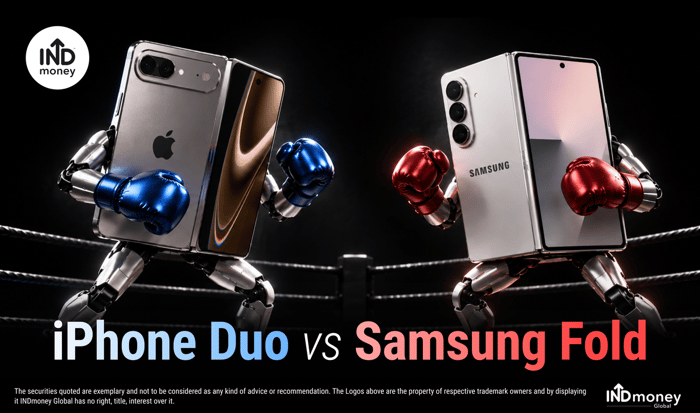
- iPhone Duo vs Samsung Galaxy Z Fold 8: Which Is Better?
- iPhone Duo vs Samsung Galaxy Z Fold 8 Specs Comparison
- iPhone Duo vs Samsung Galaxy Z Fold 8 Price in India and US
- iPhone Duo vs Samsung Fold 8 Software, Multitasking and AI
- Why Apple Launched the iPhone Duo and Entered the Foldable Market
- Does Samsung Make Money From Apple iPhone Duo Sales?
- Apple Stock vs Samsung Stock: Who Benefits More From Foldables?
- A Simple iPhone Duo Revenue Model
- Final Verdict
Apple did not just fold an iPhone. It folded its pricing curve. The new iPhone Duo costs only $99 more than the Samsung Galaxy Z Fold8 in the US, but its ₹2,99,900 India price is ₹1,19,901 higher.
That strange gap is the heart of this comparison: Apple has delivered a polished first attempt, while Samsung offers a lighter, thinner and more capable multitasking machine for far less in India. The final twist is that Samsung may even earn money when Apple sells one.
Let's break down the iPhone Duo vs Samsung Galaxy Z Fold 8 across price, display, design, cameras, battery, software and ownership risk. Then, we will examine what this foldable battle means for Apple stock, Samsung stock and the economics of a category that is still tiny, expensive and strategically important.
iPhone Duo vs Samsung Galaxy Z Fold 8: Which Is Better?
For most buyers in India, the Samsung Galaxy Z Fold 8 is the better purchase. It offers a similarly sized display, weighs 53 g less, is 1.6 mm thinner when folded, has more mature multitasking software and costs nearly ₹1.2 lakh less at 256GB.
The iPhone Duo makes sense for a narrower group: people deeply invested in Apple products who have been waiting specifically for a foldable iPhone. Its sharper displays, IP68 rating, nano-texture inner screen, Apple Pencil support and tight iOS integration are meaningful advantages. They are not, in our view, enough to make it the rational value winner in India.
| Buyer priority | Better choice | Why |
| Best value in India | Galaxy Z Fold8 | ₹1,19,901 cheaper at 256GB |
| Lowest weight and thickness | Galaxy Z Fold8 | 201 g and 9.7 mm folded |
| Serious multitasking | Galaxy Z Fold8 | Up to three apps, floating windows and DeX |
| Apple ecosystem | iPhone Duo | Native continuity with iPhone, Mac, Watch and AirPods |
| Dust and water protection on paper | iPhone Duo | IP68 versus IP48 |
| Camera-first buyer | Neither | Both lack a dedicated optical telephoto camera |
| Lowest first-generation risk | Galaxy Z Fold8 | Samsung is on its eighth Fold generation |
iPhone Duo vs Samsung Galaxy Z Fold 8 Specs Comparison
The regular Galaxy Z Fold8 is the main comparison here because it matches the Duo's 7.6-inch book-style format. Samsung also sells a larger Fold8 Ultra, which we address separately below.
| Specification | Apple iPhone Duo | Samsung Galaxy Z Fold8 |
| Status | Announced Sep. 9; ships Oct. 23, 2026 | Launched Jul. 22; on sale since Aug. 7, 2026 |
| India starting price | ₹2,99,900 | ₹1,79,999 |
| US starting MSRP | $1,999 | $1,899.99 |
| Inner display | 7.6-inch OLED, 1878 × 2670, 430 ppi | 7.6-inch AMOLED 2X, 1848 × 2448, 403 ppi |
| Outer display | 5.4-inch OLED, 1398 × 2034, 460 ppi | 5.5-inch AMOLED 2X, 1248 × 1972, 428 ppi |
| Refresh rate and brightness | Up to 120Hz; 3,000 nits outdoor peak | 1-120Hz; up to 3,000 nits |
| Weight | 254 g | 201 g |
| Thickness, folded | 11.3 mm | 9.7 mm |
| Thickness, open | 5.2 mm | 4.5 mm |
| Processor | A20 Pro, 2 nm | Snapdragon 8 Elite Gen 5 for Galaxy |
| Memory and storage | RAM not disclosed; 256GB to 2TB | 12GB/256GB, 12GB/512GB, 16GB/1TB |
| Rear cameras | 48MP main + 48MP ultrawide | 50MP main + 50MP ultrawide |
| Dedicated optical telephoto | No; 2x sensor crop | No; 2x sensor crop |
| Battery claim | Up to 31 hours inner-screen video; 24 hours mixed use | 4,800mAh; up to 26 hours inner-screen video |
| Wired charging claim | 50% in about 20 min with 60W+ adapter | 63% in about 30 min with 45W adapter |
| Wireless charging | MagSafe/Qi2 up to 25W | Up to 20W; reverse wireless charging |
| Ingress protection | IP68 | IP48 |
| Unlock method | Side-mounted Touch ID; no Face ID | Side fingerprint sensor; face unlock |
| SIM | eSIM only worldwide | Physical SIM and eSIM support varies by market |
| Stylus | USB-C Apple Pencil support later in 2026 | No S Pen support listed for Fold8 |
| Software | iOS 27.1 | Android 17 with One UI 9 |
| Formal update promise | No fixed number published | 7 OS generations and 7 years of security updates |
Sources: Apple iPhone Duo announcement, Apple technical specifications, Samsung Mobile Press specifications, Samsung software-support policy.
iPhone Duo vs Samsung Galaxy Z Fold 8 Price in India and US
We used official list prices, not temporary bank offers, trade-ins or launch discounts. That makes the comparison repeatable and keeps it useful after today's promotions disappear.
India price comparison
| Storage | iPhone Duo | Galaxy Z Fold8 | Apple costs more | Apple premium |
| 256GB | ₹2,99,900 | ₹1,79,999 | ₹1,19,901 | 66.6% |
| 512GB | ₹3,24,900 | ₹1,99,999 | ₹1,24,901 | 62.5% |
| 1TB | ₹3,74,900 | ₹2,39,999 | ₹1,34,901 | 56.2% |
| 2TB | ₹4,49,900 | Not offered | Not comparable | Not comparable |
Official prices: Apple India and Samsung India.
At 256GB, the Duo premium works out to about ₹2,498 per month over four years, before financing costs and insurance. That is not a small ecosystem tax. It is the price of a capable second phone spread across the ownership period.
Samsung also advertises two years of Samsung Care+ for the new Z range and an optional Galaxy Forever plan with an assured buyback value of up to 55%, subject to terms. Those programmes do not erase foldable repair risk, but they make that risk easier to budget. Apple's India store lists AppleCare+ availability, although final Duo plan pricing should be checked when pre-orders open.
US price comparison
| Storage | iPhone Duo | Galaxy Z Fold8 MSRP | Apple costs more | Apple premium |
| 256GB | $1,999 | $1,899.99 | $99.01 | 5.2% |
| 512GB | $2,199 | $2,099.99 | $99.01 | 4.7% |
| 1TB | $2,599 | $2,499.99 | $99.01 | 4.0% |
US prices exclude sales tax and Samsung's frequent promotional discounts. Sources: Apple US store, Samsung US store.
This produces two different verdicts. In the US, a 5.2% entry-price difference is small enough for software preference to decide the purchase. In India, a 66.6% premium demands a concrete benefit. The Duo's specification sheet does not provide one large enough.
Does the Galaxy Z Fold8 Ultra change the comparison?
It strengthens Samsung's value case in India. The Galaxy Z Fold8 Ultra starts at ₹1,99,999, still ₹99,901 below the iPhone Duo. It adds an 8-inch inner screen, 200MP main camera and 5,000mAh battery, while weighing 215 g. Buyers who want Samsung's best hardware should compare the Duo with the Ultra, but the standard Fold8 remains the closer size match.
iPhone Duo vs Samsung Fold 8 Software, Multitasking and AI
Apple has done more than stretch iOS. iOS 27.1 moves interface elements to preserve vertical space, shifts content cleanly between screens, supports two apps side by side, opens two windows of the same app and saves app pairs. Apple Pencil support is due later in 2026. For a first release, that is a credible foundation.
Samsung's lead is still obvious. One UI 9 supports up to three apps in configurable layouts, resizable split windows, floating apps, a persistent taskbar and Samsung DeX on an external display. Apple's launch implementation is limited to two equal halves in early hands-on demonstrations. Samsung is offering a pocket computer; Apple is offering a very elegant dual-app iPhone. Samsung's multitasking guide documents split view, pop-ups, taskbar and DeX.
On AI, the labels matter less than the workflow. Apple's Siri AI can use personal context and what is on screen, with on-device processing and Private Cloud Compute. Samsung combines Galaxy AI, Gemini and app-level automation. The larger screen is valuable because users can keep the source on one side and inspect an AI answer on the other. It turns AI from a magician behind a curtain into an assistant whose work you can check.
Apple's advantage is ecosystem continuity. A Mac, Apple Watch, AirPods, iCloud library and paid apps create switching friction that a spec table cannot measure. Samsung has reduced some of that friction with easier Smart Switch migration and Quick Share compatibility with AirDrop, but it cannot recreate the full Apple bundle.
Why Apple Launched the iPhone Duo and Entered the Foldable Market
Foldables are growing, but they remain a premium niche. Omdia says shipments reached 18.2 million in 2025, expects more than 22 million in 2026, 36 million in 2028 and 45 million by 2030. Even then, foldables would remain below 3% of all smartphone shipments. High display, hinge and specialised-glass costs keep the category expensive. Omdia's forecast is a useful antidote to launch-event excitement.
So why enter a category that may still be below 3% in 2030? Because Apple does not need Duo to become the mass-market iPhone. It needs Duo to do three smaller jobs:
- Raise the price ceiling. The $1,999 starting price sits $700 above the $1,299 iPhone 18 Pro Max.
- Retain premium users. Apple no longer has to send an iOS user to Android to buy a foldable.
- Create a new software canvas. A larger screen can deepen use of Services, paid apps, games and AI.
Counterpoint forecast before launch that Samsung could hold 32% of 2026 foldable shipments and Apple could take 25% in its entry year. Those are forecasts, not sales results, but they show why the launch matters competitively. Counterpoint's July 2026 forecast put Samsung at 32%, Apple at 25% and Huawei at 24%.
Apple is not necessarily trying to win the foldable unit race in year one. It is trying to own the most profitable rung of the ladder.
Does Samsung Make Money From Apple iPhone Duo Sales?
The handset rivalry is real, but the supply chain is more cooperative than the advertising.
Industry publication The Elec reported in June that Samsung Display had started producing foldable OLED modules for Apple's first foldable, with an initial order of about 3 million panels and a reported three-year exclusive arrangement. Apple has not publicly confirmed those commercial terms, so treat them as supply-chain reporting, not company guidance. The Elec's report also said module yields had exceeded 80% at the Vietnam facility.
Why does this matter for investors? Samsung Electronics' consolidated accounts include Samsung Display. In other words, Samsung can lose some Galaxy Fold handset share to Apple and still earn component revenue from the category's expansion. Apple owns the customer relationship and operating system. Samsung monetises both its own device and, reportedly, a critical layer inside its rival's device.
This is our favourite lens on the launch: Apple versus Samsung is a retail fight, but Apple plus Samsung is a supply-chain partnership. Market-share charts show only the first half.
Apple Stock vs Samsung Stock: Who Benefits More From Foldables?
The two stocks should not be compared as if they represent the same business.
| Investor lens | Apple | Samsung Electronics |
| Latest reported quarter | FY26 Q3 | Calendar Q2 2026 |
| Revenue | $109.4 billion | KRW 171.5 trillion |
| Phone exposure | iPhone: $54.25 billion, 49.6% of revenue | MX & Networks: KRW 33.2 trillion |
| Key profit engine | Premium devices plus Services | AI memory and semiconductors |
| Foldable upside | Higher iPhone mix, retention, ecosystem use | Galaxy sales plus reported display supply |
| Main foldable risk | Cannibalisation, high component cost, first-gen returns | Mobile margin pressure and handset share loss |
Apple's Q3 FY26 financial statements show why Duo matters. iPhone revenue was $54.25 billion, up 21.7% year on year and equal to 49.6% of total revenue. Services added another $30.74 billion. A more expensive iPhone can raise hardware mix and potentially deepen the installed base, but foldable components are costly, so a high selling price does not automatically mean a higher gross-margin percentage.
Samsung's story is almost the reverse. Its Q2 2026 results reported KRW 89.5 trillion of consolidated operating profit. The semiconductor-led Device Solutions division generated KRW 89.2 trillion, while MX and Networks recorded a KRW 0.7 trillion operating loss as component costs rose. Fold8 can help Samsung's premium mobile mix, but the stock is currently far more sensitive to AI-memory prices, HBM demand and chip capacity than to one phone model.
What is already priced into Apple and Samsung shares?
| Market snapshot | Apple (AAPL) | Samsung Electronics (005930) |
| Share price | $315.34, Sep. 9 close | KRW 269,250, Sep. 10 close |
| Market value | About $4.60 trillion | About KRW 1,712 trillion |
| Trailing P/E | 36.2× | 12.0× |
Market data: Apple valuation snapshot and Samsung valuation snapshot, sourced there from S&P Global Market Intelligence. Prices and multiples change daily.
Apple's much higher P/E means investors already pay heavily for brand strength, recurring Services revenue and resilient cash generation. Duo must contribute to durable growth, not merely create headlines. Samsung's lower multiple is not automatically “cheap”; semiconductor profits are cyclical, and peak earnings can make a chip company's P/E look deceptively low.
Duo is more strategically important to Apple than Fold8 is financially important to Samsung. Yet Samsung may have the more diversified way to win, through phones, displays and the wider component cycle.
A Simple iPhone Duo Revenue Model
Apple does not disclose a Duo sales forecast. Instead of pretending to know it, we can test scenarios. The base US list-price gap between iPhone Duo and iPhone 18 Pro Max is $700. If every Duo buyer would otherwise have purchased a base Pro Max, the following is the theoretical list-price uplift:
| First 12-month Duo units | Base-price sales value at $1,999 | Uplift versus $1,299 Pro Max |
| 5 million | $10.0 billion | $3.5 billion |
| 8 million | $16.0 billion | $5.6 billion |
| 10 million | $20.0 billion | $7.0 billion |
This is a sensitivity table, not a forecast. It ignores storage mix, regional pricing, channel discounts, taxes, returns and gross margin. It also assumes full cannibalisation of a base Pro Max, while some Duo buyers may come from Android or skip a purchase altogether.
The model reveals the real question. Duo does not need iPhone-scale volume to add billions of dollars to Apple's price mix. But even 10 million units would not, by itself, justify a $4.6 trillion valuation. For Apple stock, the longer-lived signals are upgrade rates, net Android switchers, Services engagement and whether Duo creates a repeatable product family.
Final Verdict
Our sharper conclusion is this: Samsung currently makes the better foldable phone for the money, while Apple may make the foldable market better for everyone. Apple's entry can attract developers, accelerate component investment and expand consumer interest. Samsung is prepared to compete at the checkout and, if supplier reports are correct, collect revenue from behind the iPhone Duo's screen.
For buyers, Samsung wins today. For the category, Apple changes the game. For investors, the most interesting winner may be the company that can profit from both sides.