

- What Has Reuters Reported About Anthropic's IPO Financials?
- Why Did Anthropic Record a $34 Billion Accounting Charge?
- Anthropic’s Real Challenge: $8 Billion Operating Loss and AI Compute Costs
- Can Claude Become Profitable? A Simple Profit Test For Claude's Business
- Doesn't 2026 Growth Make The 2025 Loss Obsolete for Anthropic?
- Could Anthropic Fund The Loss Without An IPO?
- What We Would Watch In Anthropic's Financial Performance
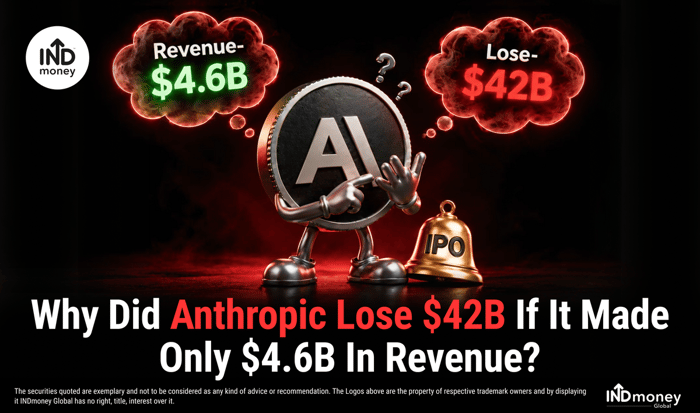
Anthropic brought in almost $4.6 billion in 2025, yet its reported net loss came close to $42 billion. The obvious reaction is that Claude somehow burned nine dollars for every dollar it earned.
The truth is more interesting: a huge financing-related accounting charge explains most of that headline, while a separate, very real operating gap tells us whether the AI business can eventually pay its own way.
Let's break down the two losses, why the financing charge grew, and which numbers actually test Anthropic's path to profit.
What Has Reuters Reported About Anthropic's IPO Financials?
Reuters reviewed Anthropic's IPO prospectus and reported roughly $4.6 billion of 2025 revenue, up about twelvefold from 2024. It also reported a net loss close to $42 billion, an operating loss greater than $8 billion excluding certain fundraising-related liability remeasurements, $12.65 billion of operating expenses and $7.33 billion of computing and infrastructure spending.
These figures come from Reuters' account of a prospectus that Anthropic has not publicly released as of September 29, 2026. Reason why we cannot yet independently inspect the full financial statements or footnotes.
| Anthropic 2025 figure | Reported amount | Why it matters |
| Revenue | Nearly $4.6 billion | Sales of Claude-related products and services |
| Computing and infrastructure expense | $7.33 billion | Building and running AI models |
| Total operating expenses | $12.65 billion | Reported cost base including computing |
| Operating loss, excluding noted remeasurements | More than $8 billion | Approximate gap in the underlying business |
| Financing-related accounting charge | Roughly $34 billion | Revaluation, largely linked to earlier fundraising |
| Net loss | Nearly $42 billion | Headline accounting result |
| Cash, cash equivalents and short-term investments | $20.28 billion | Balance on December 31, 2025, not today's balance |
Source: Reuters' prospectus reporting. Figures are rounded. A precise income statement reconciliation requires the underlying filing; the rows should not be mechanically added to produce an audited total.
The distinction between the $42 billion loss and the operating loss is the centre of the story. One is dominated by the changing accounting value of financing instruments. The other reflects the cost of delivering and developing the product. Both matter, but they answer different questions.
Why Did Anthropic Record a $34 Billion Accounting Charge?
Reuters says the near-$42 billion net loss included roughly $34 billion because the estimated value of financing that could eventually turn into Anthropic shares went up. This was an accounting charge, not $34 billion wired to a supplier to run Claude that year.
Here is a simple way to picture it. Suppose a company promised an early backer a financial instrument linked to its future shares. If investors later think those future shares will be worth much more, the company's obligation to that backer can also be worth more. Depending on the instrument's accounting treatment, that increase is recorded as an expense or loss even if the company makes no cash payment at that moment. Accounting guidance on convertible instruments describes cases in which changes in fair value run through earnings.
That example explains the mechanism, not Anthropic's exact contract terms. We have not seen the note that identifies each instrument, conversion price, settlement right or treatment at IPO. It would be a mistake to assume the entire charge disappears automatically on listing or that it creates exactly the same number of new shares as its dollar amount suggests.
| Question | What the $34 billion charge tells us | What it does not tell us |
| Did Anthropic spend that sum on 2025 computing? | No, Reuters describes a valuation-related charge | The actual 2025 cash outflow |
| Can it affect shareholders? | Potentially, depending on how financing converts or settles | The precise dilution without conversion terms |
| Will it recur? | Fair-value marks can change as instrument values change | Whether this instrument remains outstanding after an IPO |
| Does removing it make Claude profitable? | No, the underlying operating loss still exceeds $8 billion | That the business has positive free cash flow |
The apparently absurd loss can therefore be partly the shadow cast by Anthropic's rising private valuation. It is still an economic issue for future shareholders if the financing gives earlier investors a larger slice of the company.
Noncash does not mean irrelevant; it means the expense is not the same as money spent operating the business.
Anthropic’s Real Challenge: $8 Billion Operating Loss and AI Compute Costs
Now put the financing item aside and inspect the cost of the business. Reuters reports $7.33 billion spent on computing and infrastructure in 2025, more than half of its $12.65 billion in total operating expenses. The remaining expenses are about $5.32 billion by subtraction. Against nearly $4.6 billion of revenue, that produces an operating gap of about $8 billion using rounded figures, consistent with Reuters' description.
| For every $1 of 2025 revenue | Approximate amount | Calculation |
| Computing and infrastructure | $1.59 | $7.33B ÷ $4.6B |
| Other operating expenses | $1.16 | ($12.65B − $7.33B) ÷ $4.6B |
| Total operating expenses | $2.75 | $12.65B ÷ $4.6B |
| Operating shortfall | $1.75 | $2.75 costs − $1 revenue |
This is an analytical simplification of rounded Reuters figures, not a company-reported unit cost per customer or per Claude query. Computing includes more than serving today's paying customers. Training newer models and maintaining capacity for growth can burden current results while supporting possible future sales. We cannot use the $1.59 figure to conclude that every additional dollar of Claude revenue loses $0.59 on computing.
Still, it asks the question an IPO investor should ask. Can Anthropic spread large model-development costs across enough durable demand while reducing the cost of serving each customer? More users do not automatically fix the economics if every wave of usage requires another expensive model and more costly computing.
Can Claude Become Profitable? A Simple Profit Test For Claude's Business
The right way to test the story is to separate two cost buckets. Some spending follows customer usage: when customers ask Claude to do more work, serving them consumes more computing power. Other spending goes into developing new models, staff, sales and infrastructure that may grow in steps rather than with every query. Reuters' reported computing figure does not separate these neatly, so any model must label its assumptions.
Here is an illustrative sensitivity test. Assume annual revenue reaches either $20 billion or $40 billion, computing and infrastructure account for either 50% or 70% of that revenue, and all other annual operating expenses rise to $8 billion or $12 billion respectively. Those cost ratios and future revenue figures are our hypothetical inputs, not Anthropic guidance.
The simple calculation is revenue minus computing minus other operating expenses.
| Illustrative annual revenue | Compute as share of revenue | Other operating expenses | Illustrative operating result |
| $20B | 50% | $8B | +$2B |
| $20B | 70% | $8B | −$2B |
| $40B | 50% | $12B | +$8B |
| $40B | 70% | $12B | $0B |
At $20 billion of revenue, changing only the compute share by 20 percentage points swings the result by $4 billion. At $40 billion, it swings by $8 billion. This is why a growing sales line, on its own, tells us much less than the direction of computing cost per dollar of sales and the cadence of new model-development spending.
The exercise also has limits. The assumed 50% or 70% compute share does not come from Anthropic's disclosed unit economics, and expenses may rise faster than shown. It makes the decision variable visible; it does not forecast profit.
Doesn't 2026 Growth Make The 2025 Loss Obsolete for Anthropic?
The historical loss needs current context. In April 2026, Anthropic said its annualised revenue run rate had passed $30 billion. In May, it said that measure had crossed $47 billion. Those are annualised snapshots of recent sales activity, not actual revenue booked across a full year.
The Financial Times reported that second-quarter 2026 revenue was $11.5 billion and that Anthropic was headed toward a second consecutive quarter of adjusted operating profit. Annualising $11.5 billion for four equal quarters would be $46 billion, but growth, customer behavior and pricing will not necessarily stay at that quarterly level. The adjusted profit measure also cannot be treated as the same thing as reported net income or free cash flow; the exact adjustment bridge matters.
| Measure | Period and meaning | Sensible reading |
| Nearly $4.6B revenue | Actual full-year 2025 sales reported by Reuters | Historical scale for the loss |
| Above $30B run rate | April 2026 snapshot disclosed by Anthropic | Sales pace at that time, not 2026 sales |
| Above $47B run rate | May 2026 snapshot disclosed by Anthropic | A newer pace, still not a full year |
| $11.5B Q2 revenue | Quarter reported by the FT | A later period, with costs and adjustments still to assess |
The fair comparison is between revenue and costs measured over the same period and under the same accounting definition. Comparing 2025 costs with a 2026 run rate can make profitability look closer than it was. Ignoring the acceleration in 2026 can make the 2025 loss look like a permanent condition. Neither shortcut does investors a favour.
Could Anthropic Fund The Loss Without An IPO?
Reuters says Anthropic had $20.28 billion in cash, equivalents and short-term investments on December 31, 2025. Anthropic later announced a $65 billion Series H financing in May 2026. Those are two different dates. Adding them and calling the sum today's cash balance would ignore spending, deal structure, later inflows and other changes.
There is a more basic accounting trap. Operating loss is not cash burn. Capital spending, prepayments for computing, customer collections, noncash compensation and financing arrangements can all cause cash flow to differ from accounting profit. Dividing $20.28 billion by an $8 billion operating loss would produce a number, but it would not be a reliable cash runway. The prospectus cash-flow statement, the timing of infrastructure payments and later balance sheets are the pieces needed for that calculation.
For a new shareholder, there are two potential ways a financing-heavy business can affect their stake. Cash losses can require fresh funding, which may dilute existing owners if new shares are issued. Earlier instruments linked to shares may also convert. That is why the financing charge should be separated from the operating loss during analysis, then brought back when assessing per-share ownership.
What We Would Watch In Anthropic's Financial Performance
Our assessment is that the net-loss headline exaggerates what Anthropic spent to operate in 2025, while a casual claim that the loss was “only on paper” understates the size of its operating challenge. A more useful scorecard has five entries:
- Reported operating result and adjustments. Are adjusted profit and the standard reported measure converging, and what is removed from the adjusted figure?
- Computing cost relative to sales. Does spending to train and serve Claude grow more slowly than revenue across comparable periods?
- Cash from operations and capital commitments. Does growth generate cash after paying for capacity, or require repeated external funding?
- Revenue quality. Do customers stay and pay for recurring use, rather than one-time trials or temporary spikes? Reuters says nearly one quarter of 2025 revenue came from two clients and many large clients lacked long-term contracts.
- Shares after conversion. How do earlier financing arrangements affect the ownership and earnings attributable to one public share?
The strongest version of Anthropic's investment case is not simply that a $34 billion charge was noncash. It is that later, much larger revenue can support the recurring costs of Claude and the next round of model development, with manageable dilution. The weakest version is a business that reports rapid sales growth but has to keep raising capital to finance each new level of demand. Those outcomes require different evidence, even though both can coexist with the same spectacular 2025 net-loss headline.
INDmoney has a separate explainer on how a proposed $2 trillion Anthropic valuation is being framed. The narrower financial test here is whether sales growth can convert into sustained operating profit and cash generation per share.