

- Why Electricity Travels at High Voltages
- What the National Grid Actually Looks Like
- Who Plans and Controls the Network
- How Transmission Companies Make Money
- What Drives Success in Transmission
- Why Renewables Make Transmission Critical
- Looking Ahead: The Final Leg of the Journey
Electricity generated at a power plant is practically useless if it cannot reach the people who need it. A solar plant might sit in the sunny deserts of Rajasthan, a coal unit next to mines in Chhattisgarh, and a hydro station high in the hills of Himachal Pradesh, while the actual power is consumed thousands of kilometres away in cities like Mumbai, Delhi, or Bengaluru.
Power transmission is the high voltage national highway system for electricity. It takes massive volumes of power from generating stations, carries it across city and state boundaries, and steps it down so local utilities can deliver it straight to homes and businesses.
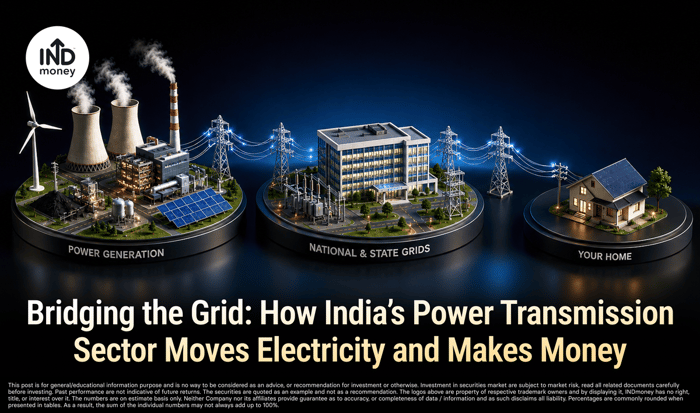
The journey follows a clear sequence. Electricity leaves the generating station, steps up into ultra high voltage long distance lines, enters regional substations to step back down, flows into the local distribution grid, and finally reaches your wall socket.
Why Electricity Travels at High Voltages
When power travels across hundreds of kilometres of wire, energy is lost as heat due to natural electrical resistance. The physics here is straightforward: higher voltage means lower current, which slashes energy losses dramatically.
To make long journeys efficient, transformers step up electricity to massive operating levels like 220 kV, 400 kV, and 765 kV. For long distance bulk power transfers from mega renewable hubs, such as Khavda in Gujarat or Leh in Ladakh, utilities build High Voltage Direct Current (HVDC) corridors. HVDC lines act like dedicated express highways, carrying huge amounts of power over vast distances with minimal energy loss. As electricity approaches cities, substations step the voltage back down in stages so local networks can safely handle it.
What the National Grid Actually Looks Like
A power grid is far more than just metal towers and cables. It relies on three critical assets working seamlessly together:
- Transmission Lines: High capacity conductors carrying bulk power across regional boundaries.
- Substations: Critical junction stations that control, switch, and reroute electricity across different parts of the network.
- Transformers: Specialized heavy equipment that steps voltage up for long haul transport or steps it down for local delivery.
India operates one of the largest single frequency connected grids in the world. Its national transmission network spans over 5,09,000 circuit kilometres with more than 1,478 GVA of transformation capacity. To put that scale in perspective, over 2,18,000 circuit kilometres were added after 2014 alone.
Who Plans and Controls the Network
The national grid is organized into two distinct operational layers:
- Inter State Transmission System (ISTS): Handles high voltage power moving between different states and regions.
- Intra State Transmission System: Manages power movement within an individual state's borders.
The Central Transmission Utility of India Limited (CTUIL) plans and coordinates the national ISTS network, overseeing grid connectivity and General Network Access (GNA). State Transmission Utilities handle internal state planning.
Crucially, the organization that plans the grid does not have to build or own every line. Private developers and state run companies compete directly to build, own, and maintain individual transmission corridors.
How Transmission Companies Make Money
Unlike power generation companies that sell physical units of electricity, transmission utilities sell network capacity and asset availability. A transmission owner's revenue does not double just because twice as much power flows through its lines. Instead, they are paid to construct the infrastructure and guarantee that it stays ready and operational whenever the grid operator needs it.
In India, transmission projects are built under two primary economic models.
Model 1: Regulated Tariff Mechanism (RTM)
Under regulatory guidelines set by the Central Electricity Regulatory Commission (CERC), projects operate on an approved cost recovery basis. Allowed revenues cover operating expenses, depreciation, interest on debt, and a regulated base Return on Equity (RoE) of 15% for new assets, based on a standard 70:30 debt equity capital structure.
For instance, in a ₹10,000 crore project, ₹3,000 crore is funded through equity. A 15% base RoE yields ₹450 crore in baseline annual return for shareholders, while operating expenses and debt servicing costs are paid out separately through approved tariffs.
However, revenue collection relies heavily on Normative Availability, typically set at 98.5%. If the lines stay available above 98.5% of the time, the company earns bonus incentive tariffs. If unscheduled outages push availability below that threshold, the regulator penalizes their revenue recovery.
Model 2: Tariff Based Competitive Bidding (TBCB)
Under TBCB, designated agencies auction off projects to the developer willing to build and operate the asset for the lowest annual transmission charge over a 35 year concession period. Public and private players, including Power Grid Corporation of India (PGCIL), Adani Energy Solutions, and Sterlite Power, compete aggressively in these auctions.
TBCB rewards operational efficiency. A developer that procures equipment cost effectively, builds quickly, and secures low cost debt can quote an aggressive bid while still earning strong returns. But aggressive bidding carries real risk: construction delays, land issues, or rising interest rates can quickly shrink expected profit margins.
What Drives Success in Transmission
- Financing and Execution: Because transmission is capital intensive and debt heavy, securing lower borrowing rates and completing projects on time directly impacts equity returns.
- Right of Way (RoW): Securing land access across hundreds of kilometres of private farmland, forests, and populated areas is the single biggest bottleneck. Delays on even a tiny 2 km stretch can hold up an entire 300 km line.
- Grid Reliability: Once operational, keeping asset availability above 98.5% using drones, automated line monitoring, and rapid repair protocols ensures full tariff recovery and performance bonuses.
Why Renewables Make Transmission Critical
Solar panels and wind turbines are bound by geography. The massive solar farms of Rajasthan or the coastal wind corridors of Tamil Nadu cannot move closer to major industrial demand centers like Mumbai or Delhi.
Because solar and wind farms take just 12 to 18 months to build, while major transmission corridors often take 36 to 48 months, power lines must be planned and constructed well in advance.
- 537 GW Target: CTUIL has planned dedicated ISTS corridors to integrate 537 GW of renewable energy capacity by 2030.
- Substantial Investment: Evacuating this green power requires over 50,800 circuit kilometres of new lines and 4.34 lakh MVA of substation capacity, representing roughly ₹2.44 lakh crore in total capital expenditure.
- Future Grid Demand: The Central Electricity Authority expects national peak demand to hit 388 GW by FY32, requiring the grid to accommodate nearly 590 GW of total generation additions over the coming decade.
Adding generation capacity is meaningless if the grid lacks the transmission lines to move that power.
Looking Ahead: The Final Leg of the Journey
Once electricity travels long distances across high voltage corridors, it still needs to enter local neighborhoods, step down to lower voltages, and be billed to individual consumers.
That critical final leg belongs to India’s distribution companies (DISCOMs), a sector operating under a completely different set of financial and operational pressures.