

- Why Samsung, SK Hynix Are Driving South Korea’s Stock Market Rally
- What Is the Korea Stock Market Discount and Why Is It Fading?
- Beyond AI Chips: Shipbuilding, Defence and Energy Storage Join the Rally
- Is South Korea’s Stock Market Rally a Bubble?
- Why South Korea Overtook India in Market Capitalisation
- How to Get Exposure to the Korean Stock Market from India
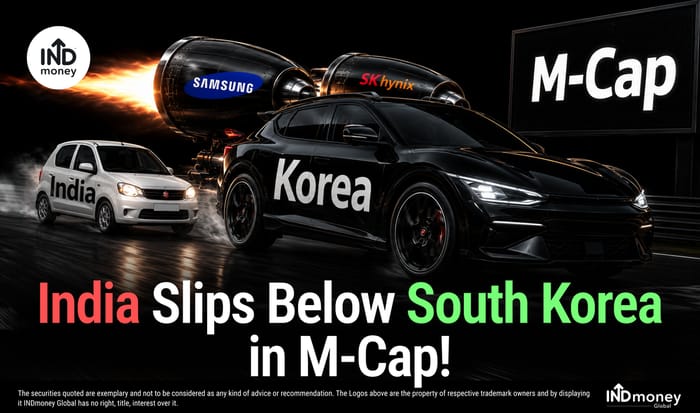
India just got leapfrogged in market capitalisation again. First Taiwan, now South Korea. As of June 2026, South Korea's total listed market capitalisation has surged to $5 trillion, while India's has slipped to $4.8 trillion, per Bloomberg data.
South Korea's benchmark index KOSPI has doubled in 2026 alone. That's not a typo. A market that, not long ago, was setting 5,000 as a "dream target" is now past 8,800, with Goldman Sachs calling 12,000 its next stop.
Let's break down why this happened, what's still fuelling the fire, whether there's a bubble forming and most importantly, how you as an Indian investor can get exposure without flying to Seoul.
Why Samsung, SK Hynix Are Driving South Korea’s Stock Market Rally
The headline story is well known: Samsung Electronics and SK Hynix, both now members of the decorated $1 trillion valuation club, are the twin engines of Korea's rally. Together, they account for roughly 50% of the KOSPI by market cap. Samsung is up approximately 180% this year, SK Hynix around 248%, per Google Finance Data.
The reason? High-Bandwidth Memory (HBM), the specialised chip stack that sits inside every advanced AI server on the planet. Samsung and SK Hynix together account for nearly 80% of the global HBM market. In Q1 2026, SK Hynix held 58% of the global HBM market, while Samsung held 21%, according to Counterpoint Research data.
NVIDIA can't build its accelerators without it. Hyperscalers like Meta, Microsoft, Google can't run their AI infra without it. That is a structural chokehold on the AI supply chain.
| Metric | Samsung Electronics | SK Hynix |
| 2026 YTD Performance | 180% | 248% |
| Market Cap | $1.5 trillion | ~$1 trillion |
| KOSPI Weight (combined) | ~50% | |
| Key Product | HBM, DRAM, NAND | HBM3E, HBM4 |
Source: Google Finance, CompaniesMarketCap, KOSPI
Goldman Sachs now projects KOSPI earnings growth for 2026 at 277%, up from its own January estimate of 48%. To put that in perspective, Goldman calls it the strongest earnings expansion in any Asian market since Korea's recovery from the 1997 Asian Financial Crisis.
What Is the Korea Stock Market Discount and Why Is It Fading?
Here is the angle most market coverage is missing entirely. South Korea’s stock market was cheap for years not because its companies were weak, but because investors did not fully trust how those companies were run.
Many large Korean businesses are controlled by powerful family groups called chaebols. In the past, these groups were often seen as prioritising the founding families over ordinary shareholders.
That meant minority investors, including foreign investors, had less confidence that company profits would be shared fairly through dividends, buybacks, or better capital allocation. So even though companies like Samsung and SK Hynix were globally important, Korean stocks often traded at lower valuations than they probably deserved.
Korea’s Governance Reforms: Why They Matter for Investors
In June 2025, President Lee Jae-myung came to power with a clear promise: reduce the “Korea discount” and make the stock market fairer for ordinary shareholders. His government pushed through major changes to Korea’s Commercial Act, aimed at making companies more accountable to shareholders.
The key changes included:
The key changes were aimed at giving ordinary shareholders more protection:
- Company directors now have to consider shareholders’ interests, not just what the controlling owners want.
- Big companies must give smaller shareholders a better chance to influence who gets a board seat.
- Audit committees, which check a company’s accounts and internal controls, need to be more independent.
- Controlling shareholders now face a 3% voting cap in certain key board votes meaning they cannot use all their voting power in some important board decisions.
The government is also reportedly looking to restrict duplicate listings by holding companies and subsidiaries. This matters because such structures have often been criticised for allowing controlling families to shift value away from minority shareholders.
Think of it simply: India has long had stronger investor protection rules through SEBI. Korea, for years, felt more like buying into family-controlled companies where ordinary shareholders had limited power. That is now changing, and markets are starting to value Korean stocks differently.
"Korea is our highest-conviction view. Our forecast of earnings growth at 300% is the strongest for any market in Asia ever, with the exception of the 1999 recovery from the Asian Financial Crisis,” said Timothy Moe, Chief Asia Pacific Regional Equity Strategist, Goldman Sachs.
Beyond AI Chips: Shipbuilding, Defence and Energy Storage Join the Rally
But this is no longer just a semiconductor story. In April 2026, even when chip stocks slowed down, South Korea’s KOSPI still touched new highs. That happened because investor money started moving into other sectors too, such as:
- Shipbuilding
- Defence
- Nuclear power equipment
- Energy storage
Companies like HD Hyundai Heavy Industries, Hanwha Aerospace, and Doosan Enerbility saw sharp gains as foreign investors stayed invested in Korea, but shifted money beyond Samsung and SK Hynix. That matters because it makes the rally healthier. If only chip stocks were rising, it could look like a narrow AI-driven rally. But now, more parts of the Korean market are participating.
Global brokerages have also pointed this out. HSBC highlighted shipbuilding, defence, and energy storage as new support pillars for Korea’s market. Goldman Sachs noted that if the rally becomes less dependent on Samsung and SK Hynix, it could make room for more foreign fund flows into Korea.
Is South Korea’s Stock Market Rally a Bubble?
There are still real risks. The biggest risk is concentration. Samsung and SK Hynix together make up about 50% of South Korea’s benchmark index. That means the market can keep rising even if many other stocks are not doing well, simply because these two giants are pulling the index up.
There are other concerns too:
- Foreign investors pulled money out of Korean equities in May 2026
- Korea’s domestic economy is still under pressure
- Slow wage growth, high energy costs, and inflation remain challenges
But calling it a bubble may be too early. There are three reasons:
- Korean stocks are still not very expensive compared with earnings
- Global investors are still under-invested in Korea
- AI-driven demand for memory chips, especially HBM, is backed by large spending plans from US tech giants
The HBM point is important. Samsung and SK Hynix did not build this advantage overnight. It took years of research, manufacturing scale, and supply-chain expertise. So competitors cannot easily copy it quickly.
That said, investors should watch two risks closely: any slowdown in AI spending by large US tech companies, and a sharp move in the Korean won, which can affect foreign investor returns. So the takeaway is simple: Korea’s rally has risks, but it does not look like a pure bubble yet.
Why South Korea Overtook India in Market Capitalisation
India's GDP is $4.15 trillion vs Korea's $1.93 trillion, according to IMF estimates. India's economy is more than twice as large. Yet Korea's market cap is now bigger. Why?
India's market cap is built on domestic consumption, financials, and IT services, sectors that are valuable but don't capture the world's imagination the way AI hardware does right now. India has no Samsung, no SK Hynix. There is no Indian company in the global AI semiconductor supply chain at meaningful scale.
Foreign investors pulled out approximately $26 billion from Indian equities in 2026, partly driven by rupee weakness, inflation concerns, and this exact absence of AI-linked infrastructure plays.
This isn't a verdict on India's long-term story as the domestic consumption J-curve thesis is intact. But for the global capital that is chasing AI infrastructure returns right now, India simply isn't in the race. Korea is.
How to Get Exposure to the Korean Stock Market from India
The good news is Indians can access global markets like South Korea from India itself through US-listed South Korea ETFs like EWY and FLKR.
| ETF | YTD Performance | Expense Ratio |
| iShares MSCI South Korea ETF (EWY) | 106.4% | 0.59% |
| Franklin FTSE South Korea ETF (FLKR) | 103.9% | 0.09% |
| Direxion Daily MSCI South Korea Bull 3X (KORU) | 458.64% | 1.32% |
For Indian investors sitting on a market that is down roughly 11% in 2026, the Korea trade is diversification into a market with genuine earnings momentum, improving shareholder rights, and a once-in-a-cycle AI supply chain advantage. Just size it appropriately. Korea is a high-conviction idea with real concentration risks. Think satellite position, not core.