

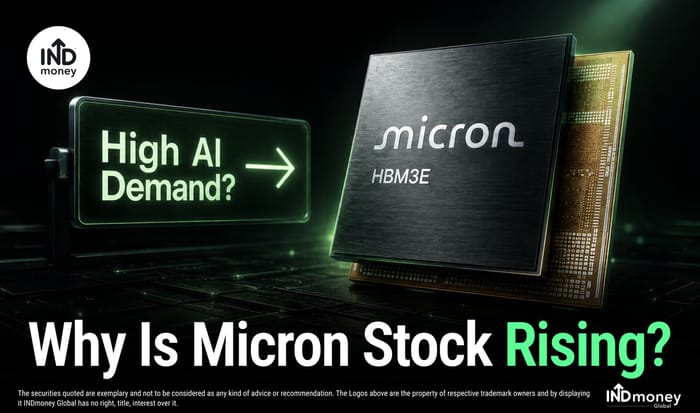
- Why Is Micron Stock Rising Today?
- Micron Just Crossed The $1 Trillion Mark
- Why Did UBS Raise Micron’s Target So Much?
- What Are Other Major Analysts Saying About Micron?
- Why the Nvidia P/E Comparison Is the Most Important Line in the UBS Note
- What This Means For Indian Investors
- What Could Go Wrong With Micron?
- Final Takeaway
On the morning of May 26, 2026, UBS analyst Timothy Arcuri, who is consistently ranked among the top 5 elite Wall Street analysts by TipRanks, raised his Micron stock price target from $535 to $1,625, a 204% hike that set the new Street-high on one of the most important semiconductor names in the AI era. Micron (NASDAQ: MU) shares jumped over 8% in premarket trading, crossing $800 for the first time. But the jump in the stock price is not actually the story. What matters is why UBS made this call and what it reveals about a seismic shift in how the memory chip business works.
Let's break down what drove this upgrade, why long-term supply agreements are quietly transforming Micron's earnings profile, what other top analysts think, and what all of this means for investors looking at MU stock.
Why Is Micron Stock Rising Today?
Micron shares jumped in premarket trade after UBS said long-term agreements across the memory industry could structurally change the company’s earnings profile. UBS raised its Micron price target to $1,625 from $535 while maintaining its Buy rating.
In a research note, analyst Timothy Arcuri sharply revised his earnings-per-share (EPS) estimates upward and projected that Micron will generate over $400 billion in cumulative free cash flow between 2027 and 2029.
| Metric | Prior UBS Estimate | New UBS Estimate |
| CY2027 EPS | $133 | $155 |
| CY2028 EPS | $122 | $167 |
| CY2029 EPS | $77 | $117 |
| Free Cash Flow (2027-2029) | - | $400B+ |
| Price Target | $535 | $1,625 |
Source: UBS Research Note, May 2026, via Yahoo Finance / Investing.com
Even in a "moderate memory downcycle" scenario in 2029, Arcuri expects EPS to stay comfortably above $100. For context, two years ago, Micron's EPS was near zero.
Micron Just Crossed The $1 Trillion Mark
The rally did not stop after the UBS note. On May 26, 2026, Micron shares closed 19.29% higher at $895.88, pushing the company’s market capitalization above $1 trillion for the first time in its history. The momentum continued even after the closing bell, with MU stock rising another 2.08% in after-hours trading to around $914.53.
That milestone matters because markets rarely assign trillion-dollar valuations to cyclical commodity businesses. Historically, memory chip companies traded at discounted valuations because earnings were volatile and difficult to predict across semiconductor cycles. Crossing the $1 trillion mark signals that investors are beginning to value Micron differently, not as a traditional DRAM manufacturer, but as a critical layer of AI infrastructure.
Why Did UBS Raise Micron’s Target So Much?
For decades, DRAM memory was priced like tomatoes in a wholesale mandi: volatile, cyclical, and largely unpredictable. When global supply flooded the market in 2022-2023, Micron's stock fell. When demand picked up, it surged. Investors priced memory stocks with low P/E multiples because earnings were impossible to forecast reliably. That era may now be over.
What UBS is really saying is that Micron is undergoing a business model transformation. Long-Term Agreements (LTAs); three-to-five-year supply contracts with hyperscalers like Microsoft Azure, Google Cloud, and Amazon AWS, are now being locked in across the industry. According to UBS, approximately 60 to 70% of industry server DDR5 volumes are already secured under such deals, and up to 30% of all DDR volumes industry-wide will soon be locked at pricing slightly below current spot levels.
Think of it this way. For decades, Micron operated like a tomato farmer selling in the open market; great when prices are high, devastating when supply floods. These LTAs are the equivalent of Reliance Industries signing a three-year contract to buy that farmer's entire crop at ₹28/kg, regardless of season. The farmer now plants more, plans better, and earns more predictably. That predictability deserves a valuation premium.
This is precisely what Arcuri means when he says these agreements "allow Micron to trade some near-term revenue for demand visibility and a smoother earnings profile." And it is why he sees no reason Micron's P/E multiple should trade significantly below Nvidia's; a comparison that would have seemed absurd just two years ago.
Separately, Micron has already sold out its entire 2026 HBM4 (High Bandwidth Memory) capacity, with CEO Sanjay Mehrotra confirming the company is fulfilling only 50-65% of key customers' medium-term demand. That is not a supply bottleneck. That is pricing power.
What Are Other Major Analysts Saying About Micron?
UBS is the most aggressive, but the broader analyst community is firmly in the bull camp on Micron.
| Analyst Firm | Latest view | Target |
| UBS | Raised target sharply on long-term agreements | $1,625 |
| Mizuho | Reiterated Outperform, says memory remains AI backbone | $800 |
| Citi | Maintained Buy after major target hike | $840 |
| Melius Research | Street-high target before UBS’s latest move in many trackers | $1,100 |
| Benzinga consensus data | Broad analyst view remains Buy | $570.14 average |
Mizuho analyst Vijay Rakesh, reiterating an Outperform on the same day, noted there is "no clear line of sight on when the supply-demand imbalance could end," calling DRAM and NAND key secular enablers of AI infrastructure through 2026-2027.
Why the Nvidia P/E Comparison Is the Most Important Line in the UBS Note
Arcuri wrote that he sees "no reason why MU should trade a whole lot differently than NVDA in terms of P/E."
That one sentence does more work than the price target itself. Nvidia trades at a premium P/E because the market views it as essential, irreplaceable AI infrastructure and not a commodity. If Micron earns the same classification via LTAs, the re-rating story has years, not quarters, to run.
Here is the key distinction: memory is consumed by every major AI model, regardless of who wins the LLM race. Whether OpenAI, Google DeepMind, or Meta scales training runs and inference fleets, they all need more HBM and server DDR5. Micron is not a bet on which AI wins. It is a bet on the entire AI industry continuing to grow. That is a meaningfully different risk profile.
What This Means For Indian Investors
Indian investors can invest in Micron directly under RBI's Liberalised Remittance Scheme (LRS). A few things worth keeping in mind from an Indian portfolio perspective:
- Currency works in your favor over time: A US stock rally in dollar terms gets magnified when the Indian rupee depreciates against the dollar which is a long-run historical trend. Holding MU gives Indian investors both equity upside and currency diversification.
- This is not an AI speculation play: Unlike betting on early-stage AI startups or pure-play model companies, Micron makes the physical chips that run every AI data center in the world. Its customers are not startups, they are the largest technology companies on Earth, and they are now signing three-to-five year contracts.
- The cyclical risk is real but structurally reduced: Memory stocks have historically been punishing in downturns. The LTA shift does not eliminate cycle risk, UBS itself models a moderate downcycle in 2029, but the EPS floor is now significantly higher than any prior cycle would have implied.
At ~$800 today and a Street-high target of $1,625, the market has already priced in considerable optimism. Investors who are interested should do their own research, consider entry points carefully, and treat any position as part of a diversified global portfolio and not a concentrated bet.
What Could Go Wrong With Micron?
- Competing supply ramp: Samsung and SK Hynix are not standing still. Aggressive capacity additions from either could erode pricing faster than expected.
- AI capex pullback: Any meaningful slowdown in hyperscaler spending would directly reduce memory orders.
- LTA pricing below spot: UBS acknowledges LTAs are priced slightly below current levels, which is a deliberate trade-off for stability.
- Geopolitical exposure: Micron faces export restriction risks in China and broader US-China semiconductor tensions that could disrupt supply chain economics.
Final Takeaway
The UBS upgrade to $1,625 will dominate headlines today. But the real headline is quieter and far more durable: the memory chip industry is in the early stages of a structural transition from commodity pricing to contracted infrastructure economics. Micron, as the only major US-based memory manufacturer with full HBM4 capacity sold out through 2026 and LTAs being locked in, is the primary beneficiary.
Whether the stock is worth $1,625 is a question only time will answer. But whether the business has fundamentally changed, that question has a clearer answer. It has.