

- What Has Meta Banned on Facebook and Instagram?
- How Does the Ban Fit Into Meta’s Reels Strategy?
- Could Meta Lose Money by Blocking TikTok Ads?
- What Does the Ban Mean for TikTok, Creators and Brands?
- What Does This Mean for Meta Stock?
An advertising company turning away a paying customer sounds unusual. When that customer is TikTok, however, Meta faces a different calculation: the money it earns from an advertisement today could help a rival win the audience it needs tomorrow. Its decision to block TikTok-related advertising exposes how valuable control over that audience has become.
Let’s break down why Meta is blocking TikTok ads, where the restrictions apply, and how the decision affects creators, advertisers and investors. The key is understanding whether protecting future attention can be worth sacrificing advertising revenue now.
What’s Covered
- What Meta’s advertising restriction covers, including third-party campaigns.
- Why the rivalry has intensified over users, profile links and teen safety.
- How Reels and a simple revenue model explain Meta’s decision.
- What the ban means for TikTok, brands and the META investment case.
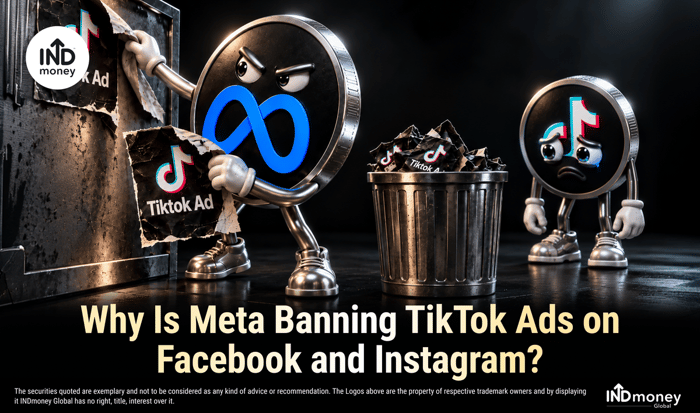
The short answer is that Meta says it does not have to sell advertising that helps a competitor draw people away from its apps. The restriction targets paid promotion of TikTok and other ByteDance services in seven countries. Its commercial logic is to protect user attention, although the financial benefit remains unproven.
What Has Meta Banned on Facebook and Instagram?
Meta confirmed an immediate restriction covering the United States, Canada, Egypt, Indonesia, Japan, Thailand and Vietnam. The announcement concerns advertising across its platforms, with Facebook and Instagram central to the reports.
The scope extends beyond TikTok purchasing advertisements under its own name. Third-party paid campaigns that link to TikTok or other ByteDance properties are also covered in those markets.
| Part of the restriction | What the reporting establishes |
| Advertiser | Ads and paid marketing messages placed by ByteDance are restricted. |
| Destination | Third-party advertising campaigns linking to TikTok or other ByteDance properties are covered. |
| Geography | Seven named countries, rather than an announced worldwide restriction. |
| Content | The announcement addresses paid advertising; it does not establish a general ban on ordinary TikTok-related posts. |
Sources: Reuters, October 8, 2026; Bloomberg, October 8, 2026
The distinction between an advertiser and an ad’s destination matters. A creator or brand could be affected even if it has no corporate relationship with ByteDance, because its paid campaign sends people to a TikTok page. Detailed implementation guidance will matter for borderline cases, including campaigns with several destinations.
There is also an ownership detail worth getting right. TikTok’s US operation was reorganised into a majority American-owned joint venture in January 2026, with ByteDance retaining 19.9%. Its official announcement says TikTok global’s US entities continue to manage certain commercial activities, including advertising, marketing and e-commerce. Describing the US business simply as an unchanged, wholly ByteDance-controlled operation would miss that structure.
Why Is Meta Banning TikTok Ads?
Meta’s stated reason is direct: it does not want to provide paid promotion that helps a competing platform take users away. Spokesperson Chris Sgro told Bloomberg: “We don’t have to run ads from a competitor whose goal is to pull people off our apps.”
The business logic becomes clearer when we separate two kinds of advertising. An Instagram advertisement for a restaurant can earn Meta revenue while supporting an activity outside social media. An advertisement encouraging someone to spend more time on TikTok can earn Meta revenue while helping strengthen a direct substitute for Instagram.
The first transaction sells access to an audience. The second can also help build a rival audience. Meta is choosing to restrict the second transaction because the long-term competitive cost may exceed the immediate payment. That is our interpretation of the economics, rather than a financial benefit Meta has quantified.
The fight is over attention, creators and advertising budgets
A person can use both Instagram and TikTok, so installing one app does not necessarily mean abandoning the other. The competitive question is how much time that person spends on each service, which creators keep them engaged, and where advertisers find useful customers.
If stronger TikTok engagement draws viewing time away from Instagram, Meta may have fewer opportunities to show advertisements. If creators build their most active communities on TikTok, they may also put more effort into content there. Advertisers can then follow the audiences and creators that deliver results.
This explains why even a large platform might care about helping a rival recruit users. A competitive threat does not need to eliminate Meta’s audience to matter. It only needs to weaken the growth or profitability of attention that Meta previously captured.
The decision follows a wider dispute over links and teen safety
TikTok’s help centre now says it no longer supports links that directly open or log users into other social media apps. Website links to those platforms remain possible. Bloomberg also reported that TikTok removed dedicated Instagram profile links in September and rejected Meta advertisements calling for comparable teen-safety commitments.
Separately, Meta’s August agreement with US state attorneys general introduced protections including a default two-hour daily limit across Facebook and Instagram for under-18s, which requires parental permission to disable, and default overnight access restrictions. Meta publicly urged TikTok and YouTube to adopt the same standards, arguing that teenagers can otherwise move between apps.
That argument has a commercial consequence: restrictions applied unevenly across competing apps could change where young users spend time. But Meta’s stated justification for this advertising decision is competitor promotion. The available statements do not establish that every blocked campaign failed a child-safety standard.
TikTok has made separate safety commitments. Alabama’s attorney general announced a September 25 settlement requiring daily usage limits, nighttime restrictions and stronger age assurance. Those commitments concern Alabama; they do not establish that TikTok adopted Meta’s proposed standards across every market.
Our earlier analysis of Meta’s teen-safety settlement explains its financial and operating implications. Here, the relevant connection is how different restrictions can affect competition for attention.
How Does the Ban Fit Into Meta’s Reels Strategy?
The advertising restriction makes most sense alongside Meta’s efforts to improve its own short-video experience. Blocking a route to TikTok can create friction, but Meta still needs compelling content and useful recommendations to keep people returning.
On its July 29 earnings call, Meta said global time spent on Instagram grew at a double-digit rate year over year in the second quarter, largely because of improvements to Feed and Reels recommendations. Facebook video time increased 9% globally. These are company-reported measures, rather than independent evidence that Meta has overtaken TikTok.
Meta is also investing in the supply of content. Its Creator Fast Track programme, announced in March, offers eligible established creators increased reach and three months of guaranteed pay for posting eligible Reels on Facebook. Qualifying audiences on TikTok and YouTube can help creators meet the programme’s eligibility criteria.
Taken together, these actions suggest a strategy with two parts: make Meta’s platforms more attractive to creators, while reducing paid promotion that sends audiences to a rival. The platform wants the creator’s content and community to help expand its own engagement.
That does not make the ad restriction a substitute for product quality. People who prefer TikTok can still seek it out through other channels. Meta’s lasting advantage has to come from an experience that users choose repeatedly, along with advertising that produces results for businesses.
Could Meta Lose Money by Blocking TikTok Ads?
Yes. Turning away an advertiser can reduce revenue unless other advertisers replace the spending. The strategic question is whether Meta can recover that direct cost through stronger engagement, better monetisation or slower growth for a rival.
The scale of Meta’s business helps frame the trade-off. Its latest reported quarter available for this analysis is Q2 2026.
| Metric | Q2 2026 | Why it matters |
| Total revenue | $60.801 billion | Establishes the size of the business. |
| Advertising revenue | $59.363 billion | Advertising generated about 97.6% of total revenue. |
| Family daily active people | 3.60 billion | Measures daily users across the app family, rather than Instagram alone. |
| Ad delivery and pricing | Impressions increased 14%; average price per ad increased 12% year over year | Both the volume and value of advertising influence revenue. |
Source: Meta’s official Q2 2026 results, July 29, 2026. Advertising share calculated as $59.363 billion divided by $60.801 billion.
The missing number is how much ByteDance and affected third parties actually spent on Meta. The reviewed disclosures and reports do not provide it. Any precise estimate of the ban’s earnings impact would therefore require assumptions.
A simple example of the revenue trade-off
Assume the restriction removes $100 million of annual advertising revenue. This is an illustrative figure, not an estimate of actual ByteDance spending. If other advertisers replace 70% of that revenue, Meta recovers $70 million and gives up $30 million.
Net direct revenue cost = blocked revenue × (1 − replacement rate)
Illustrative result: $100 million × (1 − 70%) = $30 million a year.
The same assumed blocked spending can produce different outcomes:
| Assumed replacement of blocked revenue | Revenue recovered | Net direct annual revenue cost |
| 90% | $90 million | $10 million |
| 70% | $70 million | $30 million |
| 0% | $0 | $100 million |
Source: INDmoney illustrative calculations. Every input is hypothetical; this table does not forecast Meta’s results.
For scale, multiplying Meta’s Q2 advertising revenue by four produces an annualised baseline of approximately $237.45 billion. Against that baseline, the middle scenario’s $30 million cost is about 0.013%. The baseline is a comparison tool, not full-year guidance, and does not account for seasonality.
The calculation explains why Meta might tolerate losing an advertiser if it expects even a small improvement in its wider business. It does not prove that such an improvement will happen. The actual blocked spending and replacement rate could differ substantially, and preventing an advertisement does not tell us how many users will spend more time on Meta.
There is also a difference between revenue and profit. Replacement advertisements may command different prices, while any additional engagement has costs. A proper investment case ultimately requires evidence of better cash generation, rather than simply more minutes spent scrolling.
What Does the Ban Mean for TikTok, Creators and Brands?
TikTok loses a promotional route, with an uncertain growth impact
The immediate effect is the loss of an advertising channel through Meta in the affected markets. TikTok could respond by using other paid channels, relying more on organic discovery, or strengthening creator-led promotion. These are possible responses, not announced plans.
The important metric is the cost of attracting an additional useful user. If Meta was an efficient way to reach people likely to become active TikTok users, losing it could make growth more expensive. If those users would have joined TikTok anyway, the incremental damage could be modest.
That distinction prevents a common analytical mistake: treating every blocked advertisement as a lost customer. Some advertising creates new demand; some reaches people who would have discovered the product without it. Without campaign data, we cannot know the balance here.
Creators and brands need to examine campaign destinations
Because third-party TikTok-linked campaigns are included, the issue reaches beyond the two companies. Based on the reported wording, an Instagram advertisement promoting a creator’s TikTok profile would appear to fall within the restriction in an affected country. Campaign-specific enforcement still needs to be checked.
For a brand, an advertisement directing people to its own store has a different destination from one directing them to a TikTok page. The announcement does not establish that ordinary businesses advertising their own products are barred simply because they also use TikTok.
This makes audience ownership more valuable. A creator or business that can reach customers through several platforms and its own channels is less exposed to a single advertising-policy change. The practical lesson is to evaluate how the customer relationship survives a change in one platform’s rules.
Users face a change in paid promotion
The announcement addresses how TikTok and related services can be promoted through advertisements on Meta. It does not establish a general prohibition on discussing TikTok, sharing ordinary posts about it, or using TikTok itself.
TikTok and ByteDance had not responded to Reuters’ request for comment when its October 8 report was published. Their subsequent response, if any, needs to be checked before updating the article with a claimed countermeasure.
What Does This Mean for Meta Stock?
Our assessment is that the decision has a defensible commercial logic, but its financial value is unproven. Meta is protecting a business that depends heavily on attracting and monetising attention. Restricting paid promotion of a direct rival is one way to support that goal, but it gives investors no measurable earnings uplift on its own.
For investors studying Meta Platforms stock, the useful question is whether this policy strengthens future cash flow. A restriction can reinforce an existing advantage, but it cannot demonstrate how durable that advantage will be. Product improvements, creator participation and advertisers’ returns remain essential.
The wider financial context deserves more weight. Meta reported Q2 free cash flow of $784 million and guided for 2026 capital expenditure, including finance-lease principal payments, of $130 billion to $145 billion. That makes the return on its investment programme a much larger valuation question than the advertising restriction alone.
Our analysis of Meta’s AI spending and investment case covers that broader issue. This development adds information about Meta’s competitive priorities; it does not justify a new share-price target without evidence of changed earnings expectations.
The decision could also disappoint. TikTok might replace the channel efficiently, users might continue to divide their time in the same way, or third-party advertisers might find the restrictions disruptive. Any competitive response or regulatory challenge could add complexity. These are risks to monitor, rather than outcomes established by the announcement.
What would show that the strategy is working?
| What to watch | What would make it useful evidence |
| Engagement and Reels performance | Sustained improvements in usage alongside evidence of monetisation. |
| Advertising demand | Other advertisers absorbing spending without weaker pricing or returns. |
| Enforcement and TikTok’s response | Clear rules for third-party campaigns and evidence of how TikTok adapts. |
| Earnings and cash flow | Management disclosures showing benefits large enough to affect financial expectations. |
Source: INDmoney analytical framework. These are evaluation criteria, not forecasts. Changes in company-wide metrics would not, by themselves, prove that the ad ban caused them.
The strongest conclusion today is that Meta is willing to sacrifice some immediate revenue to defend its audience. That tells us how management views the competitive threat. The investment case becomes stronger only if Meta turns that protection, together with better products, into durable cash generation.