

- What Is IBM Stock Rising?
- The Intel Precedent Worth Noting
- The $850 Billion Prize and Why Timing Matters
- The India Angle Most Investors Are Missing
- The Bigger Picture
The US government just handed IBM a $1 billion cheque and quietly asked for a piece of IBM back. On May 21, 2026, the US Department of Commerce signed a Letter of Intent to award $1 billion in CHIPS Act grants to IBM, making it the anchor of a $2 billion federal push into quantum computing spread across nine companies. Stocks across the sector surged between 7% and 25% in premarket trading. But here's an important nuance: this isn't just another government grant. It's Washington placing an ownership bet on quantum computing and the Intel precedent shows exactly what that bet is worth.
Let's break down what "America's first pure-play quantum foundry," a government equity stake in nine companies, and a $850 billion market estimate by 2040 actually mean; for the industry, and for you as an investor.
What Is IBM Stock Rising?
IBM stock went 4% in pre market trading after the news broke out. IBM confirmed it will launch a new standalone company called Anderon, headquartered in Albany, New York. Anderon will be America's first dedicated quantum chip manufacturing facility; a 300-millimeter quantum wafer foundry that aims to supply quantum chips not just for IBM, but for the entire industry. (Think of it like TSMC, but for quantum hardware instead of classical chips.) The $1 billion CHIPS Act grant from the Commerce Department is matched dollar-for-dollar by IBM's own $1 billion cash investment, giving Anderon a $2 billion foundation before it's even officially open.
IBM wasn't the only winner. The Commerce Department's full $2 billion package spans nine companies:
| Company | Estimated Award | What It's For |
| IBM | $1,000M | Anderon quantum wafer foundry, Albany NY |
| GlobalFoundries | $375M | Quantum Technology Solutions manufacturing unit |
| D-Wave Quantum | ~$100M | 100K-qubit annealing & 10K-qubit gate systems |
| Rigetti Computing | ~$100M | Quantum hardware R&D |
| Infleqtion | ~$100M | Quantum sensing and computing |
| Others (4 firms incl. Diraq) | $38M-$100M each | Various quantum hardware programs |
Source: Wall Street Journal, CNBC, Yahoo Finance, May 21, 2026
In exchange, the US government receives a minority equity stake in each company. For GlobalFoundries, that's already confirmed at approximately 1%. The equity structure varies by company.
The Intel Precedent Worth Noting
Here's the angle that separates this from a routine grant story.
Last August, the Trump administration converted a CHIPS Act grant to Intel into a 9.9% equity stake worth $8.9 billion at the time. Eight months later, that stake is worth approximately $36 billion with an unrealised gain of $26.5 billion, or roughly 300%. The Council on Foreign Relations has described this as one of the most profitable government investments in American industrial history.
The quantum equity deals follow the exact same playbook. When Washington takes ownership rather than just writing a cheque, three things happen simultaneously: private capital floods in (because government ownership is a quality signal), companies gain long-term strategic stability, and the incentive structure aligns because if quantum firms win, taxpayers win too.
This matters for investors because it reframes what a government grant actually is. It's no longer charity. It's a sovereign vote of confidence, the kind that drew over $450 billion in private semiconductor investment following the original CHIPS Act. Quantum is now on the same industrial policy track.
The $850 Billion Prize and Why Timing Matters
Quantum computing is not classical computing with more steps. A classical computer works in binary; think of it as a light switch, either on or off. A quantum computer uses "qubits" that can be on, off, and both at the same time (called superposition). That allows it to process certain classes of problems like drug discovery, financial modelling, materials science, cryptography, etc. at speeds that no classical machine can match.
The BCG-estimated $850 billion in economic value by 2040 is why nine companies just got federal grants on the same morning.
IBM already operates more than 90 deployed quantum systems globally, that’s more than all other industry players combined and is targeting the world's first large-scale fault-tolerant quantum computer by 2029.
The global quantum computing market, currently around $1 billion in 2025, is projected to grow at a 35% CAGR through 2035.
The India Angle Most Investors Are Missing
This story has a direct Indian thread, and it's already active.
In May 2025, IBM and Tata Consultancy Services announced a partnership to install IBM Quantum System Two, a 156-qubit Heron processor, at Andhra Pradesh's Quantum Valley Tech Park in Amaravati, making it the largest quantum computer in India. TCS is developing quantum algorithms and applications on top of this system for Indian industry and academia.
India's National Quantum Mission, backed by approximately $735 million over 2023-2031, explicitly names becoming a global quantum hub as a national priority.
Today's news strengthens IBM's quantum manufacturing base and accelerates the global quantum ecosystem, which directly feeds the ambitions of the Amaravati tech park and India's mission timelines.
For Indian investors, the question becomes: how do you play this theme?
| Investment Angle | Risk Level | Relevance |
| IBM (NYSE: IBM) | Low-Medium | Direct: TCS partner, diversified revenue |
| Rigetti (RGTI) | High | Pure-play quantum |
| D-Wave (QBTS) | High | Pure-play quantum |
| Defiance Quantum ETF (QTUM) | Medium | Basket of quantum names |
| TCS (NSE: TCS) | Low | IBM quantum partner in India, indirect beneficiary |
Source: Motley Fool, Barchart, Yahoo Finance, StreetInsider
IBM remains the most conservative quantum entry point as it has a profitable core business (AI + hybrid cloud), a 2.9% forward dividend yield, and trades at roughly 20x next year's earnings. You get quantum exposure without betting the farm on a pre-revenue startup.
Indian Investors Saw It Coming
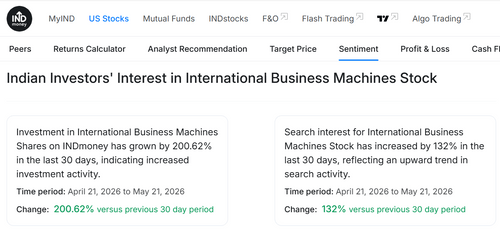
Data from INDmoney tells an interesting story. Between April 21 and May 21, 2026, investment in IBM shares on INDmoney grew 200.62% and search interest for the stock surged 132%. Indian retail investors had been steadily building positions well before the news broke out.
The Bigger Picture
What Washington did today is not just industrial policy. It's a declaration that quantum computing has crossed the threshold from "interesting research" to "national security asset"; the same line semiconductors crossed in 2022, energy crossed in 2023, and rare earth minerals crossed in 2024. Each time that line was crossed, the corresponding sectors attracted years of private capital that no amount of analyst notes could replicate.
The Anderon foundry, if successfully built, positions the US to manufacture most of the world's quantum wafers; creating supply chain leverage in quantum hardware the same way TSMC created it in classical chips. That's a structural shift, not a quarterly catalyst.
For investors, the signal is clear: quantum computing is no longer a theme to watch. It's a theme to position in, thoughtfully, with appropriate risk sizing, and with a time horizon measured in years rather than quarters.