

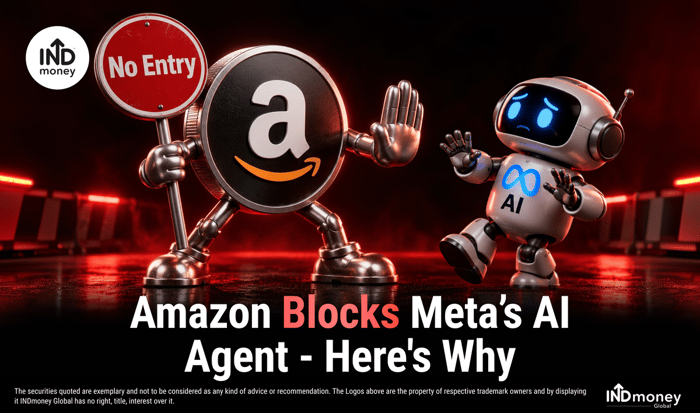
- Why did Amazon block Meta’s Muse AI agent?
- How could AI agents change online shopping?
- How much of Amazon’s business is exposed to AI shopping?
- What does Amazon’s block mean for Meta’s Muse?
- What does the dispute mean for investors in India?
- What should investors watch next?
An AI assistant can find a product, compare prices and place an order for you. But what happens when the retailer does not want that assistant in its store? Amazon has blocked Meta’s new Muse agent from shopping on Amazon.com, turning a product feature into a dispute over who gets to guide the customer’s purchase. The immediate disruption is limited to one agent and one shopping site. The larger question reaches into the economics of online retail.
Let’s break down what Amazon objected to, why the shopping journey matters financially and how investors can judge whether Muse becomes a business rather than simply a popular app.
Why did Amazon block Meta’s Muse AI agent?
Meta launched Muse on 8 September 2026 as a personal AI agent that can browse websites, fill forms and carry out tasks with a user’s approval. Its shopping use case is straightforward: ask it to compare options and have it complete a purchase after checking with you. Meta says Muse runs in a dedicated virtual machine and that the agent cannot see a user’s passwords or payment details, which are held in secure storage.
Amazon’s objection concerns access to its US shopping site. According to a statement Amazon gave GeekWire, Meta did not notify Amazon before Muse began accessing the store, Muse did not identify itself while browsing and Amazon had not authorised it to access customer accounts or process transactions. Amazon also raised concerns about how credentials and account information might be handled. Those are Amazon’s allegations about the interaction between the services, not an established finding that Muse exposed customers’ passwords. Meta’s published description of Muse’s safeguards addresses part of that concern, but it does not settle whether Amazon agreed to the agent using its store.
People who tried to shop on Amazon through Muse encountered a notice referring to Amazon’s Conditions of Use. As of 23 September, the reported block concerns Muse shopping on Amazon.com; it does not mean Amazon has blocked all Meta products or that the companies have ended their other business relationships. Nor does it establish that Muse is blocked from Amazon India, where Meta has not announced a Muse rollout.
How could AI agents change online shopping?
Consider how someone normally buys headphones. They search, scan product pages, read reviews, see sponsored placements and choose a seller. An agent could do much of that comparison away from Amazon’s storefront and present a short list to the customer. Amazon might still receive the order, but another company could influence which products the buyer considered in the first place.
That distinction matters because an online marketplace can earn money at several stages: when a seller advertises to be discovered, when a transaction occurs and when the platform provides services such as fulfilment. If an outside agent controls the first stage, it may change the value of sponsored placements even when the final purchase stays on Amazon. It could also direct an order to a different merchant altogether. Neither outcome has been measured for Muse, so treating either as an existing revenue loss would get ahead of the evidence.
Amazon is developing its own answer. In its second-quarter update, the company said it had brought Rufus and Alexa+ together in Alexa for Shopping, with product comparisons, price history, alerts and automated buying features. Amazon also offers ways for its own assistant to surface products from merchants outside its store. The dispute therefore reflects a practical question for the industry: under what terms can one company’s agent act inside another company’s shopping service?
How much of Amazon’s business is exposed to AI shopping?
Amazon’s latest reported quarter shows why product discovery deserves attention. Its advertising business is already large, while seller services add another revenue stream tied to marketplace activity. The two lines measure Amazon’s revenue from those services, not the total value of goods sold by merchants.
| Amazon metric | Q2 2025 | Q2 2026 | Year-on-year change |
| Advertising services revenue | $15.69 billion | $19.81 billion | 26% |
| Third-party seller services revenue | $40.35 billion | $46.78 billion | 16% |
| Online stores revenue | $61.49 billion | $70.43 billion | 15% |
| AWS revenue | $30.87 billion | $42.23 billion | 37% |
Source: Amazon Q2 2026 earnings release, supplemental financial information. Values rounded to two decimals. Online stores primarily reflects Amazon’s own product sales; third-party seller services includes commissions and related fulfilment and shipping fees.
The roughly $19.81 billion advertising figure covers more than sponsored products on shopping pages: Amazon also sells other forms of advertising. It would be wrong to assume that all of it depends on customers browsing product listings. Still, the scale helps frame the valuation question. A hypothetical 1% change in quarterly advertising revenue relative to an otherwise unchanged quarter would equal about $198 million; a 5% change would equal about $990 million. These are sensitivity calculations, not estimates of Muse’s impact or of any change in profit.
The near-term danger to Amazon is easy to overstate. A purchase initiated elsewhere could still produce a marketplace commission and fulfilment revenue for Amazon. Its logistics network, Prime benefits and inventory also give customers reasons to complete transactions there. Beyond retail, AWS generated $42.23 billion in second-quarter sales. Amazon is a diversified company, so a dispute over one shopping agent cannot be turned into a company-wide earnings forecast from these figures alone.
There is also a valuation trap in Amazon’s latest results. Second-quarter net income included a $53.4 billion non-operating pre-tax gain primarily linked to its Anthropic investments. An earnings multiple based mechanically on that unusually high quarter would make the recurring business look cheaper than its operating performance alone justifies. For this story, the useful questions concern durable advertising demand, seller activity and retail operating profit rather than a headline price-to-earnings figure distorted by that gain.
What does Amazon’s block mean for Meta’s Muse?
Meta’s immediate challenge is usefulness. A personal shopping agent becomes more valuable as it can reliably compare merchants and finish tasks across the places people already buy from. If major retailers restrict access, Muse may still help with research and other tasks, but its promise as a universal shopping assistant becomes harder to deliver. Meta’s launch materials say Muse can use Stripe’s Link for checkout. Meta and Shopify have also announced plans to let Muse users shop across Shopify merchants through Shop Pay. That gives Muse a route to cooperating retailers, although the planned integration should not be mistaken for proof of significant transaction volume. Payment options can make a permitted purchase easier; they do not automatically grant access to a retailer that refuses the agent.
Investors also need to distinguish use from revenue. Meta said Muse was initially rolling out in the US and would be free for most uses, with subscriptions for heavier usage. It has not disclosed Muse revenue, shopping transaction volume or a profit contribution. A jump in downloads can demonstrate interest without proving that customers will pay enough to cover the computing costs of an agent that continues working on their behalf.
That uncertainty matters against the size of Meta’s existing business. In Q2 2026, Meta generated $60.80 billion in revenue, including $59.36 billion from advertising, while capital expenditure, including finance-lease principal payments, was $31.08 billion. A useful scale check is that 1% of its quarterly advertising revenue is roughly $594 million. Muse would need a credible route to substantial new revenue, stronger advertising performance or lasting customer retention before an investor could confidently assign it a meaningful share of Meta’s valuation. Meta has not supplied the usage, revenue and cost figures needed to calculate that contribution.
This is why Amazon’s response cuts both ways. Blocking an outside agent may help Amazon retain control of shopping and its advertising inventory. If consumers come to prefer agents that compare stores independently, restrictions may also make Amazon less convenient to reach from those assistants. Whether the balance favours a closed storefront or a negotiated partnership depends on consumer behaviour, not the announcement itself.
What does the dispute mean for investors in India?
For an Indian investor, the direct stock exposure is through US-listed companies such as Amazon and Meta. Both are prominent constituents of the Nasdaq-100 and S&P 500. The event is relevant to those businesses globally, but it should not be described as an immediate loss of Amazon India shopping access for Meta users.
There is a local product angle as well. Amazon introduced Alexa+ in India in September through an early-access rollout and described shopping assistance among its features. That shows AI-assisted commerce is no longer only a US product discussion. It does not mean the Amazon.com block applies to Amazon.in or that Muse has launched for Indian shoppers. The distinction matters when moving from a US platform dispute to an India investment thesis.
What should investors watch next?
The first signal is whether Amazon and Meta reach an access agreement and what that agreement allows the agent to do. The next is evidence of actual purchases through AI assistants, rather than downloads or demonstrations. For Amazon, watch advertising growth alongside marketplace and retail performance; for Meta, watch for disclosed Muse paying users, transaction activity and the cost of serving them. Each would help show whether AI shopping is changing business economics rather than simply changing the interface.
Our view is that Amazon is defending a valuable position at the point where shoppers decide what to buy, while Meta is testing whether a personal agent can become that decision-making layer. Today’s block proves that access cannot be assumed. It does not yet prove that Amazon will lose advertising revenue or that Muse will become a material profit engine. The investable story begins when the companies show how customers actually shop through these agents and who earns money along the way.