

- How Accenture-Microsoft Copilot Rollout Happened
- The Revenue Math Nobody Is Talking About
- Microsoft Stock: Where Things Stand After Q3 Earnings
- What Indian Investors Should Know
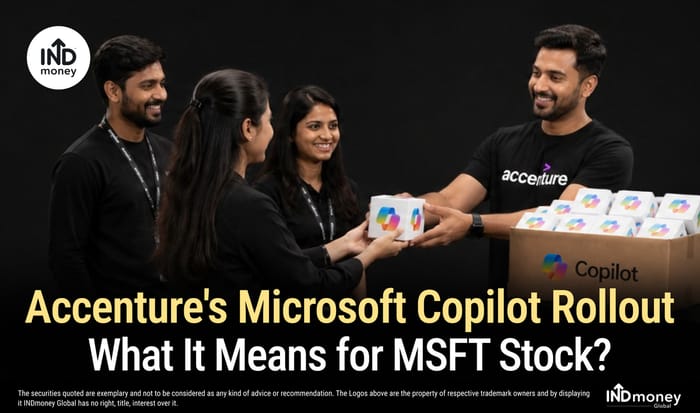
Imagine rolling out a new software tool to a population roughly the size of Patiala. That is exactly what Accenture just did recently when it deployed Microsoft 365 Copilot to its entire global workforce of approximately 743,000 employees across 120 countries, making it the single largest enterprise Copilot rollout in history.
For Microsoft, this is a live proof of concept that its $30-per-seat-per-month AI bet is starting to pay off at scale, and investors paying attention to Microsoft share price should take notice.
Let's break down what happened, what the numbers actually mean for Microsoft's AI monetization story, and whether this is the kind of catalyst that moves the needle on MSFT stock.
How Accenture-Microsoft Copilot Rollout Happened
Accenture started its Copilot journey in August 2023 with a small pilot of a few hundred senior leaders. That grew to 20,000 users, then 2,00,000, and now, the full 7,43,000. According to Microsoft, the phased approach was deliberate, focusing first on data governance and change management before going wide.
The results Accenture reported from its 200,000-user cohort are striking: 97% of employees said Copilot helped them complete routine tasks up to 15 times faster, 53% reported significant productivity gains, and monthly active usage hit 89%. Those are not survey numbers you manufacture. That is genuine stickiness.
The Revenue Math Nobody Is Talking About
Microsoft did not disclose the deal's financial terms. But here is the back-of-the-envelope math worth doing.
| Metric | Numbers |
| Accenture seats deployed | 743,000 |
| List price per seat | $30/month |
| Implied annual revenue (list price) | ~$267 million |
| Likely annual revenue post enterprise discount (30-50%) | ~$133M to $187M |
| Microsoft AI business ARR (Q3 FY26) | $37 billion |
| Copilot paid seats (as of April 2026) | 20 million |
Even after enterprise discounts, a deal of this size adds meaningful recurring revenue. But here is the real story: Accenture represents just one client. Only about 3% of Microsoft's 450 million enterprise users currently pay for Copilot. That 97% of untouched users is the actual prize, and Accenture's scale sends a signal to every Fortune 500 CFO watching.
Microsoft Stock: Where Things Stand After Q3 Earnings
Microsoft just reported its fiscal Q3 2026 results on April 29, 2026. Revenue came in at $82.89 billion, beating expectations, with Azure growing 40% YoY. Copilot paid seats crossed 20 million, up 250% year over year and up from 15 million just one quarter ago.
Yet MSFT stock fell roughly 5% the day after earnings, largely because Microsoft guided for $190 billion in total capital expenditure for calendar year 2026, up 61% from 2025. That is the bear case in one number.
Key MSFT Stock Snapshot (as of May 2026):
- Trading around $414, down roughly 12% year-to-date in 2026
- 66 analysts covering MSFT as per INDmoney: 94% have a “Buy” rating on the stock
- Consensus 12-month price target: ~$560, a 26% upside from current price
- Wedbush target: $625 | Goldman Sachs: $655 | Morgan Stanley: $650
The stock is trading at around 22x forward earnings, its lowest valuation in three years. Recent major selloffs in MSFT's history (COVID, 2022 inflation shock) have shown strong resilience, recovering in roughly 4 to 20 months, though older historical crashes took longer.
What Indian Investors Should Know
For Indian investors holding or tracking Microsoft share price, here’s what matters
- The Copilot story is still early: With 20 million paid seats against a 450 million user base, penetration is only 4.4%. Accenture's 743,000-seat win is the kind of reference case that unlocks the next wave of enterprise deals.
- The capex is the real risk: $190 billion in annual spending is not a small number. Free cash flow in Q3 came in at just $15.8 billion. Margins are compressed right now.
- The valuation is attractive: At roughly 22x forward earnings and a $560 consensus target implying 26% upside, the risk-reward looks meaningfully different than it did when MSFT was trading at $540 in October 2025.
- Watch the seat count: Microsoft's AI monetization will show up in seat growth and ARPU expansion. If Copilot seats hit 30 million by late 2026 as some analysts project, the margin story starts to improve.
So, the Accenture Microsoft Copilot deal is the clearest live proof yet that large enterprises are moving from pilot programs to full-scale AI deployment, and Microsoft is the infrastructure they are building on. For long-term investors, the question is not whether Copilot becomes a multi-billion dollar business. According to Microsoft's Q3 FY26 earnings, it already is, at a $7.2 billion annualized run rate. The question is how fast it scales from here.