

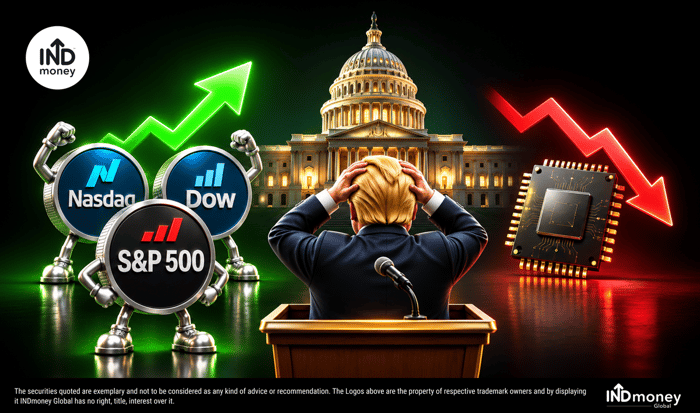
- How Did the US Stock Market React to the Midterm Results?
- Why Did a Democratic Sweep Lift US Stocks?
- Why Did Semiconductor Stocks Fall After the US Midterms Election Results?
- Why Did Microsoft and Amazon Rise While Chip Stocks Fell?
- Why Did Gold and Bonds Rise as Oil and the Dollar Fell?
- Why Did International and Emerging Market Stocks Rise?
- Why Did the Indian Stock Market Rise After the US Midterm Results?
- Author’s Take: What Would Make This Market Reaction Last?
The Dow Jones added nearly 1,600 points. Gold climbed. US government bonds rose. Even shares outside America joined the rally.
Then there were the chipmakers.
Nvidia fell more than 3%. Micron, Marvell and Sandisk lost 7% or more. On the first US trading day after the 2026 midterm elections, some of the companies supplying the AI boom moved sharply against the broader market.
That looks strange until you follow the money. Investors were reassessing two different things: how expensive energy and borrowing might become, and how quickly America would allow the next wave of data centres to be built.
Cheaper oil and lower bond yields helped the wider market. The prospect of construction delays worried the companies waiting to supply those buildings. And, in a twist, some of the companies paying for the buildings rallied.
How Did the US Stock Market React to the Midterm Results?
Democrats won both chambers of Congress in the November 3 elections, according to Ballotpedia’s results reporting. Donald Trump remains president. The result sets up a Republican White House facing a Democratic Congress when the new congressional terms begin in January 2027.
Here is how major market indexes performed as per Google Finance:
| Market exposure | Relevant ETF | November 4 price | Daily change |
| S&P 500 | Vanguard S&P 500 ETF (VOO) | $704.78 | +1.62% |
| Nasdaq-100 | Invesco Nasdaq 100 ETF (QQQM) | $284.92 | +0.95% |
| Dow Jones Industrial Average | SPDR Dow Jones Industrial Average ETF Trust (DIA) | $533.11 | +3.10% |
| US small companies | iShares Russell 2000 ETF (IWM) | $284.02 | +1.51% |
| Developed and emerging markets outside the US | Vanguard Total International Stock ETF (VXUS) | $83.88 | +1.98% |
| Semiconductor companies | iShares Semiconductor ETF (SOXX) | $450.41 | −3.14% |
Source: Google Finance, November 4, 2026 daily price figures, checked on November 5. These are ETF market-price changes, excluding separately displayed after-hours moves.
ETF returns and index returns are slightly different: the Dow index rose 3.03%, the S&P 500 gained 1.58%, and the Nasdaq-100 advanced 0.91%. The broader Nasdaq Composite rose 1.44%.
The rally also had exceptions beyond chips. Reuters reported that the S&P 500 energy sector fell 4.8% as oil plunged. “The market rose” describes the overall basket; individual businesses were responding to very different changes in their outlook.
Why Did a Democratic Sweep Lift US Stocks?
Let’s start with what changed in Washington.
With different parties controlling the presidency and Congress, major new tax and spending legislation becomes harder to negotiate. Investors can see value in that restraint when they are worried about unpredictable policy changes, inflation and government borrowing.
Reuters’ November 4 market reporting identified this expectation of policy gridlock, alongside the removal of election uncertainty, as support for the rally. The mechanics behind those congressional powers are covered in our guide to the US midterm elections’ impact on the stock market.
But the more immediate development was happening in oil.
Investors raised their bets that the electoral setback would increase pressure on the Trump administration to seek an end to the war with Iran. Reuters attributed the sharp oil decline to those expectations. A negotiated resolution remained a possibility being priced into markets.
Think about what cheaper oil can do. Transporting goods costs less. Households potentially spend less on fuel. Businesses using petroleum products get some relief. If the decline lasts, it can also reduce inflation pressure.
That gives investors a reason to reassess how high interest rates might need to go. Lower expected borrowing costs can help companies finance their operations and make their future profits more attractive to shareholders.
The political result therefore fed into a familiar financial chain: less expected pressure from energy prices, some relief in bond yields, and greater willingness to own shares.
There are limits to this argument. Morgan Stanley’s November 4 policy research stressed that the administration retains substantial authority over trade and geopolitics. A change in Congress creates new constraints, while leaving plenty of room for policy surprises.
Why Did Semiconductor Stocks Fall After the US Midterms Election Results?
For semiconductor investors, another election story mattered, which is the growing resistance to data centre construction.
An AI service runs on physical equipment. Somewhere, a building needs powerful processors, memory, storage, networking equipment, cooling and a dependable electricity connection. Before a chip can help earn money inside that building, the project needs land, approvals and power.
That is where politics enters the supply chain.
Texas governor-elect Gina Hinojosa’s campaign platform called for a moratorium on new data centres until legislators establish protections for residents. Her stated concerns included electricity costs, water supplies, public participation and subsidies.
The Texas Tribune reported that outgoing Republican Governor Greg Abbott had already imposed a permitting and grid-connection freeze during an audit. Hinojosa’s position raised the prospect of a longer pause and additional conditions. The opposition to unrestricted expansion was already crossing party lines.
Local votes reinforced that message. Duane Morris Government Strategies’ November 4 tracker counted 38 outcomes limiting development among 39 called local data centre measures from election day. Those measures included binding restrictions and non-binding advisory questions, so their legal effects differ.
For a chip supplier, the financial concern is straightforward. A delayed building can push equipment deliveries and revenue into a later period. If enough projects move, the sales growth investors expected next year becomes harder to achieve.
Memory and storage suppliers face an additional sensitivity: expectations about demand relative to available supply influence pricing. Concern about slower deployment can therefore affect assumptions about both the number of products sold and the prices they command.
The share-price reaction was substantial:
| Company | November 4 close | Daily change |
| Nvidia (NVDA) | $200.13 | −3.17% |
| Micron (MU) | $795.23 | −7.00% |
| Marvell (MRVL) | $159.80 | −7.08% |
| Sandisk (SNDK) | $1,037.40 | −7.91% |
| AMD (AMD) | $488.78 | +1.01% |
Source: Google Finance, November 4, 2026 regular-session figures. After-hours changes are excluded.
Notice AMD at the bottom. Semiconductor stocks fell as a group, but company news still mattered. AMD had just reported quarterly data centre revenue of about $8.5 billion, up 97% from a year earlier. Its earnings provided a company-specific counterweight to the wider concerns.
For Nvidia and the other suppliers, the election added uncertainty to future deployment. The price declines by themselves do not establish that customers cancelled orders.
Nor did the result create a nationwide data centre ban. Morgan Stanley notes that electricity connections, utility charges, locations and tax incentives depend heavily on state and local decisions. The practical outcome could be a patchwork of delays, safeguards and more welcoming locations.
Slower construction in one state and a permanent reduction in global chip demand are different financial outcomes.
Why Did Microsoft and Amazon Rise While Chip Stocks Fell?
Microsoft gained 6.68%, while Amazon rose 6.12%, according to Google Finance’s November 4 closing figures.
Both are major participants in the AI infrastructure buildout. Why would they rise when investors were worrying about that buildout?
Because an equipment order appears on two different sides of the financial relationship. The supplier earns revenue. The customer spends cash.
Large cloud companies have been committing substantial sums to infrastructure. Investors want that spending to produce future growth, but they also worry about the amount of cash being consumed before those returns arrive. A more measured expansion could ease some of that pressure.
Microsoft’s latest filing shows the scale. In the quarter ended September 30, 2026, it generated $58 billion in operating cash flow and spent $39.37 billion in cash additions to property and equipment. Subtracting those capital outlays leaves approximately $18.63 billion under the usual operating-cash-flow-minus-capital-expenditure calculation.
Those cash capital outlays absorbed about 68% of operating cash flow. They are company-wide figures, and the cash expenditure measure excludes equipment acquired through finance leases, but they show why the pace of investment matters so much to shareholders.
Reuters’ market coverage described investors favouring large, well-funded technology companies while marking down equipment suppliers and smaller infrastructure operators.
There is another possible advantage for established cloud providers. If demand stays strong while new competing capacity arrives more slowly, existing computing capacity could become more valuable. That is a conditional business argument, rather than evidence that cloud prices have already increased because of the election.
The trade-off is real, though. A company that cannot build enough capacity may struggle to serve customers and lose future revenue. The favourable interpretation depends on spending becoming more disciplined while the underlying business keeps growing.
This is why an “AI stocks” label can hide very different exposures. The company writing the cheque and the company collecting it can respond differently to the same development.
Why Did Gold and Bonds Rise as Oil and the Dollar Fell?
The moves across other assets help explain the equity rally.
| Asset or exposure | Instrument | November 4 price | Daily change |
| Brent crude oil | January-delivery futures | $94.62 per barrel | −8.7% |
| US crude oil | December-delivery WTI futures | $88.12 per barrel | −8.3% |
| Gold | SPDR Gold Shares (GLD) | $372.49 per share | +3.68% |
| Long-term US government bonds | iShares 20+ Year Treasury Bond ETF (TLT) | $81.76 per share | +0.80% |
| US dollar exposure | Invesco DB US Dollar Index Bullish Fund (UUP) | $28.90 per share | −0.38% |
Sources: Reuters’ November 4 oil settlement report; Google Finance for November 4 ETF price changes. GLD, TLT and UUP are listed investment products, so their returns should be distinguished from spot gold, a Treasury yield or the cash dollar index.
Bonds benefited from the reassessment of inflation and borrowing risks. The US Treasury’s official daily 10-year par yield fell from 4.95% on November 3 to 4.90% on November 4. That is a decline of five basis points, or 0.05 percentage point.
Bond prices and yields move in opposite directions. When investors accept a lower return on comparable debt, an existing bond’s fixed payments become more valuable. That helps explain the rise in long-term Treasury prices.
Gold received support from both yields and the dollar. Gold pays no interest, so lower yields can reduce the income investors give up by owning it. A weaker dollar also makes dollar-priced gold more affordable to buyers using other currencies.
Reuters reported that spot gold rose about 3.4% on November 4. By 8:46 AM IST on November 5, it had gained another 1.9% in that session to $4,134.83 per ounce. The spot-market move and GLD’s ETF return use different instruments and pricing windows.
Gold and shares can rise together when they share a helpful driver. In this case, easing yield pressure supported both. Gold’s gain therefore does not require an explanation based entirely on investors becoming frightened of equities.
The dollar lost some support as US yields declined. When the return available on dollar assets becomes less attractive relative to alternatives, demand for the currency can weaken. Expectations about growth and the Federal Reserve also matter; one day’s bond rally does not determine the next interest-rate decision.
Why Did International and Emerging Market Stocks Rise?
The benefits of cheaper energy and lower US yields travelled beyond Wall Street.
Alongside VXUS, Google Finance showed the Vanguard FTSE Developed Markets ETF, VEA, up 2.09%, and the Vanguard FTSE Emerging Markets ETF, VWO, up 1.70%, in the November 4 US session.
A softer dollar can help countries and businesses with dollar-denominated debt by reducing its burden in local-currency terms. Lower US yields can also improve the relative appeal of assets elsewhere.
There is a currency effect inside international equity returns, too. When a foreign currency strengthens against the dollar, the dollar value of shares denominated in that currency rises, all else equal. A US-listed international ETF can therefore benefit from exchange rates as well as movements in the underlying shares.
These figures reflect dollar-denominated ETF prices during US trading hours. Local markets closed at different times, and ETF gains alone do not measure how much new foreign money entered each country.
And the international response was uneven. Reuters’ early Asian trading report on November 5 put South Korea’s KOSPI down around 4% and Taiwan’s benchmark down 1.8%, as technology and equipment suppliers remained under pressure. Those were intraday readings, separate from the previous US session.
The difference comes back to what each market contains. An economy importing expensive oil can welcome its decline. A stock market heavily exposed to supplying AI hardware can face a stronger earnings concern at the same time.
Why Did the Indian Stock Market Rise After the US Midterm Results?
India received several potentially helpful developments together: lower crude prices, a softer dollar, easing US yields and improving appetite for equities.
Its reaction also unfolded in two stages.
Sources: NSE’s indexed November 4 market data and November 4 Sensex snapshot; Google Finance for the timestamped November 5 readings. November 5 figures are intraday snapshots, not closing results.
India’s November 4 session ended before Wall Street opened for its first regular session after the election. November 5 was India’s first session after the full US market rally and oil settlement.
For India, crude is an important link. The country imports a large share of its oil requirements, so a sustained price decline can reduce its import bill and ease pressure on inflation and foreign-exchange demand.
Businesses with significant fuel or petroleum-related costs may benefit, depending on contracts, inventories and how much of the saving they pass to customers. For oil producers, lower selling prices can create a headwind.
The currency and bond channels also help explain the optimism. Lower US yields can improve India’s relative appeal to overseas investors. A stronger rupee can improve their dollar-denominated returns, although that alone does not ensure fresh inflows.
There was evidence of foreign buying. Business Standard reported roughly ₹7,284 crore of net foreign institutional purchases in the November 4 cash market, against about ₹3,712 crore of net domestic institutional sales, based on provisional exchange figures.
Still, the election joined a recovery already underway: November 4 was the fifth consecutive session of gains. Domestic earnings and existing market positioning also shaped the response.
And India had its own sector split. The Nifty IT index fell about 1.5% on November 4 even as the headline indices rose. A stronger rupee can also weigh on the translated earnings of exporters receiving dollars.
Author’s Take: What Would Make This Market Reaction Last?
The most useful reading of this result is that investors reassessed several risks at once. They saw a potentially better energy and inflation outlook for the wider economy, while putting a higher cost on uncertainty around AI construction.
The test now is whether those expectations become business outcomes.
For the broader rally, watch oil alongside actual diplomatic progress. If crude stays lower because supply conditions improve and conflict risks ease, the relief can reach company costs and household budgets. Renewed disruption could quickly weaken that argument.
For semiconductor companies, the important details are the duration and reach of restrictions. A temporary permitting pause, a project moved to another location and a cancelled global investment plan have different consequences for orders. Morgan Stanley’s post-election research expects the broader AI investment cycle to remain intact, while recognising the risk of project delays.
For cloud companies, the evidence needs to appear in cash generation and customer growth together. Spending restraint looks more attractive when revenue keeps expanding; a capacity shortage that blocks growth changes the calculation.
Investors in semiconductor ETFs should also examine the underlying holdings. Owning several suppliers can spread company-specific risk while leaving substantial exposure to the same customers’ construction schedules.
November 4 brought that shared dependency into view. A data centre’s spending is somebody else’s sales. The market had started asking harder questions about when that spending would happen, who could afford to wait, and who needed the next order to arrive on time.