

- What Is DAWG and Why Is the Pentagon’s Drone Budget Rising So Fast?
- Why Drone Stocks Rallied After Pentagon Funding Talks
- Why the Drone Market Opportunity Goes Beyond Defense Spending
- How the DJI Ban Could Benefit US Drone Companies
- What Past Defense Spending Cycles Tell Us About Drone Stocks
- Key Risks That Could Hurt the Drone Stock Investment Thesis
- How Investors Can Track the US Drone Stock Theme
- Bottom Line: Is the US Drone Investment Theme Still Worth Tracking?
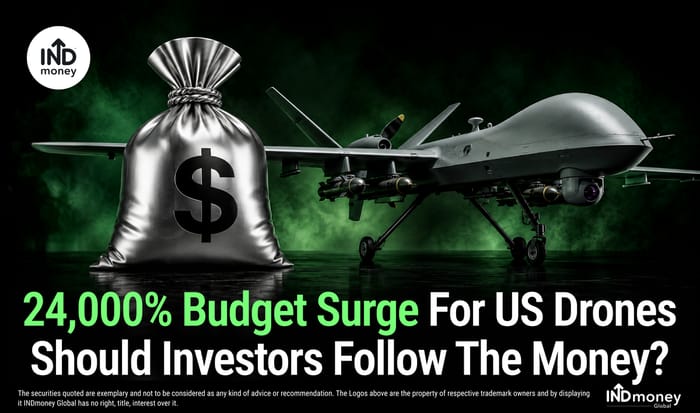
In April 2026, the Pentagon dropped a budget line that stopped defense analysts cold. The Defense Autonomous Warfare Group, DAWG, a unit that barely existed 18 months ago, proposed a $54.6 billion budget for FY2027. Up from $225.9 million the prior year. That's a 24,070% increase in a single fiscal year, one of the most dramatic year-over-year increases in the defense request for any program in the entire $1.5 trillion defense budget request, as per DefenseScoop and Bloomberg.
Then came May 27. Reuters and the Wall Street Journal reported that the Trump administration was in active talks to provide direct funding to domestic drone companies, possibly even taking equity stakes. No deal was signed. No contracts issued. Just a conversation. Unusual Machines (UMAC) shot up 57% the next day. Red Cat Holdings (RCAT) climbed 33%. AeroVironment (AVAV) gained 18%. Kratos Defense (KTOS) rose 14%. A rumor moved hundreds of millions of dollars.
Let's break down what this drone investment wave is really built on, how it stacks up against prior defense cycles, what could go wrong and should investors follow the theme.
What Is DAWG and Why Is the Pentagon’s Drone Budget Rising So Fast?
DAWG didn't arrive out of nowhere. Its predecessor, the Biden-era Replicator initiative, was supposed to fast-track thousands of cheap drones into US military hands. By late 2025 it was quietly falling apart with persistent technical failures, supply chain dependence on Chinese-made components that violated NDAA rules, and no permanent institutional home. The Pentagon dissolved Replicator and folded its mandate into the DAWG.
But DAWG isn't Replicator with a fresh coat of paint. The scope is fundamentally different. Where Replicator focused on buying small, ready-made FPV drones, DAWG is tasked with building the entire ecosystem; the agentic AI infrastructure that lets drone swarms coordinate autonomously, execute targeting decisions, and operate at machine speed without human input at every step, per the Pentagon's own FY27 briefings.
Think of DAWG like a startup that got ₹20 crore in seed funding in Year 1. Then its backer walked in the next year and said, "Here's ₹4,500 crore more, and we need you to build the whole factory, not just the product." The ambition changed, not just the budget.
One number investors should flag immediately: of DAWG's $54.6 billion ask, $53.6 billion sits inside the reconciliation tranche, not in the base defense budget. A per Breaking Defense, only $1 billion of the DAWG request is in the base budget. This is a risk we'll return to.
| Budget Item | FY2026 Actual | FY2027 Proposed | YoY Change |
| DAWG Allocation | $225.9M | $54.6B | +24,070% |
| Total Drone + Counter-Drone | ~$16.5B | ~$74B | +349% |
| Total DoD Budget | ~$886B | $1.5T | +42% |
Sources: DefenseScoop, Bloomberg, Breaking Defense | April 2026
Why Drone Stocks Rallied After Pentagon Funding Talks
The May 28 rally wasn't irrational. Investors were pattern-matching to something the US government has already done once, and recently: the CHIPS Act. When Washington decided semiconductors were a national security issue, it didn't just write procurement contracts, it co-invested in factory capacity, subsidized domestic production, and took direct stakes in the industrial base. The result? Companies like Intel saw massive government-backed re-ratings. The drone sector now seems to be following the same script.
As per Reuters, the funding discussions involved the Pentagon's Office of Strategic Capital (a Biden-era lending unit focused on national-security supply chains) and named companies including Unusual Machines and Sequoia Capital-backed Neros. UMAC's appeal here is straightforward: it manufactures NDAA-compliant drone components, meaning zero Chinese-origin parts, and in Q1 2026 its revenue jumped 296% year-over-year to $8.1 million, as per its earnings call transcript. After a $150 million equity raise in March 2026, it holds $222.9 million in cash with no debt. That's a balance sheet the Pentagon can co-invest alongside comfortably.
| Stock (Ticker) | May 28 Single-Day Move | What Makes It Relevant |
| Unusual Machines (UMAC) | +57% | NDAA-compliant components; named in funding talks |
| Red Cat Holdings (RCAT) | +33% | Small drone systems for military ISR missions |
| AeroVironment (AVAV) | +18% | Proven battlefield platforms; long DoD relationship |
| Kratos Defense (KTOS) | +14% | Larger autonomous combat drone programs |
| Ondas Holdings (ONDS) | +23% | Counter-drone systems; FIFA World Cup deployment |
Sources: Bloomberg, Seeking Alpha, GuruFocus | May 28, 2026
Why the Drone Market Opportunity Goes Beyond Defense Spending
Here’s an important angle to make note of. Drones don't need a war to grow.
The commercial side of this market is scaling independently of any defense budget. The global drone services market surpassed $16.5 billion in 2025 and is forecast to reach approximately $142 billion by 2035 at a roughly 24% CAGR, as per Precedence Research (via Yahoo Finance). Agricultural drone revenue alone is projected to grow from approximately $6.2 billion in 2026 to $14 billion by 2036, as per IDTechEx. Infrastructure inspection, logistics, emergency response; each of these is a multi-billion-dollar use case developing at its own pace.
This is the GPS parallel, and it's worth understanding properly. GPS was designed as a US military navigation tool. Today it sits at the foundation of Google Maps, Uber, food delivery apps, and logistics networks worth trillions. The companies building drone manufacturing capacity for Pentagon contracts today are also building the IP, supply chains, and production capability that the civilian market needs tomorrow. Defense contracts aren't just revenue, they're R&D funding for the commercial wave.
| Drone Segment | 2025-2026 Estimate | Projected Target | CAGR |
| Military Drones | ~$15-24B (range across research firms) | $22B-$98B by 2030-33 | 8-12% |
| Commercial Drone Services | ~$16.5B (2025) | ~$142B by 2035 | ~24% |
| Agriculture Drones | ~$6.2B (2026) | ~$14B by 2036 | ~8% |
Sources: MarketsandMarkets, Precedence Research, IDTechEx, Grand View Research. Note: Market size estimates vary significantly across research firms. These figures are directional indicators, not precision forecasts.
How the DJI Ban Could Benefit US Drone Companies
In December 2025, the FCC added DJI, Autel Robotics, and other foreign drone manufacturers to its Covered List, blocking the sale of new models from Chinese manufacturers in the US, as per CNN and ASIS Online. At the time, DJI held approximately 70% of the global drone market. Its products were embedded across American law enforcement agencies, firefighting departments, infrastructure operators, and commercial users.
That market vacancy is now open for domestic players, permanently, unless courts overturn the designation.
For US drone companies, the DJI ban combined with NDAA compliance requirements means the addressable market just got structurally larger, independently of whether the $54.6 billion DAWG budget ever clears Congress.
What Past Defense Spending Cycles Tell Us About Drone Stocks
When the US entered the War on Terror in 2001, the week markets reopened saw Raytheon spike 37%, L-3 Communications jump 35.8%, and Northrop Grumman gain 21.2% in days, as per FPIF reporting. That headline is always what gets cited. What gets left out: investors who bought on the event and sold within weeks left most of the return on the table. The S&P Aerospace & Defense index posted average returns of +10.8% over the following six months and +9.1% over twelve months, as per InvestorsObserver analysis; after the initial volatility.
The lesson is consistent across defense cycles: the event itself is a signal, not the trade. The real money in procurement-driven sectors tends to come from identifying the inflection point of when the proposed budget becomes actual contract and then becomes company revenue; and positioning before contracts land, not after headlines run.
Key Risks That Could Hurt the Drone Stock Investment Thesis
Having understand the bull case of the Drone theme; here are some important risk factors to keep in mind before considering an investment:
- Reconciliation stalls in Congress: This is the most concrete near-term risk. Of DAWG's $54.6 billion ask, $53.6 billion depends on the "One Big Beautiful Bill" passing. As per Breaking Defense, only $1 billion is in the base budget. If reconciliation fails or gets heavily cut, the drone budget doesn't zero out, but it drops to a fraction of what's been priced in. That's a thesis-changing difference, not a rounding error.
- Execution looks a lot like Replicator: DAWG's predecessor had political support, a mandate, and funding, and still failed to field drones at scale due to procurement dysfunction, vetting failures, and technical integration problems. DAWG has more money, but the institutional challenges that sank Replicator don't automatically disappear with a larger budget line.
- DJI's legal challenge succeeds: DJI has an active lawsuit against its DoD designation, and a favorable court ruling could reopen US market access for Chinese drones. That wouldn't eliminate the military opportunity, but it would materially compress the domestic commercial opportunity that forms part of the long-term thesis.
How Investors Can Track the US Drone Stock Theme
There are two paths to consider and both have meaningful trade-offs.
- Thematic ETFs reduce single-stock concentration risk. Defiance's JEDI (Drone & Modern Warfare ETF) and the iShares U.S. Aerospace & Defense ETF (ITA) are some of the options. But checking the underlying holdings carefully before assuming pure-play drone exposure is very important as many funds labeled as "drone ETFs" carry heavy allocations to legacy defense contractors, diluting the thematic bet significantly.
- Individual stocks offer more direct exposure but higher volatility. For those going that route, the signals worth tracking aren't headlines, they're Congressional progress on the reconciliation bill, DAWG contract award announcements, and quarterly revenue growth from NDAA-compliant pure-play names.
A framework worth borrowing from semiconductor investing during the CHIPS Act cycle: the companies that consistently outperformed weren't necessarily the ones that got the biggest headline contracts. They were the ones that turned government demand into gross margin expansion and repeat bookings over 6-12 quarters.
Bottom Line: Is the US Drone Investment Theme Still Worth Tracking?
The 24,000% headline is a directional signal, not a return guarantee. What's structurally different about this cycle is that the US government is moving from being a drone customer to being a co-architect of the domestic drone industrial base. It's simultaneously writing procurement checks, potentially taking equity stakes, and using regulation to legislate Chinese competition out of the market.
But the path from proposed budget to signed contract to company revenue is long, uncertain, and runs through a Congress that hasn't yet approved the bill. Investors treating this as a multi-year structural theme, sized appropriately relative to the risks, and built on fundamentals rather than news flow, are asking exactly the right question. Those chasing the post-rally pop in small caps without that framework are playing a different, much harder game.