

- What Every Fed Chair Transition Actually Delivered
- What Warsh Is Actually Inheriting: The Stagflation Trap
- What the US Market Is Currently Mispricing
- What the Institutional World Is Saying
- How Should Investors Position Themselves Over the Next Few Months
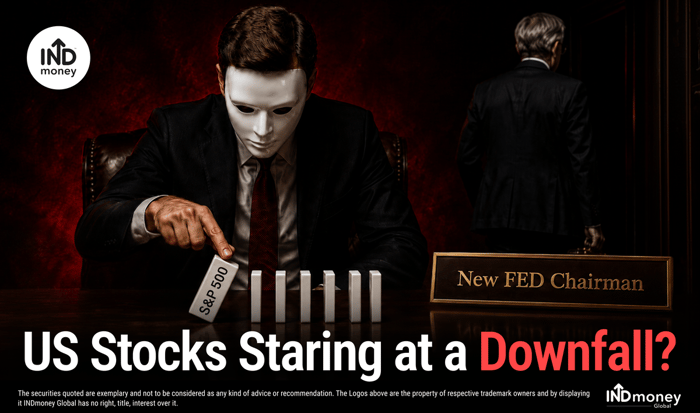
US Markets don't fear new Fed Chairs, they fear uncertainty about policy direction. Every time a new chair has taken the wheel since 1914, equities have repriced risk, producing an average S&P 500 drawdown of –12% in the first three months, per Barclays &, Bloomberg data. That number is a structural signature of institutional repositioning every time the Fed's communication framework is in transition.
The worst single instance: Alan Greenspan in 1987, when the S&P 500 fell –33% within three months of his appointment, coinciding with Black Monday. The median Dow correction across all 16 chair transitions since 1914 sits at –10.5%, with the average max drawdown at –15.2% in the first six months, according to Carson Investment Research.
Critically, 87.5% of those same transitions saw the Dow recover and post positive returns one year from its six-month low. Let's break down exactly why the Warsh era breaks the mould of those US Stocks recoveries and what that means for how you structure your portfolio from today through the end of 2026.
What Every Fed Chair Transition Actually Delivered
The table below maps S&P 500 three-month drawdowns across every Fed Chair appointment. The data is unambiguous: transitions consistently cause short-term pain, but the macro backdrop dictates whether that pain is temporary or structural.
| Fed Chair | Max Correction First 6 Months (Dow) | One Year Off 6-Month Lows (Dow) | 3-Month S&P Drawdown | Context |
| Eugene Meyer | -33.7% | -51.4% | –32% | Great Depression |
| Eugene Black | -22.4% | 16.8% | –21% | Depression recovery |
| Marriner Eccles | -9.8% | 58.5% | –8% | New Deal era |
| Thomas McCabe | -8.9% | 2.1% | –4% | Post-war normalisation |
| William Martin | -7.8% | 13.3% | –8% | Korean War inflation |
| Arthur Burns | -20.4% | 44.7% | –7% | Vietnam-era stagflation |
| William Miller | -7.0% | 12.6% | –3% | Pre-Volcker inflation |
| Paul Volcker | -11.2% | 17.0% | –10% | Shock rate hike cycle |
| Alan Greenspan | -36.1% | 23.1% | –33% | Black Monday crash |
| Ben Bernanke | -8.0% | 26.6% | –2% | Pre-GFC expansion |
| Janet Yellen | -3.8% | 6.7% | –4% | QE tapering |
| Jerome Powell | -8.5% | 9.0% | –7% | Trade war, rate hike cycle |
| Average | -15.2% | 18.5% | -11.6% | |
| % Positive | 87.5% |
Source: Barclays, Bloomberg, Carson, Factset
What this data really says: The –12% average is not driven by a fear of the incoming chair but instead driven by the macro conditions they inherit.
- Greenspan's –33% was Black Monday
- Burns's –7% was Vietnam-era stagflation.
- Volcker's –10% preceded his historic rate shock.
The pattern is consistent: the more complex the macro backdrop, the deeper the drawdown. Kevin Warsh inherits arguably the most complex backdrop of any incoming chair in 40 years.
What Warsh Is Actually Inheriting: The Stagflation Trap
Kevin Warsh was sworn in as the 17th Fed Chair on May 22, 2026. He is not stepping into a standard slowdown. He is stepping into a policy trilemma with no clean exit.
1. The inflation shock is geopolitical, not cyclical. Ongoing US-Israel-Iran tensions have driven energy prices to multi-year highs, pushing inflation to its highest readings in nearly three years. This is supply-side inflation, the type monetary policy is least equipped to fix without inflicting serious economic damage.
2. Futures markets are currently pricing in rate hikes, not cuts: A sharp contrast to the political environment. President Trump has publicly and repeatedly pressured the Fed for rate reductions. Warsh must decide, very publicly, which master he serves: the inflation data or the White House.
And to make the chessboard even more complex: Jerome Powell has chosen to remain on the Board of Governors. This is not a clean handover. Warsh will chair meetings that include his predecessor, navigating a divided committee while simultaneously trying to convince bond markets of his independence.
What the US Market Is Currently Mispricing
Most market commentary frames the Warsh risk as a "Fed credibility" story, will he be hawkish enough? That is the wrong question, and it's the most underestimated structural mispricing in equities right now.
The real risk is earnings pressure during sticky inflation.
Growth stocks usually benefit when markets expect the Fed to cut rates. But in a stagflation-like setup, that support weakens. Inflation keeps the Fed cautious, while consumers spend less, hiring slows, and companies delay investments. So growth stocks face a double hit: weaker earnings and limited rate-cut support.
That is why the usual “buy the dip 3–6 months after a new Fed Chair” rule may not work in 2026. Carson and FactSet data shows markets were positive 87.5% of the time one year after the six-month low, but those recoveries happened in different inflation regimes.
The key question is not whether markets have fallen enough. It is whether the Fed has room to support growth without worsening inflation. Right now, that room looks limited and that is the risk investors may be underestimating.
A simple analogy to put things into context for people investing in US Stocks from India
Imagine a large residential colony (the US economy) where the previous chowkidar (Jerome Powell) kept things stable for years. The new chowkidar (Kevin Warsh) has just taken charge but the mohalla is in chaos. There's a major dispute with the neighbouring colony (Iran, via the Israel conflict), fuel prices at the local petrol pump have doubled, and the RWA president (President Trump) is publicly demanding that the chowkidar reduce night-patrol hours to save costs, even while break-ins are spiking.
To add to the drama, the old chowkidar hasn't left, he's still on the committee of residents and attending every meeting. In this environment, would a smart flat owner in that colony rush out and buy more property right now or would they first wait to see whether the new chowkidar can restore order, the fuel dispute gets resolved, and the RWA stops making headlines?
The answer is obvious. You buy quality. You hold dry powder. And you only commit capital when the data confirms stability not because six months have passed on the calendar.
What the Institutional World Is Saying
The Bloomberg & Barclays historical drawdown data clearly shows that while drawdowns are consistent, recoveries are historically robust under the right macro conditions.
The critical institutional caveat: recoveries are data-dependent, not time-dependent. The 87.5% positive recovery rate from the Carson/FactSet analysis covers chairs who inherited environments where the Fed ultimately gained the flexibility to support markets.
How Should Investors Position Themselves Over the Next Few Months
| Probable Strategy | Positioning Move | Why It Matters |
| Inflation Hedge | Diversify across energy and real assets | Geopolitical supply shocks can support commodities and energy stocks, while traditional bonds and equities may struggle if stagflation deepens. |
| Quality Rotation | Trim high-beta growth | High-multiple tech is vulnerable when the Fed cannot cut rates. Shift towards cash-generative businesses with pricing power and strong balance sheets. |
| Dry Powder | Prefer short-duration Treasuries | If rate-hike risk returns, the short end of the yield curve can offer safer yield while investors wait for macro clarity. |
| Data Triggers | Buy the data, not the calendar | Redeploy into the broader S&P 500 only when crude stabilises, Fed independence is clear, and earnings show consumer resilience. |
INDmoney Investor Verdict
The volatility we are about to see won't be because Kevin Warsh is sitting in the Chair's seat. It will be because the Fed is trapped between a geopolitical inflation shock and intense political pressure. Protect your capital with inflation hedges and quality, and let the macro data, not the calendar, tell you when it's safe to buy the dip.