

- What Does the Dollar Losing Value Trade Mean?
- How Big Is America’s $40 Trillion Debt?
- Why Is US Debt Becoming a Bigger Market Problem?
- Why Did Treasury Bond Buybacks Worry Wall Street?
- How Does US Debt Pressure Move Into the Dollar and Gold?
- Why Has Gold Become the Main Dollar Losing Value Trade?
- How Can $40 Trillion US Debt Affect Stock Markets?
- Is the Dollar Really Heading for a Collapse?
- Three Ways the US Debt Story Could Affect Markets
- Our Take: The Problem Is the Direction, Not Just the $40 Trillion Number
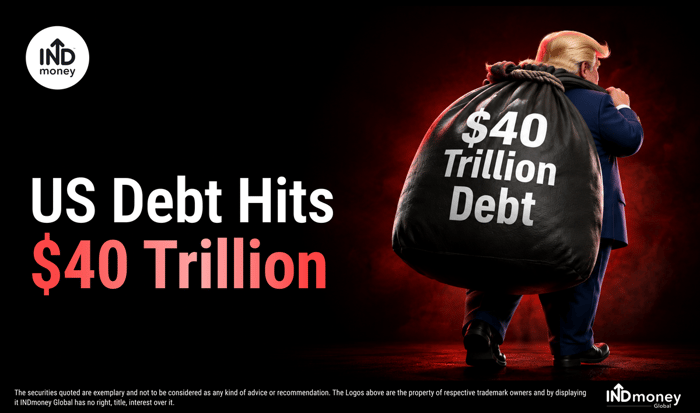
America added $2 trillion in debt in just ten months, pushing the total to $40.03 trillion.
Then another warning appeared: the 30-year Treasury yield hit 5.34%, its highest level since 2007. The Treasury increased bond buybacks, yields fell briefly, the dollar weakened and gold gained.
Wall Street calls this the debasement trade, a bet that rising debt will slowly reduce the dollar’s purchasing power.
What Does the Dollar Losing Value Trade Mean?
A government can broadly manage a large debt burden in four ways:
- Reduce spending
- Increase taxes
- Grow the economy faster than the debt
- Allow inflation to reduce the real value of debt
The first two options are politically difficult. Faster growth is the ideal solution, but it cannot be guaranteed.
That leaves inflation as the less visible option.
Inflation allows government revenue and the overall economy to grow in dollar terms, while the real value of older fixed-rate debt declines. But the same process also reduces the purchasing power of cash and fixed-income investments.
For example, if inflation averages 3.4% for ten years, $100 kept in cash would have purchasing power equal to only around $71.60 in today’s money.
The dollar losing value trade is therefore not necessarily a bet on a currency crisis. It is a bet on a slow reduction in purchasing power.
How Big Is America’s $40 Trillion Debt?
The $40 trillion headline becomes easier to understand through comparison:
- Repaying $40 trillion at $1 billion per day would take nearly 110 years, assuming no new debt or interest.
- Based on a Q2 2026 US population of around 342.75 million, it equals approximately $116,800 per person. This is only a size comparison, not an actual bill owed by each resident.
- US annualised GDP was approximately $32.48 trillion in Q2 2026. Total debt was therefore around 123% of one year’s economic output.
There is one important distinction.
The $40.03 trillion figure includes approximately $7.76 trillion owed between government accounts. Debt held by outside investors, institutions and the Federal Reserve was approximately $32.28 trillion.
Debt held by the public is the more relevant number for financial markets because this debt must be funded through Treasury bills, notes and bonds.
Why Is US Debt Becoming a Bigger Market Problem?
A large debt does not automatically create a crisis. The US borrows in its own currency and the dollar remains the world’s main reserve currency.
The real problem is the combination of:
- Large annual fiscal deficits
- Higher interest rates
- Rising refinancing requirements
- Inflation remaining above target
- Increasing Treasury bond supply
The Congressional Budget Office expects the US government to spend approximately $7.45 trillion in FY2026 while collecting around $5.60 trillion in revenue.
This produces a projected deficit of approximately $1.85 trillion, equal to 5.8% of GDP.
Net interest spending is projected at approximately $1.04 trillion, compared with projected defence spending of around $885 billion.
By 2036, it is expected that:
- Annual net interest costs to reach $2.14 trillion
- The fiscal deficit to increase to approximately $3.1 trillion
- Debt held by the public to reach around 120% of GDP
A one-percentage-point increase in the average interest rate on $32.28 trillion of publicly held debt would eventually add roughly $323 billion to annual interest costs as existing debt is refinanced.
This creates the real debt problem. More debt produces higher interest expenses. Higher interest expenses increase the deficit. The larger deficit then requires even more borrowing.
Why Did Treasury Bond Buybacks Worry Wall Street?
On August 19, 2026, the US Treasury announced that it would increase the maximum size of buybacks for 10-year to 30-year bonds from $2 billion to at least $4 billion per operation.
The larger operations will run from September 9 to November 4.
The Treasury said the purpose was to improve liquidity in long-term government bonds. This matters because older Treasury bonds can become harder to trade than newly issued bonds.
The buybacks are not the same as Federal Reserve money printing. The Treasury uses available cash or other borrowing to repurchase selected bonds. It does not directly create new central-bank reserves.
The current operations are also very small compared with the $32 trillion Treasury market.
The concern is therefore not the present size of the buybacks. It is the signal being sent.
The announcement came immediately after the 30-year Treasury yield touched 5.34%. Some investors interpreted the move as an attempt to prevent long-term borrowing costs from rising further.
If buybacks keep increasing every time yields rise, markets may begin to believe that the government is trying to manage bond prices without reducing the deficit behind the higher yields.
How Does US Debt Pressure Move Into the Dollar and Gold?
US debt does not automatically weaken the dollar or push gold higher. The effect depends on inflation, interest rates, investor demand and confidence in government policy. However, the pressure generally moves through the following four stages.
1. Larger deficits require more Treasury borrowing
When the US government spends more than it collects, it covers the gap by issuing Treasury bills, notes and bonds. It must also issue new securities to repay debt that is reaching maturity.
A larger supply of Treasuries is not automatically a problem. Demand for US government debt remains strong because Treasuries are widely used as safe assets and financial collateral. The risk appears when the supply of bonds grows faster than investor demand.
2. Investors may demand higher long-term yields
Bond prices and yields move in opposite directions. If investors become less willing to buy long-term Treasuries at existing prices, bond prices fall and yields rise.
Investors may demand higher yields for several reasons:
- Inflation is reducing the real value of future interest payments.
- The government is issuing a large amount of debt.
- Investors expect interest rates to remain high.
- Concerns about future deficits are increasing.
- Buyers want additional compensation for locking up their money for many years.
This extra return is sometimes called a term premium. It compensates investors for inflation, interest-rate and fiscal uncertainty over the life of a long-term bond.
3. Higher yields gradually increase the government’s interest bill
Higher market yields do not immediately affect every dollar of government debt. Much of the existing debt continues paying its original interest rate until it matures.
The pressure builds when old debt must be refinanced and new borrowing is issued at higher rates. Over time, a greater share of the debt begins carrying the higher interest cost.
This can create a difficult cycle:
More debt leads to greater interest costs, which increase future deficits and require even more borrowing.
The government may respond by issuing more short-term debt or conducting Treasury buybacks to improve market liquidity. However, buybacks do not automatically reduce total government debt. The Treasury generally finances them by issuing other securities.
The Federal Reserve is also independent from the Treasury. It may lower interest rates or purchase bonds when economic and inflation conditions justify doing so, but such support is not guaranteed.
4. The dollar depends on inflation-adjusted returns and investor confidence
Higher Treasury yields can initially strengthen the dollar because they make US assets more attractive to global investors. But the reason behind the rise in yields matters.
If yields rise because the US economy is strong, the dollar may benefit. If they rise because investors are worried about inflation, heavy borrowing or fiscal credibility, the dollar may weaken despite the higher return.
Foreign investors must consider both bond income and currency movement. For example, suppose an unhedged overseas investor earns 5% from a Treasury bond, but the dollar loses 5% against the investor’s home currency. The combined return is approximately zero and, after compounding, would be slightly negative at about 0.25%.
Inflation also matters. A 5% bond yield with 3% inflation produces a real return of only about 2% before taxes and currency movements.
Therefore, the dollar becomes more vulnerable when investors believe that:
- Inflation will remain high.
- Interest rates will be pushed lower too quickly.
- Government borrowing will continue rising.
- Fiscal policy will not bring debt under control.
- Dollar depreciation could reduce their final returns.
Why can this support gold?
Gold does not pay interest, so high inflation-adjusted bond yields are normally a disadvantage for it. Investors can earn a return from bonds while gold produces no regular income.
But gold can become more attractive when real yields decline or confidence in currencies weakens. Investors may buy it because gold:
- Is not issued by any government.
- Cannot be created in unlimited quantities.
- Has no government or corporate default risk.
- Is widely held as a reserve asset.
- Can provide protection against inflation, currency weakness and financial stress.
Gold can even rise while nominal bond yields are increasing if investors believe those higher yields reflect growing inflation or government-debt risk. What matters most is not simply whether yields rise or fall, but what is causing the movement.
What the August 19 buyback announcement showed
On August 19, 2026, the US Treasury announced that it would at least double the maximum size of its liquidity-support buybacks for longer-dated Treasury securities, from $2 billion to $4 billion per operation, beginning September 9. The Treasury said the purpose was to improve liquidity in older, less actively traded securities. It was not presented as money printing or a Federal Reserve-style quantitative easing programme.
Markets nevertheless treated the decision as an important signal. Long-term US yields initially fell by as much as 10 basis points, the Dollar Index dropped 0.75% to 98.90, and gold and cryptocurrencies rose. US equity indexes also recorded modest gains as lower yields reduced pressure on asset valuations.
The reaction suggested that some investors interpreted the larger buybacks as evidence that policymakers were becoming more concerned about stress in the long-term Treasury market.
The main takeaway
The debt-to-dollar-and-gold connection is not a straight line. In the short term, high Treasury yields can attract capital and support the dollar. Over time, however, persistent deficits, rising interest costs and inflation concerns can reduce confidence in the purchasing power of dollar-based assets.
That is when investors may increase their exposure to gold, inflation-linked bonds and other currencies. The central question is not whether the US can issue more debt today. It is whether investors will continue financing that debt at manageable interest rates without demanding greater protection from inflation and currency risk.
Why Has Gold Become the Main Dollar Losing Value Trade?
Gold does not depend on the promise of a government, company or borrower. Its supply also cannot be increased through a policy decision.
This makes gold attractive when investors worry about:
- Inflation
- Currency weakness
- Government debt
- Financial sanctions
- Central-bank credibility
Gold rose approximately 67% in US dollar terms during 2025. Global gold ETF holdings increased by 801 tonnes, while central banks purchased another 863 tonnes.
Central-bank buying is an important part of the story. It suggests that demand is not coming only from short-term investors. Some countries are also reducing their dependence on another government’s bonds and financial system.
However, gold is not a guaranteed winner.
It pays no interest, generates no earnings and can fall when inflation-adjusted interest rates rise. Gold above $4,600 also means that significant concerns about debt, inflation and geopolitics may already be reflected in the price.
How Can $40 Trillion US Debt Affect Stock Markets?
Debt does not hurt stocks directly. The impact comes through bond yields, borrowing costs, inflation and the dollar.
| What changes? | Likely impact on stocks |
| Treasury yields rise | Stock valuations fall, especially for technology and growth companies |
| Business borrowing costs increase | Interest expenses rise and profits may weaken |
| Dollar weakens | US multinationals may benefit, while import-dependent firms face higher costs |
| Inflation stays high | Companies with pricing power perform better |
| Fiscal confidence falls | Market volatility and risk premiums increase |
Technology and growth stocks
Higher Treasury yields reduce the present value of future profits. For example, $100 expected after ten years is worth $55.84 at a 6% discount rate, but only $46.32 at 8%. That is a decline of around 17%, even if the expected profit remains unchanged.
Debt-heavy companies
REITs, utilities, smaller companies and unprofitable businesses are more exposed because they regularly need fresh funding. When debt is refinanced at higher rates, interest expenses rise and less cash remains for expansion or shareholders.
Multinationals and inflation-linked sectors
A weaker dollar can increase the reported US revenue of companies earning heavily overseas. However, retailers and manufacturers dependent on imports may face higher costs.
Energy producers, miners and companies with strong pricing power may perform better if inflation and commodity prices rise.
Impact on Indian equities
Rising US Treasury yields can attract money away from Indian equities, increase foreign investor selling and put pressure on the rupee.
A weaker dollar can support emerging markets, but only when it comes with stable global growth and lower US yields. If dollar weakness reflects a loss of confidence in US debt, global volatility could still hurt Indian stocks. Higher oil prices would be an additional risk for India because the country imports most of its crude oil.
The key indicators for investors are US long-term bond yields, the Dollar Index, inflation, oil prices and foreign investment flows.
Is the Dollar Really Heading for a Collapse?
The available data does not show investors abandoning the dollar.
The dollar’s share of allocated global foreign-exchange reserves increased from 56.42% in Q4 2025 to 57.13% in Q1 2026.
The dollar still benefits from:
- The world’s deepest government bond market
- Large and liquid US equity markets
- Widespread use in global trade
- Strong US companies
- The lack of a similarly large alternative currency
This is why a sudden dollar collapse is not the central case.
The more realistic risk is a slower decline in purchasing power, combined with higher volatility in bonds, gold and equities.
Three Ways the US Debt Story Could Affect Markets
| Possible outcome | What could happen | Likely market impact |
| Fiscal repair | Deficits fall and inflation moves towards 2% | Dollar stabilises, yields become easier to manage and gold may cool |
| Slow loss of purchasing power | Inflation remains moderately high and borrowing continues | Gold stays supported, while pricing-power stocks perform better than debt-heavy companies |
| Bond-market stress | Yields keep rising despite government action | Equity valuations fall, borrowing costs rise and market volatility increases |
The second scenario currently appears more realistic than either a quick fiscal solution or an immediate currency crisis. However, this can change if inflation, economic growth or government policy changes materially.
Our Take: The Problem Is the Direction, Not Just the $40 Trillion Number
The US is not facing an immediate default simply because total debt crossed $40 trillion.
The bigger concern is that debt continues to grow while interest costs have already crossed $1 trillion. The Treasury is now showing greater sensitivity to long-term yields, but small bond buybacks cannot replace a credible plan to reduce fiscal deficits.
For equities, the main risk is a combination of high long-term yields, sticky inflation and weaker economic growth. Growth stocks and debt-heavy businesses are more exposed. Companies with strong cash flows, manageable debt and pricing power are better placed.
For gold, the debt and currency concerns remain supportive. But after a major rally, gold should be viewed as protection against uncertainty, not as a guaranteed one-way trade.
The market is not pricing the immediate end of the dollar. It is pricing a growing possibility that the dollar will lose purchasing power slowly while debt, interest costs and bond-market intervention continue to rise.