

- What is OPEC?
- Why Is UAE Leaving OPEC After 59 Years?
- What Does This Mean for OPEC?
- Impact on Crude Oil Prices: The Short-Term vs Long-Term Story
- How This Affects US Stock Market and Energy Stocks
- What About UAE ETFs?
- What Are Analysts Saying?
- What Should Investors Watch and Do Now?
- The Bottom Line
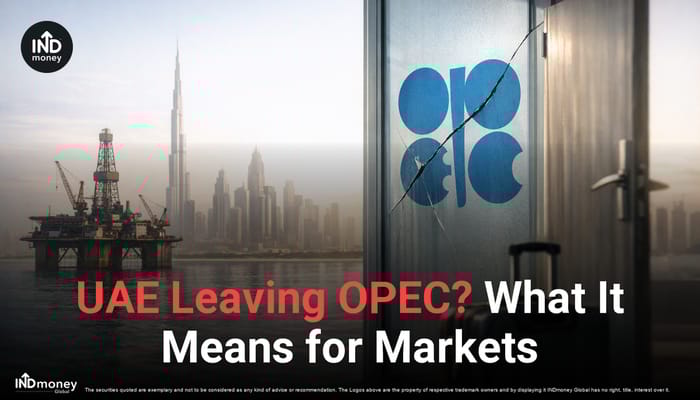
Picture this: one of the world's most powerful oil cartels just lost its third-biggest player, right in the middle of a global energy crisis. On April 28, 2026, the United Arab Emirates dropped a bombshell announcement that it's leaving OPEC and OPEC+ on May 1, ending nearly 60 years of membership. Think of it like Iron Man leaving Avengers during Endagame, except this time, the game is global oil markets and the stakes involve trillions of dollars.
Let's break down why the UAE is walking away from OPEC, what this means for crude oil prices, how it will impact your investments in US stocks and UAE ETFs, and most importantly, what you should do as an investor right now.
What is OPEC?
OPEC, or the Organization of the Petroleum Exporting Countries, is a group of oil-producing countries that work together to manage oil supply in the global market. In simple terms, OPEC decides how much oil its member countries should produce.
When OPEC reduces oil production, oil prices may rise because supply becomes limited. When it increases production, oil prices may fall because more oil is available.
Why Is UAE Leaving OPEC After 59 Years?
The UAE has been stuck in what you might call a "production straitjacket." OPEC quotas have capped the UAE's output at around 3.2 million barrels per day, even though the country has capacity to produce close to 5 million barrels daily. It is like having a sports car capable of 300 Kmph but being forced to drive it at 60 Kmph forever. That's how the UAE felt.
The UAE has set an ambitious target to reach 5 million barrels per day by 2027, and OPEC's production restrictions were blocking this growth. The country has watched as Iraq and Russia routinely exceeded their quotas, creating frustration over unequal enforcement.
But timing matters here. The exit comes during the Iran-Israel conflict, with the Strait of Hormuz effectively closed, constraining around 14.5 million barrels per day of Persian Gulf production. UAE Energy Minister Suhail Al Mazrouei told CNBC that the timing was chosen to have minimum impact on prices since everyone is currently constrained.
What Does This Mean for OPEC?
This is a massive blow to OPEC's market power. The UAE wasn't just any member, it was second only to Saudi Arabia in spare production capacity, a crucial tool for influencing markets.
Think of OPEC like a group of friends splitting a restaurant bill. When everyone agrees to chip in equally, the system works. But when your biggest contributor after the organizer walks out, suddenly the whole arrangement looks shaky. The UAE was responsible for $77 billion of OPEC's $455 billion in oil sales last year, representing nearly 17% of total revenues.
Rystad Energy analyst Jorge León noted that UAE's departure removes one of the core pillars underpinning OPEC's ability to manage the market, making the cartel structurally weaker.
Impact on Crude Oil Prices: The Short-Term vs Long-Term Story
Short-Term (Next 3-6 Months): As of April 29, 2026, US crude oil (WTI) trades near $102 per barrel, while Brent crude sits at approximately $113 per barrel. The immediate price impact has been minimal because the Strait of Hormuz crisis is constraining all Gulf producers equally.
Long-Term (Post-Crisis): Andy Lipow, president of Lipow Oil Associates, expects that when the conflict ends and the Strait of Hormuz reopens, the UAE will produce as much oil as they can, utilizing spare capacity held in reserve. This could potentially add nearly 1 million barrels per day to global markets.
David Goldwyn, former State Department energy envoy, warned of significant risk of higher oil price volatility as a result of this decision. The market could swing more dramatically without OPEC's coordinating influence.
| Scenario | Brent Price Forecast (Q4 2026) |
| Base Case | $90/barrel |
| Adverse | $95/barrel |
| Severely Adverse | $120/barrel |
Source: Business Standard
How This Affects US Stock Market and Energy Stocks
Winners:
- US oil companies with UAE operations stand to benefit significantly. ExxonMobil holds assets in the UAE and Qatar comprising 20% of its global production capacity. With UAE free to increase production, Exxon could ramp up output through its joint ventures with Abu Dhabi National Oil Company (ADNOC).
- Occidental Petroleum also operates in the UAE through a joint venture with ADNOC on Al Hosn Gas, one of the largest gas developments in the Middle East. Both stocks could see upside as UAE production expands.
Impact on Energy Sector: Long-term lower oil prices could pressure margins for US shale producers. However, increased volatility might create trading opportunities for energy stocks.
What About UAE ETFs?
The iShares MSCI UAE ETF (ticker: UAE) offers direct exposure to the UAE market. The ETF tracks UAE equities with market cap allocation of 59.02% in large cap, 24.24% in mid cap, and 13.23% in small cap stocks.
The UAE's move signals confidence in its economic diversification strategy beyond oil dependence. This could benefit UAE-focused investments as the country positions itself for higher production and revenue.
What Are Analysts Saying?
The expert consensus points to transformation:
- Robin Mills, CEO of Qamar Energy: Suggested that other producers like Kazakhstan might follow UAE's lead, stating "If there is a time to leave, now is the time".
- Sam North, Market Analyst at eToro: Noted that the UAE has spent heavily to lift production capacity toward 5 million barrels per day, and OPEC+ quotas had increasingly looked like they were stifling a growing economy.
- Goldman Sachs: Raised its Brent crude forecast for Q4 2026 by $10 to $90 per barrel, pushing back expectations for when Persian Gulf exports will normalize to end of June.
What Should Investors Watch and Do Now?
Monitor These Key Indicators:
- Strait of Hormuz Status: When shipping resumes, expect UAE production ramps
- Other OPEC Exits: Watch if Kazakhstan or other members follow UAE
- Saudi Arabia's Response: How will OPEC's leader react to this defection?
- Oil Inventory Levels: Global inventories have been drawn down sharply and face a prolonged rebuilding phase
Investment Strategy:
- Avoid concentrating exposure in any single stock, ETF, sector, or geography.
- Track oil price movements, as they can impact energy costs, inflation, currencies, and corporate margins.
- For energy-linked themes, focus on macro indicators such as crude prices, production trends, geopolitical risks, and demand outlook.
- Treat volatility as a risk-management signal, not as a direct buying or selling trigger.
- The core strategy should be to understand the theme, diversify exposure, and avoid chasing short-term commodity or geopolitical moves.
What to Avoid: Don't make knee-jerk reactions to daily oil price movements. The real story will unfold over 6-12 months as the Strait of Hormuz situation resolves and UAE production ramps up.
The Bottom Line
UAE exiting OPEC is like watching the foundation of a 66-year-old building start to crack. This marks OPEC losing its second-largest producer by spare capacity, fundamentally weakening the cartel's ability to control global oil markets.
For investors, this creates both opportunity and risk. Lower long-term oil prices could benefit consumers and oil-importing economies, while increased volatility demands careful portfolio management. The key is staying informed, diversified, and ready to adapt as this historic shift reshapes global energy markets.
Disclaimer:
The content is meant for education and general information purposes only. Investments in the securities market are subject to market risks, read all the related documents carefully before investing. Past performance is not indicative of future returns. The securities quoted are exemplary and are not a recommendation. This in no way is to be construed as financial advice or a recommendation to invest in any specific stock or financial instrument. Readers are encouraged to verify the exact numbers and financial data from official sources such as company filings, earnings reports, and financial news platforms and to conduct their own research, and consult with a registered financial advisor before making any investment decisions. All disputes in relation to the content would not have access to an exchange investor redressal forum or arbitration mechanism. INDmoney Global (IFSC) Private Limited,Registered office address: Office No. 507, 5th Floor, Pragya II, Block 15-C1, Zone-1, Road No. 11, Processing Area, GIFT SEZ, GIFT City, Gandhinagar – 382355.