

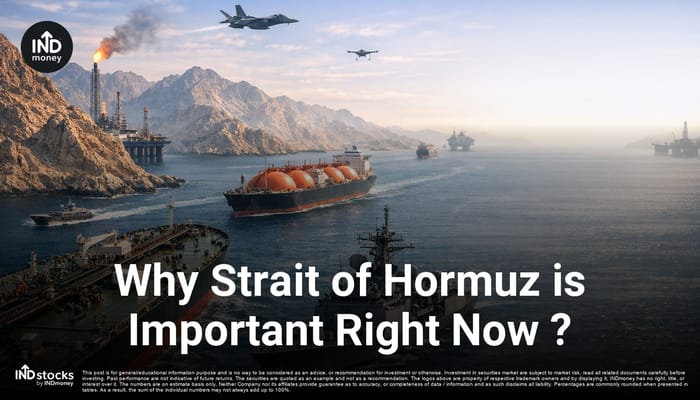
- Why is the Strait of Hormuz So Important Right Now?
- Why This Matters Especially for India
- What is Happening in the Strait Currently?
- Why Can’t Global Trade Bypass the Strait of Hormuz?
- What are the Possible Future Solutions?
- What Could Be the Long-Term Global Impact?
- Bottom Line
- Disclaimer
The Strait of Hormuz is the narrow sea passage between Iran and Oman that connects the Persian Gulf to the Gulf of Oman and the Arabian Sea. It is the main export route for oil from Saudi Arabia, Iraq, the UAE, Kuwait, Qatar, Bahrain, and Iran, and a key route for Qatar’s LNG exports.
Why is the Strait of Hormuz So Important Right Now?
Because it is one of the most important energy chokepoints in the world.
In 2025, nearly 15 million barrels per day of crude oil, about 34% of global crude oil trade, passed through Hormuz. China and India together received 44% of those crude exports. On the gas side, around one-fifth of global LNG trade passed through the strait in 2024, mainly from Qatar.
That means a disruption here is not a local shipping issue. It is a global pricing and supply issue. The current Middle East conflict is dimming the outlook for economies beyond the region, with energy importers and poorer countries more exposed than energy exporters and richer economies.
Why This Matters Especially for India
India is one of the biggest buyers of crude moving through Hormuz, so any disruption can quickly show up in three places: petrol and diesel prices, LPG and gas-related costs, and imported inflation through freight, chemicals, plastics, and fertilizers.
For India, the risk is not just oil. Fertilizer and petrochemical costs can also rise, which can later affect food inflation, industrial margins, and the current account.
What is Happening in the Strait Currently?
Iran has moved toward something like a de facto “toll booth” system, requiring many ships to move through its waters, submit cargo and crew details, and in some cases pay for passage. Traffic through the strait has fallen sharply since the start of the current conflict.
The exact operational situation is changing quickly, but the broad picture is clear. Shipping risk is up, insurance and freight costs are up, and even partial disruption is enough to shock energy markets.
Why Can’t Global Trade Bypass the Strait of Hormuz?
Some oil can be rerouted through pipelines, especially from Saudi Arabia and the UAE, but not enough to fully replace the strait’s normal volumes. A prolonged disruption could also make unavailable most of the world’s spare oil production capacity, much of which sits in Saudi Arabia and normally reaches markets via Hormuz.
For LNG, the problem is tougher because Qatar’s LNG has no real alternative export route outside the strait. So even where bypass options exist, they are partial, costly, and slower.
What are the Possible Future Solutions?
There is no single solution to the risks around the Strait of Hormuz. What’s needed is a mix of short-term measures to stabilize the situation and long-term changes to reduce dependence.
- Diplomatic de-escalation: The quickest and most effective solution is reducing tensions in the region. If stability returns and shipping routes remain open, energy flows can normalize relatively fast.
- Naval security and escort systems: International naval support can help protect ships and lower immediate risks. However, this only manages the situation and does not remove the underlying threat.
- Greater use of bypass pipelines: Some countries can reroute oil through pipelines that avoid the strait. While helpful, these routes cannot fully replace the volumes that normally pass through Hormuz.
- Stronger strategic reserves: Countries can use their oil reserves to manage short-term supply disruptions and reduce price shocks during crises.
- Long-term diversification: The real solution lies in reducing reliance on a single region. This includes diversifying energy suppliers, increasing storage capacity, expanding renewable energy, and gradually lowering overall oil dependence.
What Could Be the Long-Term Global Impact?
The effects of disruption in the Strait of Hormuz go beyond energy markets. They can reshape both the global economy and geopolitical dynamics.
- Higher and more volatile energy prices: Even if normal flows resume, markets may continue to price in risk, keeping oil and gas prices elevated and unpredictable.
- Persistent global inflation: Higher energy costs flow into transport, electricity, fertilizers, food, and manufacturing, making inflation more difficult to control.
- Slower economic growth: Energy-importing countries will face higher costs, weaker currencies, and pressure on trade balances, slowing overall growth.
- Supply chain restructuring: Companies may diversify sourcing and hold more inventory to reduce risk, which can increase operational costs.
- Uneven energy transition: While long-term investments in renewables may accelerate, short-term responses could still rely heavily on fossil fuels.
- Rising importance of energy security: Countries, especially in Asia like India, China, Japan, and South Korea, may take stronger steps to secure stable energy supplies.
- Greater geopolitical competition: Control over critical trade routes like Hormuz could challenge global trade norms and increase strategic tensions.
- Shifting global power dynamics: China’s influence in Gulf energy trade could expand, while the US may face scrutiny over its role in maintaining secure shipping routes.
Bottom Line
The Strait of Hormuz is a critical artery for global energy, and India sits directly in the line of impact. Any disruption here quickly translates into higher fuel costs, inflation pressure, and broader economic stress.
In the near term, stability depends on easing tensions and ensuring safe passage for ships. Over the long term, the focus has to shift toward reducing risk through diversified supply routes, stronger reserves, and lower dependence on a single chokepoint.
Disclaimer
Investments in the securities market are subject to market risks. Read all the related documents carefully before investing. The securities are quoted as an example and not as a recommendation. This is nowhere to be considered as advice, recommendation, or solicitation of an offer to buy or sell or subscribe for securities. INDStocks SIP / Mini Save is a SIP feature that enables Customer(s) to save a fixed amount on a daily basis to invest in Indian stocks. INDstocks Private Limited (formerly known as INDmoney Private Limited) 616, Level 6, Suncity Success Tower, Sector 65, Gurugram, 122005, SEBI Stock Broking Registration No: INZ000305337, Trading and Clearing Member of NSE (90267, M70042) and BSE, BSE StarMF (6779), SEBI Depository Participant Reg. No. IN-DP-690-2022, Depository Participant ID: CDSL 12095500, Research Analyst Registration No. INH000018948 BSE RA Enlistment No. 6428. Refer to https://indstocks.com/pricing?type=indian-stocks; https://www.indstocks.com/page/indian-stocks-sip-terms-and-condition for further details.