

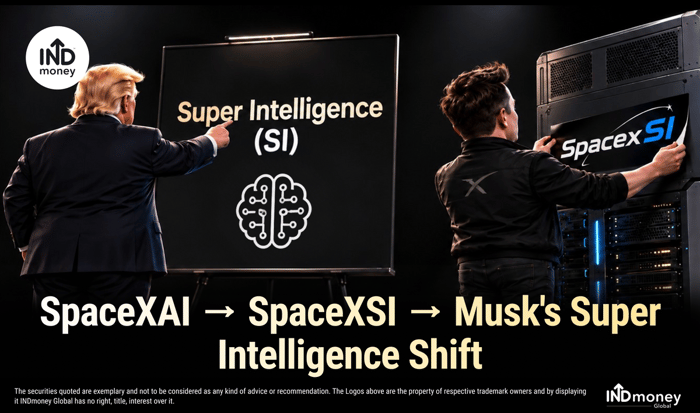
- What does the SpaceXAI to SpaceXSI rebrand actually change?
- Why is Musk bringing computing, Grok and software together?
- What do SpaceX’s AI financials reveal?
- Why are Google and Anthropic central to the SpaceXSI investment case?
- Can SpaceX justify its $2.16 trillion valuation?
- How does Musk’s superintelligence strategy compare with Mark Zuckerberg’s?
- Could orbital AI computing become SpaceX’s lasting advantage?
- What should US and Indian investors watch next?
Elon Musk wants to replace the “AI” in SpaceXAI with “SI” for superintelligence. For investors, the bigger question is whether a company valued at roughly $2.16 trillion can turn its expanding computing infrastructure and AI products into the profits that valuation demands. A more ambitious name raises expectations. It does not generate the cash needed to meet them.
Let’s break down what the SpaceXSI announcement actually changes, how Musk’s strategy compares with Mark Zuckerberg’s personal superintelligence vision and what the financial numbers tell investors about the opportunity and its risks.
Our view is that SpaceX’s strongest AI opportunity extends beyond building a popular chatbot. It is trying to sell computing capacity to other AI developers while building its own models and applications. That creates several routes to revenue but also a demanding test: customers must keep paying for infrastructure that SpaceX has already spent heavily to build.
What does the SpaceXAI to SpaceXSI rebrand actually change?
On October 4, Musk confirmed that SpaceX’s AI unit would be renamed SpaceXSI after an X user suggested the change. Reuters reported that he supplied neither an implementation date nor further details. The announcement should therefore be described as a planned rebrand rather than a completed corporate restructuring.
This is Musk’s announcement. Mark Zuckerberg leads Meta and has a separate superintelligence strategy. SpaceXSI refers to the proposed name of the SpaceX AI business, not a Zuckerberg venture.
The immediate context is President Donald Trump’s September 29 executive order directing US executive-branch agencies to use “Super Intelligence” and “SI” instead of “Artificial Intelligence” and “AI” in specified communications and documents. Crucially, the order initially defines SI using the existing statutory definition of AI. Changing the terminology does not establish that the technology has crossed a new scientific threshold.
| Development | What is confirmed | What investors should infer |
| February 2, 2026 | SpaceX announced its acquisition of xAI | AI was brought into the SpaceX group before this proposed name change |
| September 29, 2026 | Trump issued the federal terminology order | The SI label has a policy and communications context |
| October 4, 2026 | Musk said SpaceXAI would become SpaceXSI | A rebrand is planned; Reuters reported no timetable |
| As of October 5, 2026 | The renaming announcement provides no new financial results or capability demonstration | It does not by itself establish higher earnings or technical superintelligence |
The distinction matters because an announced ambition and a demonstrated capability answer different questions. In research discussions, superintelligence generally describes systems that surpass human intellectual capabilities broadly. Calling an existing AI business “SI” supplies no independent evidence that it meets that standard.
Sources: SpaceXAI acquisition announcement, February 2, 2026; White House executive order, September 29, 2026; Reuters, October 4, 2026; The Indian Express, October 5, 2026.
Why is Musk bringing computing, Grok and software together?
The strategic shift predates the new name. SpaceX is combining the infrastructure that runs AI, the models that perform tasks and the applications through which customers use those models. In plain language, it wants to own more of the journey from an expensive computer to a useful piece of work.
That matters because owning a model does not automatically mean owning the customer relationship. A developer may access it through another company’s coding tool. A business may choose a cloud platform first and use whichever model that platform supports. Whoever controls the interface can influence which model gets used and who captures the payment.
Cursor gives SpaceX a direct position in software development. Cursor confirmed on August 14 that its acquisition by SpaceX had closed. The previously disclosed agreement valued Cursor at $60 billion with consideration in SpaceX shares. By October 5, describing Cursor solely as a possible future acquisition would therefore be outdated.
The strategic benefit is access to a recurring workflow: developers write, test and revise software throughout their working day. If SpaceX can improve the usefulness of the tools while lowering their computing costs, it could benefit from both customer spending and better economics per task. The acquisition still has to earn its price through future results; using shares as payment transfers an ownership cost to existing shareholders.
Grok is also advancing separately from the branding announcement. SpaceXAI’s official release notes date Grok 4.7’s API availability to September 21. The model supports a 500,000-token context window and is aimed at coding, agentic tasks and knowledge work. A context window is the amount of material a model can consider in one request; a larger window is useful but does not establish greater reliability by itself.
| Product or asset | Verified position by October 5 | Financial significance |
| Cursor | Acquisition completed in August | Gives SpaceX an application and distribution channel for developers |
| Grok 4.7 | Available through the API and in Cursor and Grok Build | Creates opportunities to monetize model usage |
| Grok Bot | Works on a persistent cloud computer with connected tools | Extends the offering from answers to ongoing tasks |
Grok 4.7’s published API pricing starts at $2 per million input tokens and $6 per million output tokens for prompts below 200,000 tokens. Tokens are small units of text processed by the model. Those prices tell us what a customer is charged, not what SpaceX earns after computing and support costs.
The useful competitive measure is cost per successfully completed task. A cheaper model that needs several retries may cost a customer more than a higher-priced model that finishes correctly on its first attempt. SpaceX needs useful outcomes at an attractive cost, not simply a larger model or a more impressive label.
Sources: Cursor acquisition announcement, August 14, 2026; SpaceX’s Q2 Form 10-Q, Cursor merger disclosures; SpaceXAI’s Grok 4.7 announcement and release notes, September 21, 2026; Grok Bot documentation.
What do SpaceX’s AI financials reveal?
SpaceX’s latest published quarterly results available for this analysis are for Q2 2026. The group reported a consolidated net loss of $541 million. Its segment results show why AI has become central to its capital-allocation story, even though connectivity remains the strongest source of operating profit.
| Q2 2026 metric | Space | Connectivity | AI | Consolidated total |
| Revenue | $0.962 billion | $4.291 billion | $2.561 billion | $7.814 billion |
| Operating profit/(loss) | ($0.542 billion) | $1.656 billion | ($1.257 billion) | ($0.143 billion) |
| Adjusted EBITDA | ($0.205 billion) | $2.597 billion | $1.146 billion | $3.538 billion |
| Capital expenditure | $1.174 billion | $1.367 billion | $15.828 billion | $18.369 billion |
AI accounted for approximately 33% of quarterly revenue but 86% of capital expenditure. Its revenue grew approximately 247% year on year. However, the segment includes X advertising, subscriptions, data licensing, Grok API usage and infrastructure services. Its revenue cannot be presented as Grok revenue alone.
Sources: SpaceX’s Q2 2026 earnings release and Form 10-Q; author’s calculations. Figures are in US dollars. Adjusted EBITDA is a company-defined non-GAAP measure.
There are two different stories in the profit rows. AI produced positive adjusted EBITDA while still reporting an operating loss. The reconciliation adds back depreciation, amortization and share-based compensation among other items. Investors should therefore avoid treating the adjusted measure as either accounting profit or cash available to shareholders.
Depreciation spreads an asset’s cost across its estimated useful life. Although it is not a cash payment in the current quarter, the underlying computers still cost money and will eventually need replacement. For a business competing on computing performance, the price and frequency of those replacements are central to its economics.
The distinction is similar to running a delivery business. Vehicle purchases and their eventual replacement remain economic costs even if a particular profit measure excludes the accounting charge for using those vehicles. For AI infrastructure, the corresponding questions are how much useful work the equipment produces and how long customers will pay attractive rates for it.
The cash-flow statement gives another perspective:
| First half of 2026 | Amount |
| Cash generated from operating activities | $3.466 billion |
| Purchases of property, plant and equipment | $28.476 billion |
| Operating cash flow minus those purchases | ($25.010 billion) |
This simple subtraction shows the gap between internally generated operating cash and investment spending. It is not the company’s reported free-cash-flow measure and excludes items such as product rebates. Growth spending may create valuable future capacity, but the gap makes the eventual return on that capacity essential to the investment case.
Source: SpaceX’s Q2 2026 Form 10-Q, consolidated cash-flow statement; author’s calculation.
Why are Google and Anthropic central to the SpaceXSI investment case?
SpaceX does not have to win every contest between AI models to earn revenue from the industry. It can supply computing capacity to companies whose models compete with Grok. That is a commercially useful position: a rival’s success can increase demand for SpaceX’s infrastructure.
The disclosed arrangements with Google and Anthropic illustrate both the scale of the opportunity and the limits of treating contract values as guaranteed future revenue.
| Disclosed customer arrangement | Monthly fee at full contracted capacity | Stated period | Important termination provision |
| Anthropic | $1.25 billion | Through May 2029 with an initial reduced-fee ramp | Either party may terminate on 90 days’ notice after the initial three-month period |
| $920 million | October 2026 through June 2029 following a reduced-fee ramp | Either party may terminate on 90 days’ notice after December 31, 2026 | |
| Combined annualized full-rate fees | $26.04 billion | Monthly fees multiplied by 12 | Illustration only; assumes full delivery and continuing contracts |
October is particularly relevant to the Google agreement because its disclosed schedule moves to the full monthly fee this month. That schedule is not evidence that every delivery condition has been met. The filing also gives Google remedies if SpaceX does not deliver the committed GPU access by September 30 following a one-month grace period.
Sources: SpaceX’s SEC-filed Google cloud-service disclosure, June 2026; SEC-filed UK retail-offer disclosure describing the Anthropic agreements; author’s annualization.
The strongest part of this model is that SpaceX can monetize infrastructure without depending entirely on users choosing Grok. The weakness is the mismatch between substantial spending on assets and customers’ ability to exit contracts relatively quickly.
Suppose an infrastructure provider builds capacity expecting strong utilization over several years. If a large customer leaves, the equipment remains available but the provider must replace that customer, accept a lower price or use the capacity internally. Internal use may support model development, yet it does not automatically replace the lost external cash receipts.
That makes renewal rates and pricing as important as headline contract announcements. A large agreement is valuable when the customer continues using and paying for the service. Its stated end date alone does not make all scheduled payments certain.
It also explains why investors should distinguish model leadership from infrastructure leadership. SpaceX could operate a successful computing business while Grok remains one of several competing models. Conversely, excellent models would not excuse poor returns on an oversized infrastructure buildout.
Can SpaceX justify its $2.16 trillion valuation?
SpaceX stock closed at $158.96 on October 2, up approximately 7.35% in the regular session. Stock Analysis, using S&P Global Market Intelligence data, reported market capitalization of approximately $2.16 trillion. This is the value of the entire listed company, not a separate valuation for the proposed SpaceXSI unit.
The timing is essential. That trading session preceded Musk’s October 4 rebranding confirmation. Its gain cannot be described as a market reaction to the announcement. At the research cutoff on October 5 in India, the US regular session had not yet opened.
A useful starting point is to compare the valuation with reported revenue and management’s stated ambition:
| Valuation reference | Revenue denominator | Approximate equity value divided by revenue |
| Q2 revenue multiplied by four | $31.256 billion | 69.1 times |
| Management’s December 2026 annualized revenue run-rate ambition | $100 billion | 21.6 times if achieved |
Neither denominator is trailing-twelve-month revenue. The first is a simple quarterly annualization. The second is management’s forward-looking ambition based on a future month, including Cursor, rather than $100 billion of revenue already earned or guaranteed for a full year.
Sources: SpaceX stock-information page; Stock Analysis/S&P Global Market Intelligence, October 2, 2026; SpaceX’s Q2 earnings release and August 4 earnings-call transcript.
The gap between the two rows shows what the valuation is asking investors to assess. If growth accelerates substantially, the same market capitalization can become less demanding relative to sales. If delivery falls short or revenue comes with weak margins and heavy replacement spending, a lower sales multiple may offer little reassurance.
To examine the earnings requirement, start with the current approximate equity value and work backwards. The following illustration assumes a mature net profit margin of 25% across the whole group. It uses different price-to-earnings ratios, which express how much investors pay for each dollar of annual profit.
| Assumed future P/E ratio | Annual net profit needed to support $2.16 trillion | Revenue needed at a 25% net margin | Five-year revenue CAGR from the Q2 annualized base |
| 40 times | $54 billion | $216 billion | 47.2% |
| 60 times | $36 billion | $144 billion | 35.7% |
| 80 times | $27 billion | $108 billion | 28.1% |
The calculation is: required profit = equity value ÷ P/E; required revenue = profit ÷ net margin. Growth is measured from the $31.256 billion quarterly annualized starting point. Every margin and future multiple in this table is an illustrative assumption, not a forecast or consensus estimate.
Even at 40 times earnings, this illustration requires substantial profit and sustained growth. A higher P/E reduces the required earnings but assumes that investors continue paying a premium. If the achieved net margin is 15% instead of 25%, the 40-times case requires $360 billion of revenue.
This is a test of what could support today’s approximate equity value, not a discounted fair-value model. Reaching those earnings years from now would not by itself compensate investors for waiting or produce a positive share-price return. Future dilution, a required investment return and changes in the market’s earnings multiple would alter the outcome.
Our assessment is that the valuation needs evidence of several businesses scaling profitably. A successful brand change cannot substitute for that evidence. The important question is whether the next dollar of spending produces durable earnings per share after financing, replacement costs and dilution.
How does Musk’s superintelligence strategy compare with Mark Zuckerberg’s?
Mark Zuckerberg’s superintelligence vision is relevant to this story because the same language describes a different commercial approach at Meta. His July 30, 2025 letter focused on personal superintelligence that helps individuals pursue their own goals, including through devices that understand their context.
More recent product announcements make that ambition tangible. Meta introduced Muse on September 8, 2026 as a personal AI agent that performs tasks. On September 29, it announced Muse for Small Business with additional skills and connectors. Meta’s latter announcement said Muse was available in the US and Canada; that should not be described as an India launch.
| Comparison | Musk’s SpaceX AI strategy | Zuckerberg’s Meta strategy |
| Commercial emphasis | Computing infrastructure, proprietary models and software applications | Personal agents integrated with consumer and business workflows |
| Examples | Colossus infrastructure, Grok, Cursor and Grok Bot | Muse and Muse for Small Business |
| Potential advantage | Revenue from supplying capacity to other AI companies as well as serving its own users | Access to people and businesses already using Meta products |
| Investor test | Returns on infrastructure and application adoption | Useful recurring engagement and monetization that covers agent costs |
These are strategic emphases rather than exclusive boundaries. Both companies need infrastructure and useful products. The distinction is where their business case becomes strongest: SpaceX can earn from supplying capacity, while Meta’s opportunity depends heavily on making AI useful within customer relationships and daily activities.
Sources: Meta’s personal-superintelligence letter, July 30, 2025; Muse announcement, September 8, 2026; Muse for Small Business announcement, September 29, 2026; SpaceXAI and Cursor product disclosures.
For Meta Platforms, an agent creates commercial value when it helps users or businesses do something they value enough to keep using. Initial downloads alone cannot establish retention, profitability or a lasting competitive advantage.
SpaceX faces the corresponding challenge at two levels. It must keep external infrastructure customers and persuade people to use its applications. Owning more of the supply chain may improve coordination, but it also requires the company to compete effectively in several businesses at once.
Could orbital AI computing become SpaceX’s lasting advantage?
SpaceX has a distinctive long-term ambition: moving AI computing into orbit. Its launch and satellite capabilities give it tools that a conventional model developer would need to obtain from other companies. The economic thesis is that solar-powered orbital capacity could offer an alternative to power-constrained terrestrial data centers.
This is a development plan rather than a demonstrated source of computing revenue at scale. NVIDIA’s August 24 announcement confirmed that SpaceXAI plans to deploy Vera CPUs for agent workloads and to base its first-generation Starmind AI satellite on an optimized Vera Rubin NVL72 system. Musk’s August earnings call targeted initial Starmind launches in 2027. Those statements are plans, not completed deployments.
For NVIDIA, that partnership points to a potential hardware opportunity. It does not establish how much revenue the orbital program will generate or when it will become profitable for either company.
Orbital computing also requires more than putting chips beside solar panels. NVIDIA identifies different constraints around power, thermal management, bandwidth and reliability. NASA’s thermal-control guidance explains why the vacuum of space does not make cooling automatic: there is no air to carry heat away through convection. Spacecraft must manage internal heat and radiate it into their surroundings.
The financial comparison must therefore include launch costs, satellite construction, useful equipment life, communications, cooling hardware and eventual replacement. Solar energy can reduce one part of operating cost while the full system remains expensive.
A practical framework is lifetime cost divided by the useful computing work delivered to paying customers. Useful work depends on uptime, utilization and the workloads the system can serve reliably. If SpaceX eventually lowers that cost while maintaining service quality, orbital infrastructure could create a meaningful advantage. Until then, it remains an option whose value depends on execution.
What should US and Indian investors watch next?
The US policy developments provide context but do not create automatic commercial benefits. The White House’s September safety accord described voluntary internal controls, monitoring, external evaluation and board oversight. On October 4, Trump also announced a Super Intelligence Force led by Jay Clayton, according to the Associated Press. Neither development proves that SpaceX will receive additional contracts or enjoy higher margins.
Trust is commercially relevant because agents act inside real systems. A business considering an AI tool must evaluate reliability, permissions and the consequences of errors alongside price. Improved controls can support adoption; an ambitious label alone cannot resolve those concerns.
| What to monitor | Why it matters |
| Completion and scope of the SpaceXSI rebrand | Establishes whether the announcement remains a naming change or accompanies new disclosures |
| Infrastructure delivery and customer retention | Tests whether contracted capacity becomes continuing revenue |
| Grok, Cursor and agent adoption | Shows whether applications build demand beyond infrastructure rental |
| Operating profit and cash after investment | Reveals whether growth increasingly finances itself |
| Revenue per unit of deployed capacity | Helps assess utilization and pricing rather than installed capacity alone |
| Shares outstanding and acquisition economics | Shows whether business growth translates into growth per share |
| Starmind milestones and costs | Tests the orbital thesis against demonstrated engineering and economics |
This framework keeps the focus on evidence that can change the financial assessment. Strong growth with improving returns on capital would make the story more credible. More spending accompanied by weak utilization, short-lived customer commitments or continued dilution would make it harder to justify.
Sources: White House terminology order; White House safety accord as reproduced by Forbes, September 30, 2026; Associated Press, October 4, 2026.
Indian investors should also identify exactly what they own. Exposure through listed SpaceX shares is exposure to the entire group, including space, connectivity and AI. The proposed SpaceXSI name does not turn those shares into a separate investment in Grok. Product availability in India and commercial opportunities for Indian companies require their own evidence; a US announcement is insufficient.
A dollar-denominated shareholding also creates currency exposure. Its rupee return depends on both the stock’s dollar performance and movements in the rupee-dollar exchange rate, before applicable costs and taxes. The business assessment should come first, followed by how that exposure fits within the investor’s wider portfolio.
Our view is that SpaceXSI is a useful signal of Musk’s ambition to make intelligence central to the SpaceX story. The financial opportunity is more substantial than the name change: infrastructure services can monetize the AI industry’s demand while software products offer another route to customers. The valuation will ultimately depend on whether those routes produce durable profit per share and cash after investment.